Direct answer: The 博山炉 (“Boshan censer,” “universal-mountain burner”) is the iconic incense burner of the Han dynasty — a bronze vessel whose lid is cast as a miniature mountain range with peaks, figures, and animals. When incense burned inside, smoke rose through the pierced mountain, appearing as mist over the peaks.
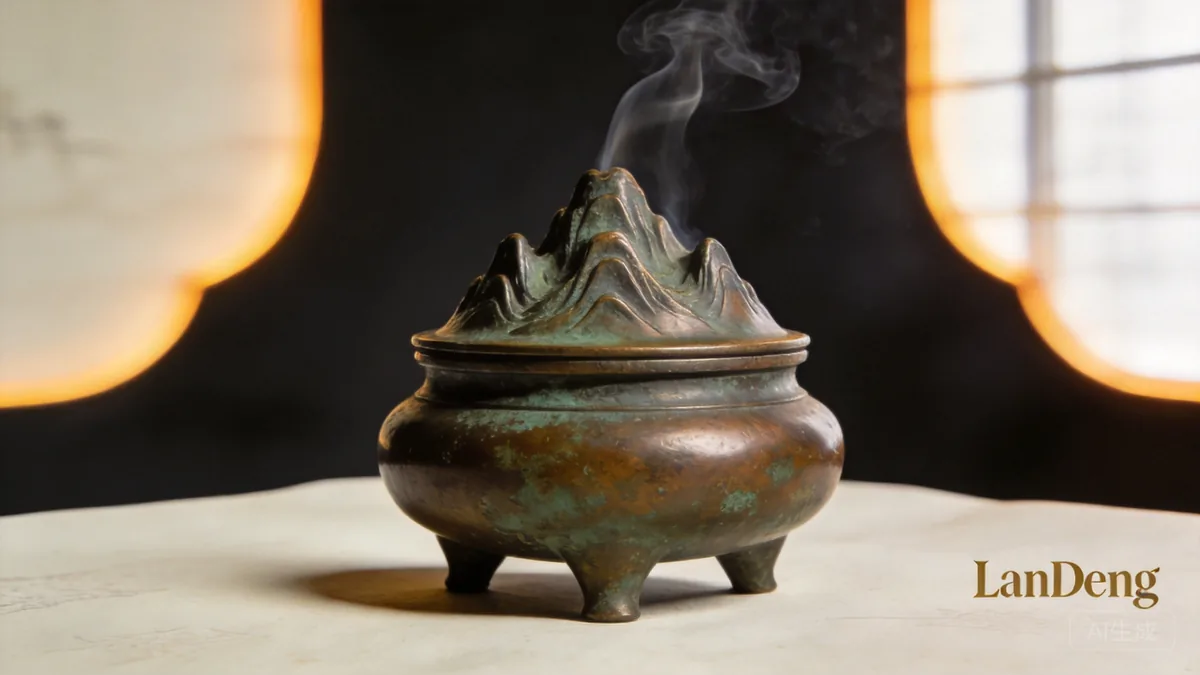
Key facts: The mountain is symbolic — it represents the mythical isles of the immortals (蓬莱, 方丈, 瀛洲) and the Daoist longing for immortality that colored Han court culture. This is a historical page, not a wellness claim.
The Form
A 博山炉 has three characteristic parts:
| Part | Description |
|---|---|
| Base (炉座) | Often a stemmed dish or a figure holding the bowl |
| Bowl (炉身) | Holds the burning incense/aromatics |
| Lid (炉盖) | Cast as layered mountain peaks, pierced to let smoke escape |
The visual effect is the point: smoke curling through the pierced peaks reads as cloud and mist over a sacred mountain — a deliberate piece of stagecraft, not just a functional lid.
What It Burned
In the Han, the 博山炉 burned raw aromatic materials — resins, woods, and dried herbs — placed directly in the bowl (not the sticks and cones we use today). The smoke was the experience, in a way that later low-smoke methods deliberately reversed.
The Symbolism
The mountain is a Daoist image of the immortals’ realm — the isles of 蓬莱, 方丈, and 瀛洲, where immortals were believed to live. A 博山炉 placed that myth on the scholar’s desk: burning incense inside a miniature sacred mountain was, in effect, a small ritual evocation of the immortals’ world.
This is why the form matters — the 博山炉 is a cosmological object, not a mere container.
The Author’s Take
Position: The 博山炉 is the clearest proof that in early China, incense was as much about vision (smoke over mountains) as about scent — a theatricality the later tradition mostly traded for refinement.
Reasoning:
- The pierced-mountain lid turns smoke into a spectacle; later methods (隔火焚香) turn scent into something almost invisible.
- The two ends of the tradition — spectacle and subtlety — are both already present in the record.
This is the author’s editorial view — not a verified fact.
Verification Notes
- The 博山炉’s Han-dynasty origin, mountain-lid form, and immortal-isles symbolism are standard cultural history.
- No therapeutic claim is made.
See Which Incense Format Is Right for You? Sticks, Cones, Coils, Powder & Beads for the full guide.
FAQ
Q: What is a 博山炉?
The 博山炉 (Boshan censer, “universal-mountain burner”) is the iconic bronze incense burner of the Han dynasty. Its lid is cast as a miniature mountain range — layered peaks, figures, and animals — pierced with small holes so that when incense burned inside, the smoke rose through the openings and appeared as mist drifting over the peaks. The effect was deliberately theatrical: a small sacred mountain on the scholar’s desk, with the smoke completing the illusion of cloud and mist. Unlike later low-smoke methods, the 博山炉 was about spectacle, making the smoke itself part of the object’s meaning.
Q: What does “博山” mean?
“博山” translates roughly as “broad” or “universal mountain.” The name points to the mountain shape of the lid, but the mountain is not any ordinary peak — it evokes the mythical isles of the immortals, 蓬莱, 方丈, and 瀛洲, where Daoist immortals were believed to dwell. By casting the lid as a miniature of that sacred place, the maker put the myth directly on the scholar’s desk. Burning incense inside a tiny model of the immortals’ world was, in effect, a small ritual evocation of that world, which is why the 博山炉 is understood as a cosmological object rather than a mere container.
Q: What did it burn?
It burned raw aromatic materials — resins, woods, and dried herbs — placed directly in the bowl, rather than the sticks and cones that dominate modern use. In the Han dynasty, incense was not yet a pressed-stick product; aromatic substances were burned loose, and the resulting smoke was the experience itself. This is a key difference from later practice: the 博山炉 celebrated the visible smoke rising through the pierced mountain, whereas the refined 隔火焚香 method that developed later deliberately minimized smoke in favor of a cleaner scent. The 博山炉’s whole design assumes direct combustion and the drama of its smoke.
Q: Why is the mountain shape meaningful?
The mountain shape is meaningful because it represents the Daoist immortals’ world — the three mythical isles of 蓬莱, 方丈, and 瀛洲, where immortals were believed to live. Han court culture was deeply colored by this longing for immortality, and the 博山炉 translated that belief into a physical object: a miniature sacred mountain on the desk, with smoke curling through its peaks like mist. In this reading, the burner is not a functional container but a cosmological model, a small evocation of the immortals’ world placed in daily view. That is why the form matters — it carries the symbolism of the whole object.
Sources
- Cultural-history references on Han-dynasty incense and the 博山炉 form.
- Incense burner, China (The Met)
- Meng Liang Lu (夢粱錄) full text on Wikisource
Related Resources
Natural next step: see the later, plainer aesthetic in 宣德炉 (Xuande censer).