Definition: Hand-rolled incense (the masala method) is made by rolling a paste of real botanicals onto a core by hand, or extruding it coreless; machine-made incense is mass-produced, uniform, and often a dipped fragrance. Hand-rolled tends to be earthier, less uniform, and built on actual materials; machine-made tends to be cheaper, stronger-smelling, and synthetic.
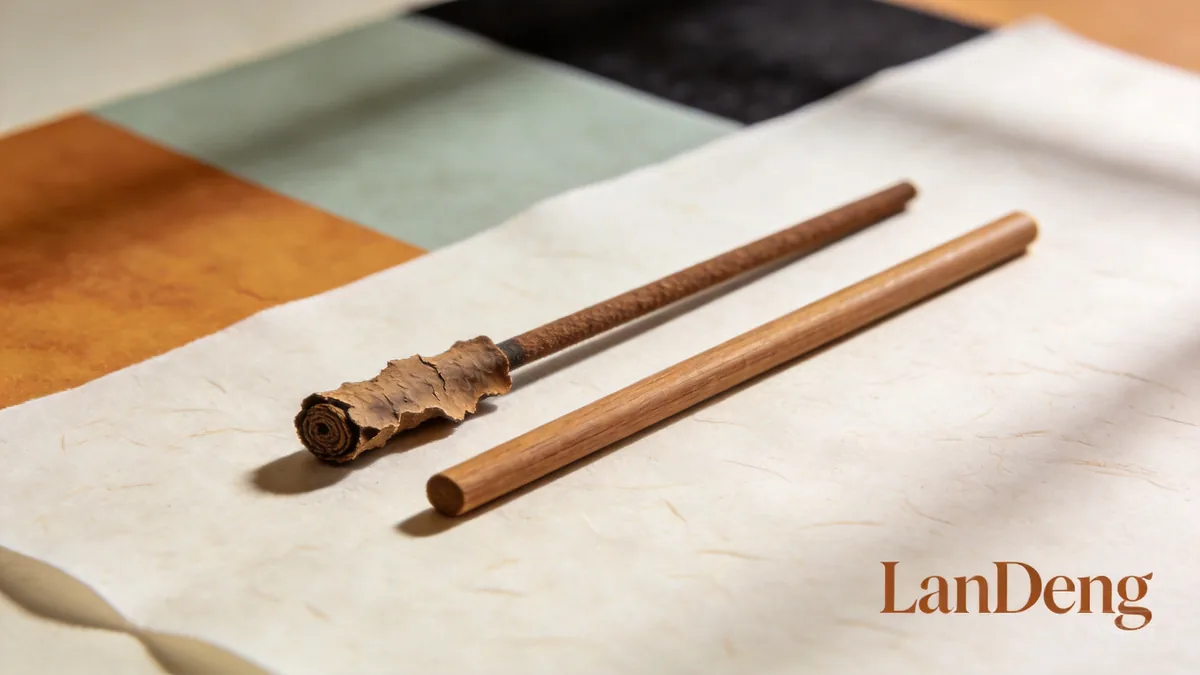
Key facts: Neither method is automatically “better” — they are different products at different price points. The skill is in knowing which you are buying, so you can match your expectation to what is in the box.
Key Takeaways
- Hand-rolled (masala) = real botanicals, less uniform, earthier, usually pricier.
- Machine-made / dipped = uniform, cheaper, often a synthetic fragrance.
- How to tell: price, scent character (earthy vs uniform), and appearance (visible botanical flecks vs smooth).
- “Hand-rolled” describes the method, “natural” describes the ingredients — related but not identical.
The Two Methods, Side by Side
| Hand-rolled (masala) | Machine-made / dipped | |
|---|---|---|
| How it’s made | Botanicals blended into paste, hand-rolled onto core (or extruded coreless) | Core machine-coated or dipped in liquid fragrance |
| Material | Real woods, resins, flowers, spices | Often a synthetic fragrance on a charcoal/bamboo core |
| Appearance | Slightly irregular; visible botanical flecks | Smooth, uniform, identical |
| Scent | Earthy, layered, less “perfumey” | Strong, uniform, often “perfumey” |
| Price | Higher | Lower |
How to Tell Which You Are Buying
- Price — a very cheap stick is almost certainly dipped; hand-rolled material costs more to make.
- Appearance — visible flecks of plant material and slight irregularity suggest masala; a perfectly smooth, identical stick suggests a dipped core.
- Scent character — earthy and layered points to real botanicals; a strong, uniform, “perfume-like” scent points to a fragrance oil.
- The label — reputable makers say “hand-rolled” or “masala”; if a product says nothing about method or materials, that is itself information.
The Honest Nuance
“Hand-rolled” is about method, not purity: a hand-rolled stick can still include a fragrance oil, and a machine-made stick can use real botanicals. The two dimensions to track are:
- Method — hand-rolled vs machine-made.
- Materials — real botanicals vs synthetic fragrance.
They usually correlate (hand-rolled usually means real materials), but they are separate questions. Ask both.
Common Mistakes
- Assuming machine-made = bad. It is cheaper and uniform — a legitimate product for a different buyer.
- Assuming hand-rolled = natural. Method and ingredients are separate questions.
- Judging by scent strength. A loud, uniform scent is usually a dipped stick, not a sign of quality.
The Author’s Take
Position: “Hand-rolled” is about method; “natural” is about ingredients — they usually correlate but are separate questions.
Reasoning:
- I have seen hand-rolled sticks that still use a fragrance oil, and machine sticks made from real powder.
- Ask both questions separately.
- Treat a very low price as a signal of a dipped stick, not a bargain.
This is the author’s editorial view and experience — not a verified fact.
Verification Notes
- The masala vs dipped distinction and the hand-rolling process are standard industry descriptions.
- Appearance and price as distinguishing signals are practical heuristics, not guarantees.
- No health or medical claims are made.
FAQ
Q: What is the difference between hand-rolled and machine-made incense?
A: Hand-rolled incense, in the masala method, is made by blending real botanicals — woods, resins, flowers, and spices — into a paste and rolling it onto a core by hand (or extruding it coreless). The result is slightly irregular, with visible flecks, and an earthy, layered scent; it costs more because of the labor and materials. Machine-made incense is mass-produced for uniformity and speed, and is often dipped in a liquid fragrance rather than built from botanicals, giving a cheaper, stronger, more uniform scent. Neither is automatically better — they are different products.
Q: How can I tell if incense is hand-rolled?
A: Check three things. Price first: a very cheap stick is almost certainly machine-dipped, since hand-rolled material costs more to produce. Appearance second: hand-rolled sticks show visible flecks of plant material and slight irregularity, while machine sticks are smooth and identical. Scent third: earthy and layered points to real botanicals, while a strong, uniform, perfume-like scent points to a dipped fragrance. The clearest signal of all is the label — reputable makers say “hand-rolled” or “masala”; if a product says nothing about method or materials, that silence is itself information.
Q: Is machine-made incense bad?
A: Not necessarily. Machine-made incense is a legitimate product: it is cheaper, consistent, and widely available, and it serves a buyer who wants a strong, uniform scent without paying for hand-rolled materials. The problem is not the method itself but the mismatch between expectation and reality — a machine-dipped stick should not be sold or priced as if it were hand-rolled with real botanicals. The point is simply to know which you are getting, so you can decide whether the trade-off is worth it for your use.
Q: Does hand-rolled always mean natural?
A: Not always. “Hand-rolled” describes the method, while “natural” describes the ingredients — they are separate questions that usually, but not always, correlate. A hand-rolled stick can still include a fragrance oil in the blend, and a machine-made stick can in principle be built from real botanical powders. So a “hand-rolled” label is a good signal but not a guarantee of purity. To be sure, ask both questions: how was it made, and what is actually in it? A maker who answers both clearly is the one to trust.
Sources
- Editorial synthesis of established incense-making craft (binder, blend, extrusion vs hand-rolling).
- Traditional craft sources on 合香 and stick-making.
- EPA indoor air quality — background on smoke from burning incense.
- American Lung Association indoor air pollutants — on particulate matter and indoor burning.
Related Resources
Natural next step: see the natural-vs-synthetic question in full in what makes incense “natural”, or the binder that both methods share in makko & natural binders.