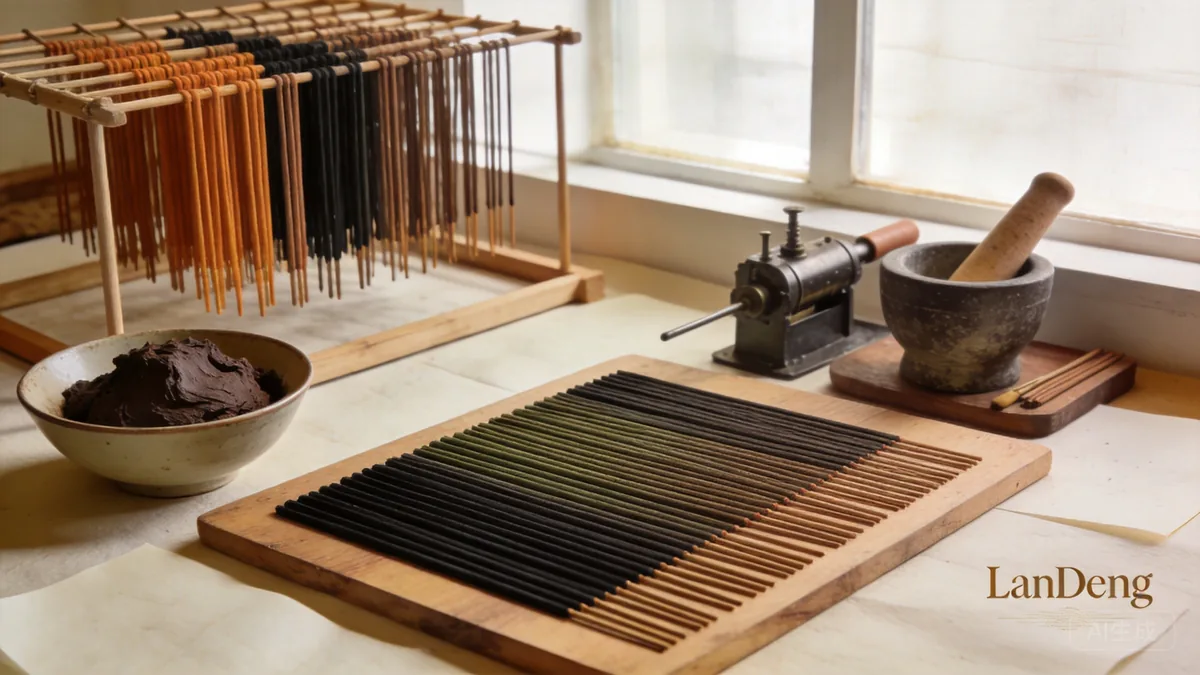
Definition: Incense is made by grinding fragrant materials (woods, resins, flowers, spices) into a powder, blending them — often with a natural binder — adding water to form a paste, then shaping it into sticks, coils, or cones and drying it. There are two broad methods: hand-rolled (from real botanicals) and machine-made (mass-produced, often fragrance-dipped).
Key facts: Traditional Chinese incense is built on the 合香 (hé xiāng) principle of blending multiple ingredients like a formula. The natural binder that holds it together is typically a combustible wood powder, most famously makko (Machilus thunbergii).
Key Takeaways
- The basic process is grind → blend → bind → shape → dry.
- Traditional Chinese incense is blended (合香), not single-note.
- The binder is usually a combustible wood powder (makko), not glue.
- Hand-rolled vs machine-made is the key quality distinction (see the dedicated guide).
- “How it’s made” directly determines what you are actually burning.
The Basic Process
| Step | What happens |
|---|---|
| 1. Grind | Woods, resins, flowers, and spices are ground to a fine powder |
| 2. Blend | Ingredients are combined — in the Chinese tradition, by a 君臣佐使 formula principle |
| 3. Bind | A combustible binder (wood powder such as makko) and water form a workable paste |
| 4. Shape | The paste is extruded, rolled onto a bamboo core, or pressed into cones/coils |
| 5. Dry | The formed incense is dried slowly to lock the shape |
The same basic steps produce sticks (线香), coils (盘香), cones, and even coreless Japanese-style sticks — the shaping step is what differs.
Two Production Methods
-
Hand-rolled (masala style) — dry botanical powders are blended into a paste and hand-rolled onto a bamboo core, or extruded as a coreless stick. The scent comes from the actual materials. This is the traditional, higher-end method.
-
Machine-made / dipped — a core (bamboo or charcoal) is machine-coated or dipped in a liquid fragrance. Faster and cheaper, with a uniform — often synthetic — scent.
See hand-rolled vs machine-made for how to tell which you are buying.
The Chinese Context: 合香 (Blended Incense)
Chinese incense is traditionally not a single material but a blend — 合香 (hé xiāng) — assembled on a formula principle analogous to Chinese herbal compounding (君臣佐使: chief, minister, assistant, guide). This is why “how incense is made” in the Chinese tradition is really “how a formula is composed,” not just “how a stick is rolled.” See the blending system for the full treatment.
Common Mistakes
- Assuming all incense is “just wood.” It is a blend of ground materials plus a binder.
- Confusing the binder with glue. The traditional binder is a combustible wood powder (makko), not a chemical adhesive.
- Thinking “hand-rolled” and “natural” are the same. Hand-rolled refers to the method; “natural” refers to the ingredients. They usually overlap but are not identical.
The Author’s Take
Position: “How incense is made” is really two questions — the mechanics and the philosophy (合香) — and the philosophy is the one worth knowing.
Reasoning:
- Most content stops at the mechanics.
- 合香 explains why a Chinese incense is rarely a single note — and why “what is in it” matters more than “how it was rolled.”
- The binder question is my favorite litmus test: makko or a chemical adhesive?
This is the author’s editorial view and experience — not a verified fact.
Verification Notes
- The grind → blend → bind → shape → dry process is standard incense-making description.
- Makko as Machilus thunbergii and the 合香 / 君臣佐使 blending principle are standard cultural/technical facts.
- No health or medical claims are made.
Cluster directory
- Hand-Rolled vs Machine-Made Incense: How to Tell the Difference
- The 合香 Blending System: How Chinese Incense Is Composed Like a Formula
- Incense Authentication: How to Spot Fake Agarwood, Sandalwood, and Resin
- Incense Ingredients Glossary: Wood, Resin, Flower, and Spice
- Makko & Natural Binders: The Wood Powder That Holds Incense Together
- Buying 奇楠 (Qinan): What to Check Before You Pay
- What Makes Incense “Natural”? Binders, Bases, and the Label Problem
FAQ
Q: What is incense made of?
A: Incense is made of ground fragrant materials — woods, resins, flowers, and spices — plus a natural combustible binder that holds them together, mixed with water into a workable paste and shaped into sticks, coils, or cones, then dried. The binder is typically a combustible wood powder such as makko (Machilus thunbergii), not glue. In the Chinese tradition, the fragrant materials are usually a blend (合香) rather than a single ingredient, composed on a formula principle. So the answer depends on the product: a hand-rolled stick uses real botanicals, while a dipped stick uses a fragrance.
Q: What holds incense sticks together?
A: A natural binder holds the ingredients together, and it is traditionally a combustible wood powder — most famously makko, from the Machilus thunbergii tree — rather than glue or chemical adhesive. The binder does two jobs: it makes the ground botanicals cohere into a shapeable paste, and because it is itself a wood powder, it burns cleanly along with the incense and helps the stick smolder evenly. In cheap, machine-dipped incense, the base may be charcoal or bamboo dust instead, and the scent is carried by a liquid fragrance rather than the binder’s material.
Q: What is the difference between hand-rolled and machine-made incense?
A: Hand-rolled incense is made by blending dry botanicals into a paste and rolling it onto a bamboo core by hand, or extruding it as a coreless stick — the scent comes from the actual materials. Machine-made incense is mass-produced for speed and consistency, and is often made by coating or dipping a core (bamboo or charcoal) in a liquid fragrance, giving a cheaper, uniform, frequently synthetic scent. The distinction is really about method and ingredients together: hand-rolled usually means real material, machine-dipped usually means fragrance oil. See hand-rolled vs machine-made.
Q: What is 合香 (hé xiāng)?
A: 合香 (hé xiāng) is the Chinese tradition of blended incense — combining multiple fragrant ingredients into a single formula, rather than burning one material alone. It is composed on a principle analogous to Chinese herbal compounding, the 君臣佐使 system, which assigns each ingredient a role: chief (君), minister (臣), assistant (佐), and guide (使). This is why a classical Chinese incense is rarely a single note — the blend is designed to balance top, middle, and base notes. See the blending system for the full framework.
Sources
- Editorial synthesis of established incense-making craft (base, binder, scent material, extrusion/rolling).
- Traditional craft sources on 合香 and stick-making.
- EPA indoor air quality — background on smoke from burning incense.
- American Lung Association indoor air pollutants — on particulate matter and indoor burning.
Related Resources
- Makko & Natural Binders
- Hand-Rolled vs Machine-Made
- What Makes Incense “Natural”
- Incense Ingredients Glossary
Natural next step: understand the binder that holds it all together in makko & natural binders, or the quality split in hand-rolled vs machine-made.