Technical answer: Chinese incense is traditionally blended, not single-note — a practice called 合香 (hé xiāng), “compound incense.” A 合香 blend is composed on a 君臣佐使 (chief–minister–assistant–guide) principle, the same structural logic as a Chinese herbal formula, where each ingredient plays a defined role rather than just adding its scent.
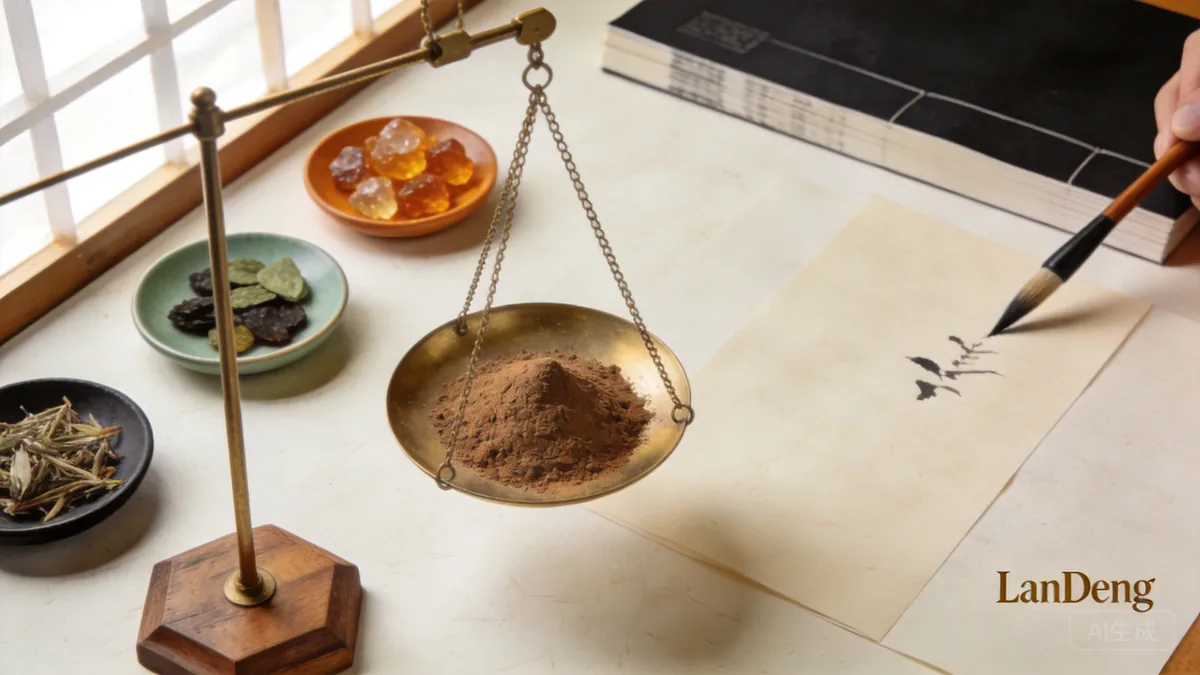
Key facts: This is the piece of Chinese incense culture most English content misses: the “recipe” logic behind the blend. It is why “Chinese incense” is not one smell but a compositional art.
Key Takeaways
- 合香 = “compound/blended incense” — the classical Chinese approach, not single-note.
- It is built on 君臣佐使 — chief, minister, assistant, guide — analogous to Chinese herbal compounding.
- Each ingredient has a role, not just a scent.
- This is the deep reason Chinese incense is a formula art, distinct from single-material traditions.
What 合香 Is
合香 (hé xiāng) means literally “combined fragrance.” Instead of burning a single material (a piece of agarwood, a stick of pure sandalwood), the Chinese tradition composes a blend of multiple ingredients — woods, resins, flowers, spices — mixed according to a structured principle and formed into sticks, pellets, or powder.
The point is not just “mixing smells.” It is that the blend has structure — the same way a herbal formula is not a random pile of herbs.
The 君臣佐使 Principle
The blend is organized by role:
| Role | Chinese | Function |
|---|---|---|
| 君 (chief) | 君 | The leading scent — the dominant character |
| 臣 (minister) | 臣 | Supports and reinforces the chief |
| 佐 (assistant) | 佐 | Harmonizes, balances, or corrects |
| 使 (guide) | 使 | Directs the blend, often a fixative or binder |
This is the same 君臣佐使 structure used in Chinese herbal medicine (中药组方). Incense and medicine shared a compositional logic in the Chinese tradition — which is exactly why a good 合香 blend is described as “balanced” rather than just “strong.”
Why This Matters (the English Gap)
Most English incense content treats incense as a single scent — “sandalwood incense,” “lavender incense.” The Chinese tradition is fundamentally different: it is a formula tradition, where the art is in the composition.
This distinction explains several things at once:
- Why “Chinese incense” has no single signature smell — it is a method, not a material.
- Why the classical canon (香谱) is full of recipes, not just ingredient lists.
- Why the blending principle connects incense to the wider Chinese art of composition (herbs, tea, perfume).
Worked Examples: Three 合香 Recipes, Deconstructed
The principle is easiest to learn through real recipes. Here are three, deconstructed by role.
Caveat: classical recipes survive in multiple versions with differing proportions, and the weights use historical Chinese units (两 liǎng, 钱 qián = one-tenth of a 两); exact gram equivalents varied by dynasty and are not essential to reading the structure. Treat these as illustrative structures, not precise manufacturing instructions — and as cultural history, never as formulas for any physiological effect.
1. 江南李主帐中香 — “The Lord of Jiangnan’s Bedchamber Incense” (Five Dynasties–Song)
The best-documented classical example, attributed to 李煜 (Li Yu), the last ruler of the Southern Tang — hence “江南李主” (“Lord of Jiangnan”). The Ming-era 香乘 records several versions; the most famous is the 鹅梨 (goose-pear) version:
沉香末一两,檀香末一钱,鹅梨十枚 — one liǎng agarwood powder, one qián sandalwood powder, ten goose pears. Hollow each pear like a jar, fill it with the powders, seal with the pear’s top, steam three times (蒸三溜), strip the peel, grind and blend, then age (久窨) before burning.
| Role | Ingredient | Job in the blend |
|---|---|---|
| 君 (chief) | 沉香 agarwood | The deep, resinous backbone — the whole formula exists to carry it |
| 臣 (minister) | 檀香 sandalwood | A trace (1/10 by weight) that warms and rounds the agarwood, never competing with it |
| 佐 (assistant) | 鹅梨 goose pear | The fruit’s juice lends a clean, sweet top note — the “fresh” in an otherwise deep wood |
| 使 (guide) | steaming + aging | The process (not an ingredient) is what fuses the fruit into the wood |
Note the economy: ten pears, one liǎng of agarwood, against a single qián of sandalwood. The chief dominates; the minister is a trace. This is the disciplined logic of 合香 — a little support, not a chorus.
2. 雪中春信 — “Snow in Spring” (Song, attributed to 苏轼)
Named for the moment winter turns to spring, and traditionally attributed to Su Shi (苏轼) — though the attribution is a romantic legend, not a documented fact. The 香乘 records the formula (with variations) as:
香附子、鬱金、檀香、麝香、樟腦、羊脛灰 — cyperus (香附子), turmeric (鬱金), sandalwood (檀香), musk (麝香), camphor (樟腦), and sheep-shin-bone ash (羊脛灰), ground fine, bound with refined honey, aged, and burned in the usual manner. Other recorded versions swap in 棧香 and 杉木炭.
| Role | Ingredient | Job in the blend |
|---|---|---|
| 君 (chief) | 檀香 sandalwood | The woody body of the scent |
| 臣 (minister) | 香附子 / 鬱金 cyperus, turmeric | Warm, faintly herbal middle tones |
| 佐 (assistant) | 樟腦 camphor | The cool, sharp “snow” note — the cold snap that makes it “winter” |
| 使 (guide) | 麝香 + 羊脛灰 + honey | Musk fixes and lifts; the ash and honey bind the powder into a burnable form |
This recipe is a lesson in the 佐 (assistant) role: camphor is not the main scent, but it is the ingredient that names the blend. The “snow” is a single cooling note set against warm woods — the same trick as a cold top note in perfume.
3. 二苏旧局 — “The Two Sus’ Old Gathering” (contemporary)
A modern formula, not an ancient text — it is from 陈云君 (Chen Yunjun)‘s 燕居香语, a contemporary incense manual. It is named for the brothers 苏轼 and 苏辙 (the “two Su” literati) and meant to evoke a scholar’s study. This distinction matters: it is a revival recipe written in the 合香 idiom, not a 香谱 original.
沉香、檀香、乳香、琥珀、蜂蜜、茉莉花 — agarwood, sandalwood, frankincense, amber, honey, jasmine. Cube the agarwood and sandalwood; grind the frankincense and amber to powder; bind all four in honey (traditionally jujube-flower honey); roll into pills; coat the outside with dried jasmine flowers; air-dry.
| Role | Ingredient | Job in the blend |
|---|---|---|
| 君 (chief) | 沉香 agarwood | The deep, quiet skeleton — the “old desk” of the study |
| 臣 (minister) | 檀香 sandalwood | Warms and supports the agarwood so it is not cold |
| 佐 (assistant) | 乳香 frankincense + 琥珀 amber | Frankincense adds a bright, resinous lift; amber adds stillness and depth |
| 使 (guide) | 蜂蜜 honey + 茉莉花 jasmine | Honey binds the pills; the jasmine coat opens a bright floral window at the top |
Here the 佐 role is split in two (frankincense + amber) doing opposite jobs — one opens, one settles — a clean illustration that “assistant” is a function, not a count.
What the Three Recipes Together Show
- The chief is almost always a wood — agarwood or sandalwood — because woods carry the longest, most stable burn.
- The minister is a smaller wood or resin that rounds the chief, usually at a fraction of its weight.
- The assistant is the signature — camphor’s “snow,” the pear’s fruit, frankincense’s lift. This is where a blend gets its name and its character.
- The guide is often a process (steaming, aging) or a binder (honey), not always a scented ingredient.
To read 合香 like a formula, ask four questions of any recipe: what carries it, what rounds it, what names it, and what binds it.
Where the 君臣佐使 Idea Comes From
The 君臣佐使 structure is not an incense invention — it comes from Chinese herbal compounding (中药组方). In herbal medicine, a formula is organized so that a chief (君) herb addresses the main condition, a minister (臣) reinforces it, an assistant (佐) balances or corrects it, and a guide (使) directs it or harmonizes the whole. This structure is documented in the foundational materia-medica tradition, including the 本草纲目’s formulation logic.
Incense borrowed the framework because incense and medicine shared a worldview: both are compositions where individual ingredients are chosen for their role in a whole, not their isolated effect. This is why classical incense recipes read like formulas — they are structured, not haphazard, and the structure is the craft.
The Materials a 合香 Draws On
A 合香 blend pulls from the same families as the wider incense tradition, each with a typical role:
| Family | Examples | Typical role in a blend |
|---|---|---|
| Woods | agarwood 沉香, sandalwood 檀香 | Chief or minister — the long, stable burn and deep base |
| Resins | frankincense 乳香, myrrh 没药, benzoin 安息香 | Assistant — brightness or sweet depth; also a fixative |
| Spices | clove 丁香, cassia 桂皮, fennel 茴香 | Assistant or guide — warmth and lift |
| Herbs/roots | spikenard 甘松, angelica 白芷, cyperus 香附子 | Minister or assistant — herbal middle tones |
| Florals/fruits | jasmine 茉莉, plum 白梅, pear 鹅梨 | Assistant — the signature top note or accord |
| Binders/fixatives | honey 蜂蜜, makko 抹香, musk 麝香, 甲香 operculum | Guide — binds the powder and fixes the scent |
The point of the table is not completeness but the pattern: the chief is almost always a wood, and the binder is almost never a scent. The materials are chosen for function first, fragrance second.
单方 vs 复方: Single-Material vs Compound
Chinese incense has two poles, and 合香 is only one of them:
- 单方 (dān fāng, “single formula”) — a single material appreciated alone: a piece of agarwood, a stick of pure sandalwood. The art here is in the material’s own quality.
- 复方 (fù fāng, “compound formula”) — 合香 proper: multiple materials composed into a structured blend.
The two are not rivals; they are different disciplines. Single-material appreciation is about grading and heating technique (隔火焚香); 合香 is about composition. The same tradition holds both, which is why “Chinese incense” cannot be reduced to a single smell or a single skill.
Historical Weights and Proportions
Classical 合香 recipes state quantities in historical Chinese units — chiefly the 两 (liǎng), its tenth the 钱 (qián), and its hundredth the 分 (fēn), with some recipes also counting pieces (枚) or “portions” (份). The gram value of a 两 varied by dynasty — on the order of 30–40 g in later dynasties, commonly cited around 37 g for the Song–Ming era — so the ratios between ingredients are the reliable part, not the exact gram weights.
This is why a recipe like 江南李主帐中香 reads “one 两 agarwood, one 钱 sandalwood, ten pears”: the useful fact is the 10:1 relationship between the chief and the minister, not a precise gram count. For the individual recipes with their recorded proportions, see the recipe library.
The Honest Limits
This page describes the cultural and technical framework of 合香. It makes no claim about the effects of any blend — a formula is a composition, not a treatment.
The Author’s Take
Position: I will say it plainly: Chinese incense is closer to cooking than to perfume — the 合香 principle is a structured formula, not a single note.
Reasoning:
- The West largely imported incense as one scent; 合香’s 君臣佐使 (chief–minister–assistant–guide) gives every part a job.
- You do not ask “what does it smell like” — you ask “how is this formula balanced?”
- Once you see it as formula art, the mystique dissolves into craft.
This is the author’s editorial view and experience — not a verified fact.
Verification Notes
- 合香 as “compound/blended incense” and the 君臣佐使 (chief–minister–assistant–guide) principle are standard in Chinese incense literature, drawn from the research notes (R-003).
- The analogy to 中药组方 (Chinese herbal compounding) is a well-established parallel.
- No therapeutic or medical claims are made.
Related data asset: the material comparison matrix supports blend design with comparative material data.
FAQ
Q: What is 合香 (hé xiāng)?
“Compound incense” — the classical Chinese practice of blending multiple ingredients into a structured formula, rather than burning a single material. Each ingredient is assigned a role (chief, minister, assistant, guide), and the result is a composition, not a random mix of smells. It is the opposite pole from single-material incense (单方), where a lone piece of agarwood or sandalwood is appreciated for its own quality. 合香 is why the classical manuals read as recipe books — the art is in the structure of the blend, not any one ingredient’s scent.
Q: What is 君臣佐使?
The chief–minister–assistant–guide principle, the same compositional structure as a Chinese herbal formula, by which a 合香 blend is organized. The chief (君) carries the leading scent, almost always a wood; the minister (臣) supports and rounds it; the assistant (佐) harmonizes, balances, or adds the signature character; and the guide (使) binds or directs the blend, often as a fixative or a processing step rather than a scented ingredient. Understanding these four roles is the fastest way to read any classical recipe.
Q: Why is Chinese incense a “blend” rather than a single scent?
Because the tradition is a formula art (合香): each ingredient plays a role in a structured composition, not just a scent of its own. The chief carries the base, the minister rounds it, the assistant gives it a signature note, and the guide binds it — the same logic as Chinese herbal compounding. This is why “Chinese incense” has no single signature smell, why the classical canon is full of recipes rather than ingredient lists, and why asking “what does it smell like” often has the answer “which formula?” Single-material appreciation (单方) exists alongside it, but the distinctive Chinese method is composition.
Q: Is 合香 connected to Chinese medicine?
It shares the same 君臣佐使 compositional logic as Chinese herbal compounding — a structural parallel, not a claim that incense is medicine. The framework came from herbal formulation, and incense and medicine shared a worldview where ingredients are chosen for their role in a whole. But the parallel is methodological, not therapeutic: a 合香 formula is a composition for fragrance, and this project makes no claim that any blend treats or prevents any condition. See the safety note in what Chinese incense is.
Sources
- 周嘉胄《香乘》(Ming) — 合香 recipes and the 君臣佐使 compounding principle. Full text on Wikisource.
- 洪芻《香谱》(Song) — the canonical incense manual. Full text on Wikisource.
- 本草纲目 — the formulation logic behind 君臣佐使 (herbal compounding). Full text on Wikisource.
- 香谱 manuals (陈氏香谱, 洪芻香谱, 香乘) — 合香 and the 君臣佐使 compounding principle.
- Research synthesis: docs/research/chinese-incense-pillar-notes.md (R-003).
Related Resources
- Chinese Incense Recipes (香方)
- How Incense Is Made
- The Incense Manuals (香谱)
- Incense Ingredients Glossary
Natural next step: see the canonical recipe texts in the incense manuals (香谱), or the ingredients a formula draws on in the glossary.