At a glance: Chinese incense is aromatic plant material — fragrant woods, resins, and dried botanicals, either burned directly or gently heated over charcoal — used for thousands of years as part of ritual, aesthetic, and daily life. In modern terms it includes both the classical materials (agarwood 沉香, sandalwood 檀香, frankincense 乳香) and the formed products made from them: sticks 线香, coils 盘香, cones, and loose powder.
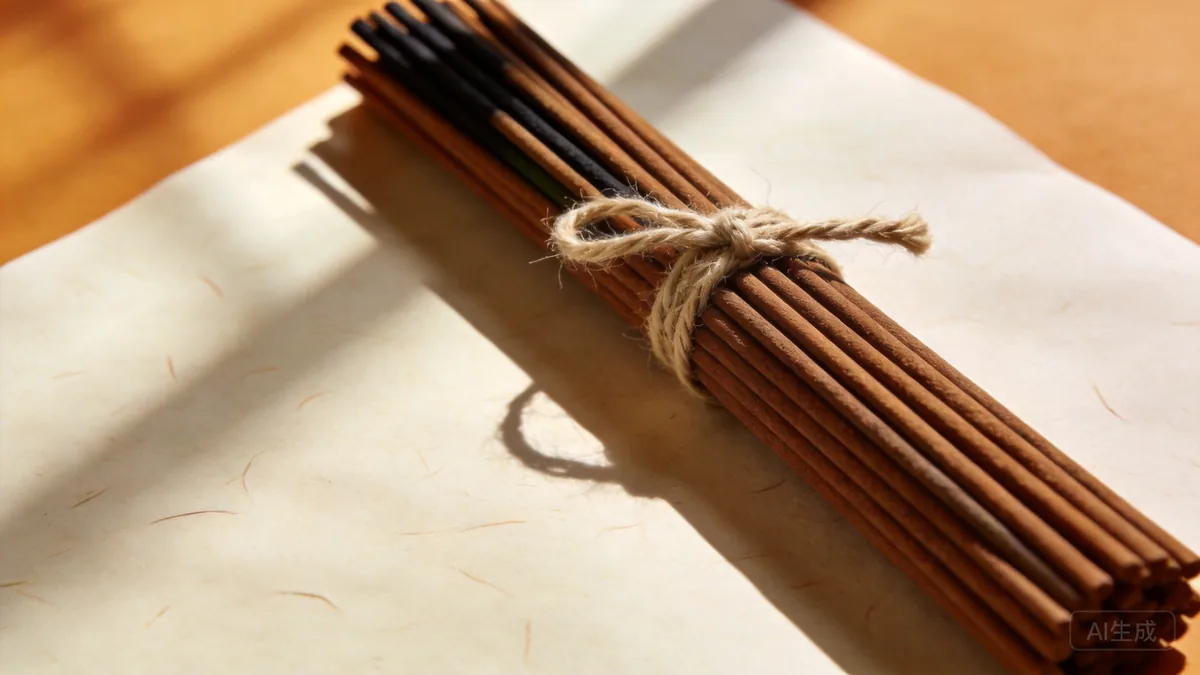
Key facts: Incense in China is called 香 (xiāng, “fragrance”), the practice is 香道 (xiāngdào, “the Way of Incense”), and the blended-art tradition is 合香 (hé xiāng, “compound incense”). The culture is older than the better-known Japanese kōdō, which descended from it.
Key Takeaways
- Chinese incense is a material tradition (wood, resin, botanicals) plus a cultural practice (ritual, aesthetics, appreciation), not just “smoke sticks.”
- The classical incense culture reached its peak in the Song dynasty (960–1279), which produced the technique of 隔火焚香 (indirect-fire incense) and the manual tradition 香谱 (xiāng pǔ).
- A common misconception is that incense appreciation is Japanese. The historical direction is the opposite: Japanese kōdō evolved from Song-dynasty Chinese technique.
- Chinese incense occupies a recognizable middle ground between India’s bold agarbatti and Japan’s minimalist kōh — elegant but warm, complex but not overwhelming.
- Incense is a wellness and ambiance practice, not a medical treatment. (See verification notes.)
What Is 香 (Xiāng)?
In Chinese, the single character 香 (xiāng) means both “fragrance” and the material that produces it. It appears in the earliest written records: oracle-bone inscriptions from the Shang dynasty (c. 1600–1046 BCE) already contain the character, in the context of aromatic offerings. That dual meaning — the smell and the thing that makes the smell — is the heart of the tradition.
A useful way to understand Chinese incense is as two layers:
- The materials. Classical ingredients include agarwood 沉香 (resin-impregnated Aquilaria wood), sandalwood 檀香 (Santalum heartwood), frankincense 乳香 and myrrh 没药 (tree resins), borneol 龙脑, clove 丁香, and cassia 桂皮. These arrived from China’s own forests and, from the Han dynasty onward, along the Silk Road and maritime trade routes.
- The practice. Incense was not only burned as an offering. By the Song dynasty it had become an art of appreciation in its own right — enjoying a subtle aroma the way one appreciates tea or painting.
What Chinese Incense Is — and Is Not
It is not just “Chinese incense sticks.” The stick 线香 is a later, everyday form. The deeper tradition is about the material itself and how it is heated — often with no flame at all.
It is not interchangeable with essential-oil aromatherapy. Aromatherapy diffuses volatile oils into the air; classical Chinese incense is a combustion-or-heating practice with its own materials, vocabulary, and grading systems. They overlap commercially but are distinct traditions.
It is not the same as Indian or Japanese incense. See the comparison below.
The “Not Japanese” Point (a Frequent Misconception)
English-language sources frequently treat incense appreciation as Japanese, because Japan’s kōdō 香道 is internationally well documented. The historical record points the other way:
- Chinese incense culture is documented centuries before kōdō.
- Japan’s kōdō is widely held to descend from the Song-dynasty Chinese technique 隔火焚香 (gé huǒ fén xiāng) — “indirect-fire incense,” where a piece of fragrant wood is set on a plate above buried hot charcoal so it releases aroma without burning.
Precise framing: Chinese incense culture is the historical source; Japan systematized and preserved the form as kōdō. Neither claim should be overstated as “invention” — the honest statement is that the refined technique Japan formalized came from China’s Song-era practice.
A Quick Comparison: Three Incense Traditions
| Tradition | Character | Typical materials | Style |
|---|---|---|---|
| Indian agarbatti | Bold, expressive | Sandalwood paste, resins, florals on a bamboo core | Thick, smoky, immediate |
| Chinese 香 | Warm, layered, elegant | Agarwood, sandalwood, blended 合香 | Subtle, often low-smoke or smoke-free (隔火焚香) |
| Japanese kōh / kōdō | Minimalist, refined | Agarwood (jinkō) with almost no binder | Very low smoke, meditative |
This “middle path” — richer than Japanese minimalism, cleaner than Indian boldness — is the position many modern Chinese-incense brands occupy, whether or not they articulate it.
The Cultural Vocabulary Worth Knowing
- 四般闲事 (sì bān xián shì) — the “Four Leisure Arts”: 烧香 (incense), 点茶 (tea), 挂画 (hanging scrolls), 插花 (flower arranging). Recorded in Wu Zimu’s 梦粱录 (Meng Liang Lu). Incense was considered one of the four refined pastimes.
- 香道 (xiāngdào) — “the Way of Incense,” the practice of preparing and appreciating incense.
- 合香 (hé xiāng) — blended/compound incense built on a 君臣佐使 (chief–minister–assistant–guide) principle, analogous to Chinese herbal formulation.
- 香谱 (xiāng pǔ) — incense manuals, the earliest and most complete body of incense literature in the world (陈氏香谱, 洪芻香谱, 香乘), still largely untranslated.
A Short History: From Oracle Bone to Song Peak
The written record of 香 runs deep. The character appears on Shang-dynasty oracle bones (c. 1600–1046 BCE), where it marks aromatic materials used in offerings. Ritual incense is clearly attested from the Han dynasty (206 BCE–220 CE), when the iconic 博山炉 (bóshān lú, “universal-mountain censer”) appears — a lidded bronze burner shaped as a mountain range, its perforated summit letting smoke drift out like mist through peaks.
The timeline, in broad strokes:
| Period | Development |
|---|---|
| Shang (c. 1600–1046 BCE) | 香 on oracle bones; aromatic offerings |
| Han (206 BCE–220 CE) | 博山炉 censer; incense moves from ritual toward aesthetic pleasure |
| Wei–Jin / Northern & Southern (220–589) | Buddhism plus Silk Road and maritime trade import 沉香, 檀香, 乳香, 龙脑, 丁香; the 合香 system takes shape |
| Sui–Tang (581–907) | First golden age; court luxury; blended incense matures |
| Song (960–1279) | The peak: 四般闲事, 隔火焚香, refined 合香, and the 香谱 manuals |
| Ming (1368–1644) | Codification; the 宣德炉 censer; stick incense perfected |
| Qing → 20th century | Decline through sumptuary laws, Western perfume, and mid-20th-century upheavals; revival from the 2000s |
Two cautions on dates. First, the “5,000 years of incense” figure that sometimes appears in marketing is not used here as established fact — the solid written evidence is the Shang oracle-bone 香, with ritual use unambiguous from the Han. Second, the Song’s status as the peak era is a consensus among secondary sources, not a single primary text.
The Forms: Stick, Coil, Cone, Seal, and Chip
Chinese incense is not one shape. The materials are the substance; the forms are how they reach flame or heat.
- Loose material (香材) — wood chips, resin tears, and powders. This is the classical core: a single piece of agarwood or a pinch of blended 合香 powder, heated or burned.
- Stick 线香 (xiàn xiāng) — the everyday form, perfected in the Ming dynasty: a thin rod of blended powder, usually around a bamboo core (or coreless, in the Japanese-influenced style).
- Coil 盘香 (pán xiāng) — a flat spiral that burns for hours; common in temples and for extended home use.
- Cone — a compact cone that burns in roughly 10–15 minutes; a modern convenience form.
- Seal incense 篆香 (zhuàn xiāng) — loose powder pressed into a patterned metal seal and lit at one end, so it burns along a timed path. It was visual art and a clock at once.
The deeper point: the classical tradition’s center of gravity was the material, not the stick. The stick is a later, everyday delivery system.
隔火焚香: The Refined “Scent, Not Smoke” Technique
The technique that best defines refined Chinese incense is 隔火焚香 (gé huǒ fén xiāng), “indirect-fire incense.” Instead of setting fire to the wood, you bury a small piece of hot charcoal in a bed of ash, lay a thin plate (silver or mica) over it, and rest the fragrant material on the plate. The material releases its aroma through gentle radiant heat, with almost no smoke.
Why it matters:
- It preserves the delicate top notes that a direct flame would burn off.
- It produces little smoke, which matters for the nose and for indoor air.
- It is the direct ancestor of Japanese kōdō — the technique Japan later systematized.
This is the answer to a common puzzle: why heat incense instead of burning it? Because heating is how the subtle, expensive materials are actually appreciated.
Buying Chinese Incense: What to Look For
If you are buying Chinese incense for the first time, a few checks do most of the work:
- Name the material. A label that says “sandalwood” or “agarwood” should also say which wood and, ideally, the species. Vague prestige names are a signal to look closer.
- Material vs. fragrance. A stick scented with essential oil is not the same product as one made from the actual wood or resin. See the substitution cross-reference.
- Binder. A natural combustible binder (makko 抹香 or a wood-powder base) indicates a material-based stick; a charcoal-and-fragrance base is a different category.
- Price as a signal. Real agarwood and true sandalwood are expensive; a very cheap “agarwood” stick is almost certainly not agarwood.
- Smoke and ventilation. Every incense produces some particulate; burn in a ventilated space.
None of this requires expertise — it requires reading the label and asking two questions: what species, and material or fragrance.
Safety and Ventilation
Incense burns, and burning produces smoke and particulate matter (PM2.5). This is a combustion fact, not a wellness judgment. The practical guidance: burn in a ventilated room, near an open window when possible, keep sessions short, and keep incense and its smoke away from children, pets, and anyone with respiratory sensitivities. “Natural” does not mean smoke-free. The American Lung Association’s indoor-air guidance and LanDeng’s own safety guide carry the detail.
Common Mistakes
- Assuming “incense = sticks.” The stick is one form; classical appreciation was often about a single heated piece of agarwood or a pressed seal-pattern (篆香).
- Assuming the culture is Japanese. It is Chinese in origin; Japan’s kōdō descends from it.
- Treating incense as medicine. Fragrance supports a calming routine; it is not a treatment for insomnia, anxiety, or pain.
- Confusing “natural” with “safe.” Natural incense still produces smoke and particulate matter; ventilation matters.
The Author’s Take
Position: In my view, Chinese incense is the middle path between India’s bold agarbatti and Japan’s minimalist kōh — and that middle is exactly why it’s underrated.
Reasoning:
- It demands balance, not a single extreme: warm but not heavy, complex but not austere.
- Holding the middle is the hardest position to sustain — which is why it reads as understated rather than showy.
- For attention without austerity, the Chinese tradition is, in my experience, the richest place to look.
This is the author’s editorial view and experience — not a verified fact.
Verification Notes
- History dates use conservative framing. The earliest material evidence is the oracle-bone 香 (Shang dynasty); ritual incense is clear from the Han dynasty. Claims of “5,000 years” are not used here as established fact.
- “香道 originated in China, and kōdō descended from Song 隔火焚香” is stated with high confidence on the basis of multiple secondary sources, but the precise transmission detail is a historical interpretation rather than a single primary-source fact.
- This page makes no health or therapeutic claims. See LanDeng’s safety page for combustion and ventilation guidance.
Cluster directory
- Chinese Incense vs Essential Oils vs Candles: What’s the Difference?
- History of Chinese Incense Culture: Shang Rituals to the Modern Revival
- Incense Terminology Glossary: Stick, Coil, Cone, Resin, and Powder
- The 香谱 Incense Manuals: The World’s Most Complete (and Least Translated) Incense Literature
FAQ
Q: What is the difference between Chinese and Japanese incense?
The culture is Chinese in origin; Japan’s kōdō formalized it, especially the low-smoke 隔火焚香 technique. Chinese incense culture is documented centuries before kōdō existed as a named practice, and the refined “scent, not smoke” method that sits at kōdō’s heart is a Song-dynasty Chinese technique. In character, the two developed differently: Chinese incense today tends to be warmer, more layered, and readier to blend many materials into a 合香 formula, while Japanese kōdō is minimalist and meditative, focused on a single precious wood — agarwood — appreciated for purity rather than composition.
Q: Is Chinese incense the same as essential-oil aromatherapy?
No. They share “pleasant smell” but differ in materials, method, and tradition. Aromatherapy disperses volatile essential oils into the air, usually by diffusion or misting, with no combustion. Classical Chinese incense is a material-and-ritual practice: solid woods, resins, and botanicals are burned or gently heated, producing aroma (and, when burned, smoke) from the material itself. The two overlap commercially — both are sold for ambiance — but they are distinct traditions with different materials, tools, vocabulary, and histories. Confusing them flattens what makes each one worth understanding.
Q: What are the main forms?
Loose material (wood chips, resin, powder), formed sticks 线香, coils 盘香, cones, and seal incense 篆香. Loose material is the classical core — a single heated piece of agarwood or a pinch of blended 合香 powder. Stick incense is a Ming-dynasty-era everyday form, built around a bamboo core or coreless. Coils burn for hours and suit temples and extended use; cones burn in roughly 10–15 minutes; seal incense is pressed powder lit along a timed pattern. The tradition’s center of gravity was the material, not the stick.
Q: Does incense help you sleep or reduce anxiety?
LanDeng does not make medical claims. Incense is not a treatment for insomnia, anxiety, or pain, and no fragrance is a substitute for medical care. What many people do is use a calming, familiar scent as part of an unwinding routine — a sensory anchor for an evening wind-down or a quiet moment. That is a wellness and ambiance practice, not a therapeutic effect. If a product claims to cure or clinically treat a condition, that claim is unverified and should be read with skepticism.
More Questions Answered
Q: What does Chinese incense smell like?
There is no single answer — it depends entirely on the material. Sandalwood 檀香 is creamy and sweet-woody, often described as buttery. Agarwood 沉香 is deep, resinous, and sweet, and it develops in stages as it warms: an opening note, a body, and a dry-down. Frankincense 乳香 is fresh and citrus-woody; blended 合香 compounds range from floral to herbal to warm and medicinal. The shared signature across the tradition is warmth and layering rather than one sharp, single note — which is exactly why asking “what does Chinese incense smell like” invites the follow-up “which one?”
Q: How long does a Chinese incense stick burn?
Roughly 20–60 minutes, depending on length, thickness, and whether the stick has a bamboo core. A short Japanese-style coreless stick burns about 25–30 minutes; a thicker bamboo-core stick about 45–60 minutes. Cones are the shortest form at roughly 10–15 minutes, and coils burn for hours. These are typical ranges, not fixed figures — the exact time depends on the specific stick and how it is made, so check the product’s stated burn time where it is given.
Q: What is 合香 (hé xiāng) blended incense?
Compound incense — a blend of multiple ingredients built on a 君臣佐使 (chief–minister–assistant–guide) formula principle, analogous to how Chinese herbal formulas are structured. Each ingredient has a role: the chief carries the scent, the minister supports it, the assistant gives it a signature character, and the guide binds or directs it. It is the opposite of a single-material incense like a lone piece of agarwood. This formula logic, not any one smell, is what makes “Chinese incense” a compositional art rather than a single scent. See the blending system.
Q: Is Chinese incense the same as temple incense?
Not exactly. Temple incense is usually a specific, inexpensive stick or coil burned as an offering — often bold, smoky, and designed to be abundant rather than subtle. Classical Chinese incense culture is broader and includes the refined appreciation of single woods and blended 合香, often heated rather than burned to release a delicate aroma. They overlap in materials and in their Buddhist and Taoist contexts, but they differ in intent: one is an offering in quantity, the other an act of appreciation for the material itself.
Q: What is the difference between incense and a candle?
A candle is wax with a wick, scented or not, burned for light and heat plus fragrance. Incense is aromatic plant material — wood, resin, or a formed stick — burned or heated for its scent alone, with no wax and no wick. The mechanisms differ (a candle melts wax around a flame; incense combusts or heats solid plant material), and the traditions differ too: incense in China is a material-and-ritual practice with its own vocabulary and grading systems, while a candle is fundamentally a lighting technology that happens to carry a scent.
Sources
- 吴自牧《梦粱录》, “烧香点茶,挂画插花,四般闲事,不宜累家” — primary textual source for the Four Leisure Arts. Full text on Wikisource.
- 洪刍《香谱》 — Song-dynasty incense manual. Full text on Wikisource.
- 周嘉胄《香乘》(Ming) — the comprehensive incense compendium. Full text on Wikisource.
- 李时珍《本草纲目》 — historical materia-medica record for aromatic materials (traditional, not clinical). Chinese Text Project.
- American Lung Association — indoor-air pollutants (combustion/particulate guidance).
- 光明日报 (Guangming Daily), Song-dynasty 香文化 features — secondary source on Song incense culture.
- Oracle-bone inscriptions — earliest written attestation of 香 (Shang dynasty).
- Research synthesis: docs/research/chinese-incense-pillar-notes.md (R-003).
Related Resources
Natural next step: curious about where it all started? Read the history of Chinese incense culture, or explore individual ingredients like sandalwood and agarwood.