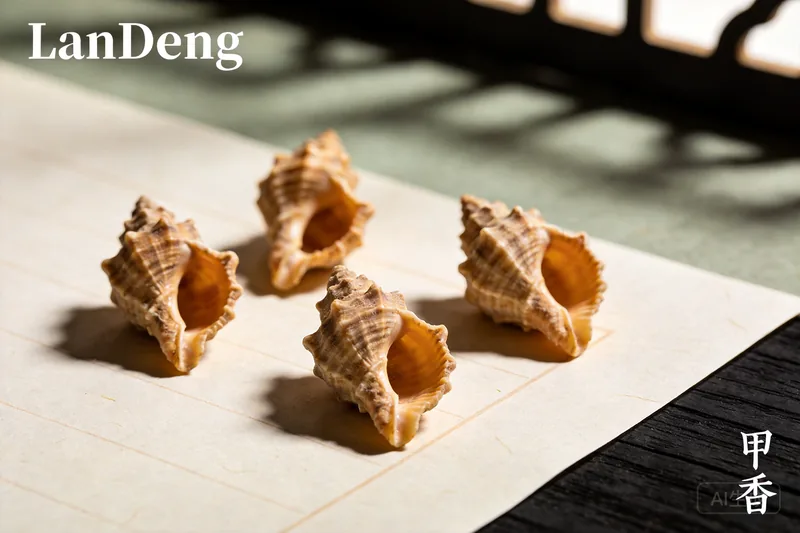
Technical answer: Onycha — jiǎxiāng (甲香) in Chinese — is the operculum, the hard, shell-like disc that seals the opening of certain marine gastropods (sea snails). In classical Chinese incense it was used as a fixative that binds and stabilizes a blend’s scent, contributing a faint marine, animalic undertone. It is one of the two animal-derived materials in this encyclopedia (alongside musk), and — like ambergris — it is animal-derived, not botanical.
Key facts
| Chinese | 甲香 (jiǎxiāng) |
| Source | Operculum of marine gastropods (sea snails) — a mollusc structure |
| What it is | A hard animal disc, not a plant, wood, or resin |
| Aroma | Faint marine, briny, animalic, musky |
| Traditional role | Fixative in classical 合香; historical formula ingredient |
Aroma profile
The operculum itself is not strongly fragrant on its own. Its role is that of a fixative — it was processed (法制, “treated”) and added to blends to bind and stabilize the scent, lending a faint marine, briny, faintly animalic undertone. Classical formulas treat it as a functional material rather than a fragrance note in its own right.
The animal-origin point (read this)
Onycha is an animal product — the operculum of sea snails — which matters in three ways:
- Category — it is animal-derived, not botanical, which is why it is unsuitable for vegetarian or cruelty-conscious makers.
- Modern use — 甲香 is largely no longer used today; it is a historical formula ingredient. Modern reproductions of classical blends typically substitute or omit it.
- Context — this page documents it as historical and connoisseurship context only.
This is a sourcing and category fact, not a health claim.
In Chinese tradition
- Classical 合香 (blended incense): 甲香 appears in the 香乘 (Xiang Cheng) and 香譜 (Xiangpu) as a fixative in court and temple blends, most famously in the 花蕊夫人衙香 (Huarui Furen’s court incense), where it is dosed at 一两 (one liǎng) alongside frankincense and borneol, and is specified to be 法制 (treated) before use.
- Materia medica: 甲香 is recorded in traditional Chinese medicine (本草綱目, 介部) with various described uses. This is traditional materia-medica language, not modern clinical evidence.
Traditional use vs modern evidence
The classical references document onycha’s fixative role in incense and a traditional medicinal reputation. We treat the medicinal descriptions as traditional, not established clinical fact, and make no medical claims. The documented, non-medical facts are the animal source, the functional fixative role, and the fact that it is now largely a historical ingredient.
Sourcing and modern-status notes
Practical points:
- 甲香 is modernly largely obsolete: it is not a material contemporary makers source, and modern reproductions of classical blends substitute or omit it.
- Its animal origin makes it unsuitable for vegetarian, vegan, or cruelty-conscious products.
- When it appears in an old formula, read it as a functional fixative from the shellfish tradition, not as a fragrance note in its own right.
Safety
Incense combustion produces smoke and particulate matter. Burn in a well-ventilated space, avoid inhaling concentrated smoke, and keep away from children and pets. This is editorial knowledge content, not medical advice.
FAQ
What is 甲香 (onycha)? It is the operculum — the hard, shell-like disc that seals the opening of certain marine gastropods, or sea snails. In classical Chinese incense it was used as a fixative to bind and stabilize a blend’s scent, adding a faint marine, animalic undertone. It is animal-derived, not botanical, and is recorded in the 香乘 (Xiang Cheng) and 香譜 (Xiangpu) as a court and temple blend ingredient.
Is onycha still used today? Largely no. 甲香 is a historical formula ingredient — it is rarely sourced or used in modern incense, and reproductions of classical blends typically substitute or omit it. Its animal origin also makes it unsuitable for vegetarian or cruelty-conscious makers. When you see 甲香 in an old formula, read it as a functional fixative from the shellfish tradition rather than a scent note.
What part of the animal is onycha? The operculum — the hard, horn-like disc on the foot of certain sea snails that seals the shell opening when the animal withdraws. It is a mollusc structure, distinct from the shell itself. In classical incense the operculum was treated (法制) before use, then added to blends as a fixative rather than for its own aroma.
Where does onycha appear in classical recipes? Most famously in the 花蕊夫人衙香 (Huarui Furen’s court incense), recorded in the 香乘 (Xiang Cheng), where 甲香 is dosed at 一两 (one liǎng) alongside frankincense and borneol and specified to be treated before use. There it serves as the fixative in an agarwood–sandalwood–musk court blend. See the Huarui Furen court incense recipe.
Why is onycha an animal product, and why does that matter? Because it comes from sea snails rather than a plant, wood, or resin. This matters for category (it is animal-derived, not botanical), for suitability (it is unsuitable for vegetarian or cruelty-conscious products), and for modern sourcing (it is now largely a historical ingredient). The page documents it as historical and connoisseurship context only.
See also: musk, ambergris, the Huarui Furen court incense recipe, and the full scent guide.
Evidence & Sources
Source identity
Source: Gastropoda (the snail class that bears the operculum) on GBIF — onycha is a mollusc operculum, animal-derived, not botanical. Evidence type: Established.
Traditional Chinese use
Source: 甲香 recorded in the 香乘 (Xiang Cheng) and 香譜 (Xiangpu) as a 合香 fixative, including the 花蕊夫人衙香 formula at 一两 with 法制 treatment; 甲香 in the 本草綱目 介部. Evidence type: Historically documented — traditional materia-medica language, not modern clinical evidence.
Modern status / sourcing
Source: 甲香 is modernly largely unused — a historical formula ingredient, substituted or omitted in modern reproductions; animal origin limits suitability. Evidence type: Industry practice.
Safety
Source: incense combustion produces smoke and particulate matter; burn in a well-ventilated space. Evidence type: Established.
Evidence status
| Layer | Status |
|---|---|
| Source identity | Established (animal, not botanical) |
| Traditional use | Historically documented |
| Modern status | Industry practice (largely obsolete) |
| Health claims | Not established |
Sources
Sources: references on onycha (mollusc operculum, fixative role, historical use, and modern obsolescence). This page documents onycha as historical and connoisseurship context only. Medicinal uses are treated as traditional, not established clinical fact. This is editorial knowledge content, not medical advice.