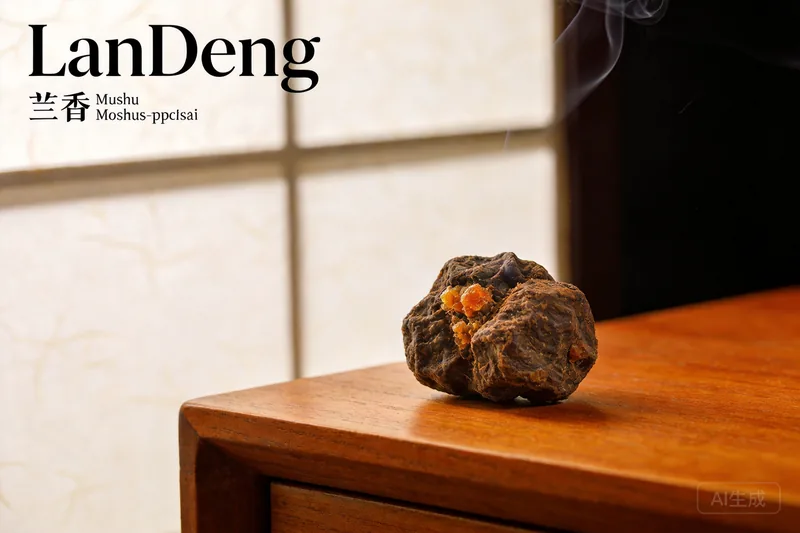
Technical answer: Musk — shèxiāng (麝香) in Chinese — is the dried secretion of the musk pod of the male musk deer (genus Moschus), a small deer of the mountains of Asia. In classical Chinese incense it was a prized fixative and precious accent, with an animalic, sweet, warm scent that rounds and extends a blend. It is the defining animal material of the court 合香 tradition — and, unlike nearly everything else in this encyclopedia, it is animal-derived, not botanical.
Key facts
| Chinese | 麝香 (shèxiāng) |
| Source | Musk deer (genus Moschus) — the male’s musk pod secretion |
| What it is | A dried animal secretion, not a plant, wood, or resin |
| Aroma | Animalic, musky, sweet, warm (aged) |
| Traditional role | Precious fixative and accent in court 合香 |
Aroma profile
Natural musk is animalic and musky at its base, with a sweetness that is often described as warm, skin-like, and leathery. It is a fixative first — it does not lead a blend so much as anchor it, adding warmth, depth, and longevity. This is why classical court formulas list it in tiny quantities (often measured in 钱, a tenth of a 两) as the precious accent that “fixes” the whole composition.
The animal-origin point (read this)
Musk is an animal product, which matters in two ways:
- Conservation — the musk deer (Moschus) is CITES-listed, wild populations are protected, and the international trade in natural musk is heavily restricted or effectively banned in many countries. Genuine natural musk is scarce and legally sensitive.
- Context — this page treats musk as a historical and connoisseurship reference only. Modern incense and perfumery almost always use synthetic musks or botanical musky substitutes instead of the animal secretion.
This is a sourcing, conservation, and category fact — not a health claim.
In Chinese tradition
- Court 合香 (blended incense): 麝香 is the defining precious animal accent of court and temple blends, listed in the 香乘 (Xiang Cheng) across many formulas — most famously in 花蕊夫人衙香, where it is dosed at 一钱 (one qián) as the fixative accent over an agarwood–sandalwood core.
- Perfume and personal scent: classical texts describe musk as a personal and clothes scent, valued for its lasting power.
- Materia medica: 麝香 appears in traditional Chinese medicine with various described uses. This is traditional materia-medica language, not modern clinical evidence.
Traditional use vs modern evidence
The classical references document musk’s aromatic and fixative role and a traditional medicinal reputation. We treat the medicinal descriptions as traditional, not established clinical fact, and make no medical claims. The documented, non-medical facts are the animal source, the conservation status, and the historical use as a precious fixative. This page describes its aromatic and cultural role only.
Conservation and sourcing notes
Practical points for anyone researching or buying:
- Genuine natural musk is an animal product from CITES-listed musk deer, and its trade is heavily restricted. This encyclopedia documents it as historical and connoisseurship context only — not as a material to source.
- What is sold as “musk” in contemporary incense and fragrance is almost always a synthetic musk (musk ketone, galaxolide, and related compounds) or a botanical musky substitute such as ambrette seed, rather than the animal secretion.
- The label “musk” on a modern incense stick should be read as a scent descriptor, not a claim of animal origin.
Safety
Incense combustion produces smoke and particulate matter. Burn in a well-ventilated space, avoid inhaling concentrated smoke, and keep away from children and pets. Note that most “musk” in modern incense is synthetic, which is a sourcing and animal-welfare matter, not a safety claim. This is editorial knowledge content, not medical advice.
FAQ
Is musk a plant? No — musk is animal-derived. It is the dried secretion of the musk pod of the male musk deer (genus Moschus), a small deer of Asian mountain ranges. This distinguishes it from the botanical materials that make up most of this encyclopedia. The distinction matters for sourcing, conservation, and labeling, and it is why most “musk” in modern fragrance is a synthetic or botanical substitute rather than the animal secretion.
Is natural musk still used in incense? Rarely, and with serious legal and conservation constraints. The musk deer is CITES-listed, wild populations are protected, and international trade in natural musk is heavily restricted. As a result, contemporary incense and perfumery overwhelmingly use synthetic musks or botanical musky substitutes (such as ambrette seed) instead. When a modern product says “musk,” it almost always refers to one of these substitutes, not to the animal secretion.
What does musk smell like? Animalic and musky at its base, with a sweet, warm, skin-like, slightly leathery character that develops and rounds with age. Its role is that of a fixative — it anchors and extends a blend from below rather than leading with a bright note. This is why classical formulas use it in tiny quantities (often a single 钱, a tenth of a 两) as the precious accent that “fixes” the whole composition.
Why does musk appear in tiny amounts in classical recipes? Because it is a fixative and a costly accent, not a body material. In the 花蕊夫人衙香 (Huarui Furen’s court incense), for example, musk is dosed at 一钱 (one qián) against several 两 of agarwood and sandalwood. A little musk goes a long way: it adds warmth and longevity, and its price and rarity meant it was always used sparingly. See the Huarui Furen court incense recipe.
Why is this page a “historical reference only”? Because genuine natural musk is an animal product from CITES-listed musk deer, and sourcing it today raises conservation and legal problems. The page therefore documents musk as a matter of historical and connoisseurship context — what it was, how it was used, and why it mattered — rather than as a material to buy. This is a transparency choice, not a judgment on historical practice.
See also: ambergris, sandalwood, the Huarui Furen court incense recipe, and the full scent guide.
Evidence & Sources
Source identity
Source: Moschus moschiferus (Siberian musk deer) on GBIF · Moschus moschiferus in the CITES species checklist — musk is an animal secretion, not botanical. Evidence type: Established.
Traditional Chinese use
Source: 麝香 recorded across the 香乘 (Xiang Cheng) as a court 合香 fixative accent, including the 花蕊夫人衙香 formula at 一钱; 麝香 in the 本草綱目 獸部. Evidence type: Historically documented — traditional materia-medica language, not modern clinical evidence.
Conservation / sourcing
Source: the musk deer’s CITES listing and the natural-vs-synthetic market note (musk ketone, galaxolide, ambrette seed substitutes). Evidence type: Trade and regulatory terminology.
Safety
Source: incense combustion produces smoke and particulate matter; burn in a well-ventilated space. Evidence type: Established.
Evidence status
| Layer | Status |
|---|---|
| Source identity | Established (animal, not botanical) |
| Traditional use | Historically documented |
| Conservation status | Established (CITES-listed) |
| Health claims | Not established |
Sources
Sources: references on musk (musk deer secretion, fixative role, CITES trade status, and synthetic/botanical substitutes). This page documents musk as historical and connoisseurship context only, not as a material to source. Medicinal uses are treated as traditional, not established clinical fact. This is editorial knowledge content, not medical advice.