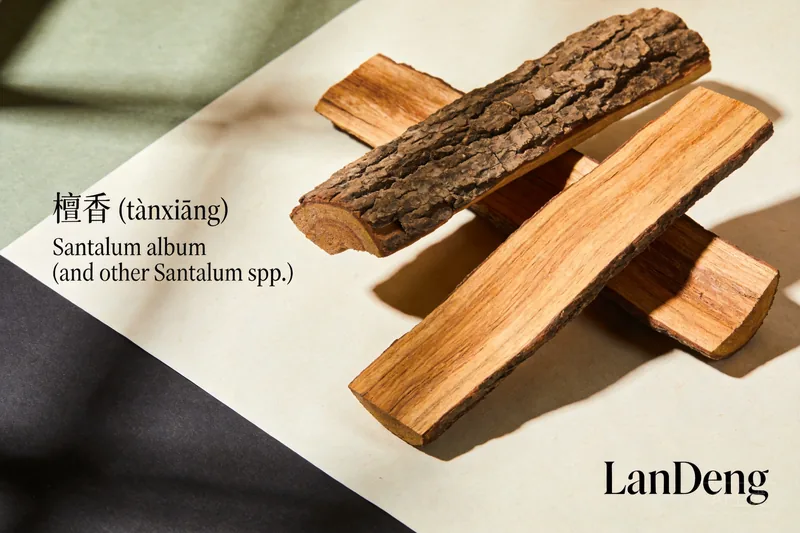
At a glance: Sandalwood — tanxiang (檀香) in Chinese — is the fragrant heartwood of Santalum trees, most classically Indian sandalwood (Santalum album). It is prized in Chinese incense for a warm, creamy, sweet, woody aroma, and has a long history in ritual, incense sticks, perfume, and carving.
Key facts
| Chinese | 檀香 (tánxiāng) |
| Botanical source | Santalum trees (Santalaceae) — primarily S. album (Indian/white sandalwood) |
| What it is | Fragrant heartwood (a hemiparasitic tree genus) |
| Aroma | Creamy, sweet, soft, woody (“buttery” in good material) |
| Key risk | Species substitution; cheap sticks are often fragrance oil, not real wood |
Aroma profile
Sandalwood’s scent is warm, creamy, and sweet with a soft woody base. The best material has a distinctive “buttery” smoothness that distinguishes it from sharper or synthetic “sandalwood” fragrances. It is widely used as a base or blending material because its aroma is gentle and long-lasting rather than sharp.
Species: what “sandalwood” means
“Sandalwood” is not one tree. In trade it can refer to several Santalum species:
- Santalum album — Indian / white sandalwood; the classic incense wood and the reference standard.
- Santalum spicatum — Australian sandalwood; a common commercial substitute.
- Santalum austrocaledonicum — New Caledonian sandalwood.
- Santalum paniculatum — Hawaiian sandalwood.
Buyer note: “sandalwood” on a label does not guarantee S. album. Species substitution is common; the aroma and price differ meaningfully. This is a key authenticity point, not a triviality.
Traditional use vs modern evidence
Sandalwood has a long record of traditional and ritual use — in incense, Buddhist and Taoist practice, perfume, carving, and traditional materia medica. It is widely described as “calming” and “grounding” in aromatherapy contexts.
Important: much of the online content about “sandalwood incense benefits” repeats health claims — relieving insomnia, relieving anxiety, lowering cortisol, lowering blood pressure, immune support — with little or no sourced evidence. We treat these as traditional belief or unverified claims, not established medical fact.
- What we can say: sandalwood has a warm, grounding aroma used for centuries in meditation and ritual settings.
- What we do not claim: that burning sandalwood treats insomnia, anxiety, or any medical condition.
In Chinese incense
Sandalwood (檀香) is a staple material in Chinese incense alongside agarwood (沉香). It is used in incense sticks (线香), in blended incense (合香), and in temple/ritual settings. Its gentle, sweet aroma makes it a common pairing or base material.
Quality & authenticity (buyer intelligence)
- Real sandalwood powder is expensive — but price alone proves nothing. Prices vary substantially by species, origin, heartwood content, grade, purity and market channel, so a low retail price cannot by itself establish authenticity. Very cheap “sandalwood” sticks are almost always synthetic fragrance oil, not wood.
- Oil ≠ wood. Sticks made with sandalwood oil smell distinctly different from those made with the actual wood; the wood gives the “buttery” note.
- Species matters. S. album is the reference standard; substitutes (Australian, New Caledonian) are legitimate but different in aroma and price.
Safety
Incense combustion produces smoke and particulate matter. Burn in a well-ventilated space; avoid inhaling concentrated smoke; keep away from children and pets. See our safety guide.
FAQ
What is the difference between sandalwood and agarwood? Both are prized woods, but they differ: sandalwood is the fragrant heartwood of Santalum trees (creamy, sweet, woody), while agarwood is resin-impregnated Aquilaria wood formed after injury (woody, resinous, sweet, complex). Sandalwood’s scent is present in the living heartwood; agarwood’s forms only through a wounding process. They sit side by side in Chinese incense, sandalwood as the gentle, creamy staple and agarwood as the deeper, more complex premium wood.
Is “sandalwood incense” real sandalwood? Often not — many commercial sticks use synthetic fragrance. Check species and whether it lists real wood powder vs fragrance oil. Genuine sandalwood powder is expensive, so very cheap sticks are almost always synthetic fragrance oil rather than wood; the label should name a Santalum species and state whether it is wood or oil. Species substitution is common, and the aroma and price differ meaningfully between real and synthetic or between different species.
Does sandalwood help you sleep? There is no established clinical evidence that burning sandalwood treats insomnia, and no fragrance should be treated as a medical sleep aid. Sandalwood does have a traditional use as a calming ritual scent, and its warm, grounding aroma has been used for centuries in meditation and evening ritual settings. Describing it as “calming” is an aromatherapy observation about how a familiar scent can anchor an unwinding routine, not a proven treatment for any sleep condition. If a product claims to cure insomnia, that claim is unverified and should be read with skepticism.
What does sandalwood smell like? Warm, creamy, sweet, and soft-woody — the best material has a distinctly “buttery” smoothness that distinguishes it from sharper or synthetic “sandalwood” fragrances. The aroma is gentle and long-lasting rather than sharp, which is why sandalwood is widely used as a base or blending material. This smooth, buttery quality is the mark of good material and is lost in cheap synthetic versions.
Is sandalwood oil the same as sandalwood powder? No. Oil is the concentrated steam-distilled extract; powder is the ground heartwood. Oil gives bright, immediate notes; wood gives the slower, deeper “cooked” aroma. Sticks made with oil smell distinctly different from those made with actual wood — the wood is what supplies the characteristic “buttery” note. So the same word, “sandalwood,” can mean two quite different materials in practice.
Why is real sandalwood so expensive? Santalum album is slow-growing and hemiparasitic, its heartwood takes decades to develop aroma, and wild stands are depleted. Scarcity plus demand drives the price — cheap “sandalwood” is usually synthetic. The species is also CITES-listed, which reflects pressure on wild populations and adds to the cost of genuine material. All of this means real sandalwood powder commands a meaningful price in craft supply.
See also: the sandalwood incense guide and the full scent guide.
Evidence & Sources
Botanical identity
Source: Santalum album on GBIF · Santalum album in the CITES species checklist. Evidence type: Established.
Traditional Chinese use
Source: 本草綱目 (Bencao Gangmu) full text on Wikisource and this page’s record of sandalwood’s long traditional and ritual use (incense, Buddhist and Taoist practice, materia medica). Evidence type: Historically documented — traditional materia-medica language, not modern clinical evidence.
Commercial grading
Source: the species distinction among Santalum album / S. spicatum / S. austrocaledonicum / S. paniculatum is market-relevant terminology. Evidence type: Trade terminology.
Authenticity / adulteration
Source: species substitution and “oil vs wood” (synthetic fragrance oil vs real wood) are the page’s buyer-intelligence points. Evidence type: Practical screening.
Safety
Source: incense combustion produces smoke and particulate matter; burn in a well-ventilated space. Evidence type: Established.
Evidence status
| Layer | Status |
|---|---|
| Botanical identity | Established |
| Traditional use | Historically documented |
| Commercial grading | Trade terminology |
| Authenticity test | Practical screening |
| Health claims | Not established |
Sources
- Santalum album on GBIF
- Santalum album in the CITES species checklist
- 本草綱目 (Bencao Gangmu) full text on Wikisource
Sources: botanical references on Santalum spp. and commercial/enthusiast accounts of the sandalwood trade. Health-benefit claims circulating online are treated as traditional/unverified, not established evidence. This is editorial knowledge content, not medical advice.