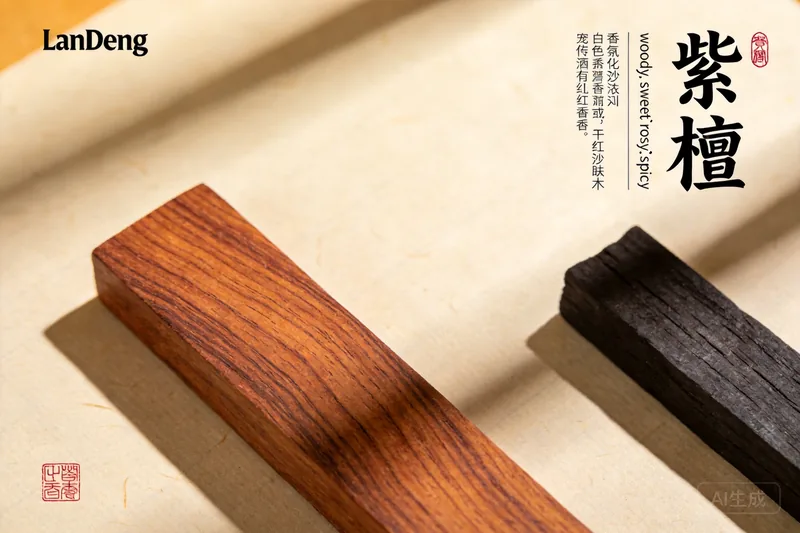
Technical answer: Red sandalwood — zǐtán (紫檀) in Chinese — is the dense, deep crimson heartwood of Pterocarpus santalinus, a leguminous tree of southern India. It is a hard, heavy dye-and-carving wood whose dark-red pigment (santalin) has been prized for centuries, and whose finely-ground wood is used in Chinese incense as a sweet, softly spicy fragrant wood. It is not the same material as “sandalwood” (檀香, Santalum album): the two share the word “sandalwood” in loose English usage but come from unrelated plant families.
Key facts
| Chinese | 紫檀 (zǐtán), also 紫檀木 / 紫檀香 |
| Botanical source | Pterocarpus santalinus (family Fabaceae) — the heartwood |
| What it is | A dense red heartwood, used as wood, powder, and dye |
| Aroma | Woody, sweet, faintly rosy and spicy when heated |
| Traditional role | Fragrant wood, carving wood, red dye; classical incense material |
Aroma profile
Red sandalwood’s scent is woody and sweet rather than resinous or sharp — a soft, slightly rosy, gently spicy note that develops on gentle heating. The wood is dense and burns slowly. The vivid red color is its signature: the heartwood yields the red dye santalin, and this pigment is why the wood has been cut, carved, and traded as much for its color as for its scent.
Botanical source and origin
Pterocarpus santalinus is a small to medium tree native to the dry deciduous forests of southern India, chiefly the Eastern Ghats. The part used is the dark heartwood, which is extraordinarily dense and hard. The tree is a legume (Fabaceae), unrelated to the true sandalwood Santalum album (檀香, Santalaceae) — a distinction that matters because the two are frequently confused in English.
A naming caution: “Red sandalwood” in English and 紫檀 in Chinese do not always name Pterocarpus santalinus alone. In historical Chinese usage 紫檀 could refer to several dark, dense rosewoods; in modern commerce other red woods are sometimes passed off as 紫檀. See the note below.
In Chinese tradition
- Fragrant wood: 紫檀 appears in classical incense contexts as a dense fragrant wood, often listed among the precious woods alongside 檀香 and 降真香.
- Carving and furniture: the hardness and deep color made 紫檀 the classic material of fine furniture, seals, beads, and Buddhist implements.
- Dye: the heartwood’s red pigment was extracted as a dye and a pigment for lacquer and textiles.
- Materia medica: 紫檀 is recorded in traditional Chinese medicine for cooling, astringent uses. This is traditional materia-medica language, not modern clinical evidence.
Traditional use vs modern evidence
The documented, non-medical facts are botanical identity and the wood’s long use as a fragrant, colored, carving material. Medicinal descriptions are treated as traditional, not established clinical fact, and we make no medical claims. The scent and dye roles are unambiguous; the medicinal reputation is not something this page asserts as clinical evidence.
Quality and sourcing notes
Red sandalwood is genuinely scarce: Pterocarpus santalinus grows slowly, is harvested from a limited natural range in southern India, and its trade has been regulated under CITES Appendix II since 2019. Practical points for buyers:
- The wood should be a deep, even crimson-red heartwood, dense and heavy, with a faint sweet scent when gently warmed.
- Because genuine 紫檀 is expensive and restricted, substitution and adulteration are common — other red or dyed woods may be sold under the name. Confirm species and origin when buying.
Safety
Incense combustion produces smoke and particulate matter. Burn in a well-ventilated space, avoid inhaling concentrated smoke, and keep away from children and pets. This is editorial knowledge content, not medical advice.
FAQ
What is the difference between red sandalwood and sandalwood? They are unrelated plants. Red sandalwood is Pterocarpus santalinus, a legume (Fabaceae) native to southern India, valued for its dense crimson heartwood, dye, and a soft woody-sweet scent. Sandalwood (檀香) is Santalum album (Santalaceae), prized for its creamy, milky-woody fragrance oil. The English word “sandalwood” lumps them together, but they are different families, different geographies, and different materials with different uses and scents.
What does red sandalwood smell like? Woody and sweet, with a faintly rosy, gently spicy character that emerges on gentle heating — softer and less resinous than a classic “sandalwood” note. Because the wood is dense and slow-burning, it is usually blended or heated rather than burned alone for fragrance. The color is as central as the scent: the heartwood’s red santalin pigment has been traded as a dye for centuries.
Why is red sandalwood regulated? Pterocarpus santalinus is a slow-growing tree harvested from a restricted natural range in the dry forests of southern India, and over-harvesting for its valuable heartwood led to it being listed under CITES Appendix II in 2019. The listing means international trade in the wood is monitored and permitted. The scarcity also drives substitution — other red woods are sometimes sold as 紫檀 — so species and origin should be confirmed when buying.
Is 紫檀 a Chinese incense material? Yes, historically. 紫檀 is recorded among the precious fragrant woods of classical Chinese incense, alongside 檀香 and 降真香, and it was also the classic material of fine furniture, seals, and Buddhist implements. In incense it reads as a dense, sweetly woody supporting wood. The term is also historically loose — 紫檀 could name several dark rosewoods — so a label should be read with that ambiguity in mind.
What part of red sandalwood is used? The dark heartwood. It is used whole for carving and beads, cut for furniture and implements, ground to powder for incense and paste, and extracted for its red pigment. The outer sapwood is pale and of little value; the deep crimson heartwood is the material of trade.
See also: sandalwood, jiangzhenxiang, and the full scent guide.
Evidence & Sources
Botanical identity
Source: Pterocarpus santalinus on GBIF · Pterocarpus santalinus on the CITES checklist. Evidence type: Established.
Traditional Chinese use
Source: 紫檀 recorded as a fragrant and carving wood in classical Chinese incense and furniture contexts; medicinal uses in the Bencao Gangmu (本草纲目) tradition. Evidence type: Historically documented — traditional materia-medica language, not modern clinical evidence.
Authenticity / sourcing
Source: Pterocarpus santalinus scarcity, CITES Appendix II listing (2019), and the common substitution of other red woods. Evidence type: Practical screening.
Safety
Source: incense combustion produces smoke and particulate matter; burn in a well-ventilated space. Evidence type: Established.
Evidence status
| Layer | Status |
|---|---|
| Botanical identity | Established |
| Traditional use | Historically documented |
| Authenticity test | Practical screening |
| Health claims | Not established |
Sources
Sources: botanical references on Pterocarpus santalinus and its CITES Appendix II listing. Red sandalwood (紫檀) is recorded as a fragrant and carving wood; medicinal uses are treated as traditional, not established clinical fact. This is editorial knowledge content, not medical advice.