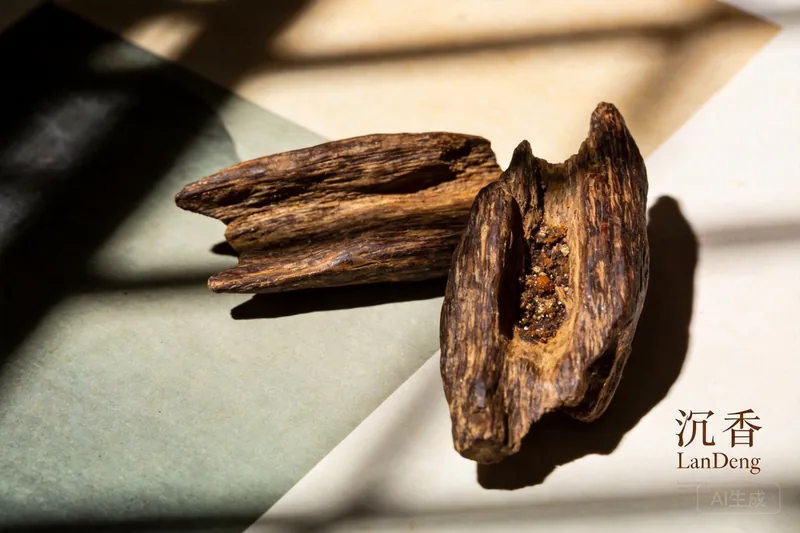
Data summary: Agarwood — chenxiang (沉香, “sinking fragrance”) in Chinese — is the resin-impregnated heartwood of Aquilaria trees, formed when the tree responds to wounding or fungal infection by saturating its wood with aromatic resin. It is one of the most prized aromatic woods in Chinese incense, perfume, and traditional practice. The name comes from the fact that the most resin-dense pieces sink in water.
Key facts
| Chinese | 沉香 (chénxiāng) |
| Botanical source | Aquilaria trees (Thymelaeaceae) — incl. A. sinensis (白木香), A. malaccensis |
| What it is | Resin-impregnated heartwood (not a distinct species) |
| Aroma | Woody, resinous, sweet, complex; develops with heat |
| Top grade | 奇楠 (qínán / “kyara-grade”) — see below |
| Key risk | Heavy adulteration (fake oil-dyed, injected, or foreign wood) |
Aroma profile
Agarwood’s scent is woody and resinous at its base, with a sweetness that varies by origin and grade. Unlike a simple floral or wood note, it develops in stages as it warms — a quality described in Chinese practice as 头香 (top note), 本香 (body), and 尾香 (dry-down). High-grade material is aromatic even unheated; ordinary material needs gentle heat to release its scent.
How agarwood forms
Healthy Aquilaria wood is pale, light, and essentially scentless. Agarwood is what happens after injury: when the tree is wounded — by insects, broken branches, lightning, or deliberate wounding — it mounts a defense, gradually saturating the damaged heartwood with resin over years or decades. The wood darkens, densifies, and becomes fragrant. Resin-bearing wood is typically found in trees older than ~20 years.
Botanical vs trade identity: “agarwood” is not a species — it is a condition of the wood. This matters for buyers: what is sold as agarwood may come from different Aquilaria species, or (fraudulently) from unrelated woods dressed up to resemble it.
Grades: the “sinking” system (沉水)
Chinese practice grades agarwood primarily by resin density, using a simple water test:
| Grade | Chinese | Meaning |
|---|---|---|
| 沉水 (chénshuǐ) | “sinks in water” | Highest resin content — most valuable |
| 半沉半浮 (bànchénbànfú) | “half-sinks” | Medium |
| floating | — | Lower (historically 黄熟香) |
奇楠 (qínán) — the top grade
Qínán (also written 伽楠 / 伽罗 / 棋楠; roughly “kyara-grade” agarwood) is the highest grade, distinguished from ordinary agarwood by a structural difference:
- Ordinary agarwood is “wood wraps oil” (木包油) — hard wood with resin veins.
- 奇楠 is “oil wraps wood” (油包木) — the wood fiber is so thoroughly transformed by resin that it becomes soft and pliable. A good piece shaves into curls and kneads into pellets (削之成卷、捏之成丸), and is fragrant even at room temperature.
奇楠 is further graded by color into five grades — 白/绿/紫/黄/黑 (white/green/purple/yellow/black). Note: the hierarchy of these color grades is disputed across sources (whether some are distinct grades or aging stages), and the etymology of “qínán” itself is uncertain. We present these as market terminology, not settled taxonomy.
Adulteration: how to spot a fake
Because genuine agarwood is expensive, it is one of the most heavily adulterated aromatic materials. Common fakes:
- Dyed white wood — non-resinous Aquilaria wood soaked in fragrance oil and dyed dark.
- Foreign woods — unrelated woods (e.g., Lauraceae, Burseraceae) treated with synthetic fragrance.
- Oil-injected / “boiled” — lower-grade agarwood pumped with resin or oil to add weight.
Practical authenticity checks (traditional + trade practice, not laboratory proof):
- Burn a small piece: genuine agarwood gives white smoke with visible oil seepage and a clean sweet aroma; fakes give black smoke and a “burnt wood / perfume” smell.
- Gentle heat (not flame) should release a complex, evolving aroma.
- The water test (沉水) is a density guide, not a guarantee — sophisticated fakes can be made to sink.
Traditional vs modern evidence
In Chinese materia medica (本草), agarwood is traditionally described as “moving qi and relieving pain” (行气止痛) and warming the middle (温中). This is traditional materia-medica language, not modern clinical evidence. We do not repeat or imply that burning agarwood treats any medical condition.
Safety
Incense combustion produces smoke and particulate matter. Burn in a well-ventilated space; avoid inhaling concentrated smoke; keep away from children and pets. See our safety guide.
Agarwood vs sandalwood
Both are premium aromatic woods, but they form differently and smell different:
| Agarwood (沉香) | Sandalwood (檀香) | |
|---|---|---|
| What it is | Resin-impregnated heartwood (forms after injury) | Fragrant heartwood (scent present in the living wood) |
| Botanical source | Aquilaria spp. | Santalum album |
| Aroma | Woody, resinous, sweet, complex | Creamy, sweet, soft, woody |
| Key buying risk | Heavy adulteration (dyed / injected wood) | Species substitution (non-album “sandalwood”) |
FAQ
What is the difference between agarwood and 奇楠? 奇楠 (qínán) is the highest grade of agarwood, not a separate plant. The difference is structural: ordinary agarwood shows a “wood wraps oil” (木包油) pattern, where hard wood carries resin veins, while 奇楠 shows “oil wraps wood” (油包木) — the fiber is so thoroughly saturated with resin that it turns soft and pliable, aromatic even at room temperature. A good piece shaves into curls and kneads into pellets. 奇楠 is further divided into color grades, though the hierarchy among those is disputed and treated here as market terminology.
Is agarwood a type of tree? No — agarwood is not a species; it is a condition of the wood. It forms inside Aquilaria trees when the tree responds to wounding or fungal infection by saturating its heartwood with resin. Healthy Aquilaria wood is pale, light, and nearly scentless; only after years of injury and resin accumulation does it darken, densify, and become fragrant. Because several Aquilaria species can produce it, the material sold as agarwood may come from different species, which is a key point for buyers checking authenticity.
Why is agarwood so expensive? Agarwood is expensive because it forms slowly and unpredictably. Resin accumulates only after a tree is wounded — by insects, broken branches, lightning, or deliberate injury — and mature resin-bearing wood typically takes decades to develop. Wild Aquilaria resources are depleted, and high-grade material is scarce, so most commercial supply today is cultivated or low-grade. The top grade, 奇楠, is rarer still, and heavy adulteration in the market further pushes up the price of genuine material.
How do I burn agarwood? The refined traditional method is indirect heat (隔火焚香): the material is rested above charcoal buried in ash on a plate, so it releases aroma without an open flame. This gentle warming avoids the charred note of direct burning and lets the complex scent develop in stages. Chips can also be warmed on an electric incense heater, which gives steadier temperature control. For high-grade material, avoid flame; ordinary material benefits from gentle, gradual heat rather than burning.
Is agarwood the same as oud? Largely yes. “Oud” (also written oudh) is the Arabic name for the same resin-impregnated Aquilaria wood called 沉香 (chénxiāng) in Chinese and jinkō or kyara in Japanese. They are one material family under different regional names. There are minor differences in grading vocabulary — for example, the top grade is called 奇楠 in Chinese and kyara in Japanese — but the underlying material is the same resin-saturated heartwood.
What does “sinking-grade” (沉水) agarwood mean? “Sinking-grade” refers to the classic Chinese density test. The most resin-saturated pieces are dense enough to sink in water, which is why the name 沉香 means “sinking fragrance.” This water test sorts material into grades: 沉水 (sinks), 半沉半浮 (half-sinks), and floating, with sinking pieces carrying the most resin and the highest value. It is a density guide, not a proof of authenticity — sophisticated fakes can be made to sink, so it should be combined with other checks.
See also: the agarwood incense guide and the full scent guide.
Evidence & Sources
Botanical identity
Source: Aquilaria sinensis in Flora of China · Aquilaria malaccensis on GBIF · Aquilaria malaccensis in the CITES species checklist. Evidence type: Established.
Traditional Chinese use
Source: this page records agarwood as traditionally described for “moving qi and relieving pain” (行气止痛) and warming the middle (温中). Evidence type: Historically documented — traditional materia-medica language, not modern clinical evidence.
Commercial grading
Source: the “sinking” water test (沉水 / 半沉半浮 / floating) and the 奇楠 (qínán) five color grades (白/绿/紫/黄/黑) are market terminology. Evidence type: Trade terminology.
Authenticity / adulteration
Source: documented fakes (dyed white wood, foreign woods, oil-injected material) and practical checks (burn test, gentle heat, water test). Evidence type: Practical screening.
Safety
Source: incense combustion produces smoke and particulate matter; burn in a well-ventilated space. Evidence type: Established.
Evidence status
| Layer | Status |
|---|---|
| Botanical identity | Established |
| Traditional use | Historically documented |
| Commercial grading | Trade terminology |
| Authenticity test | Practical screening |
| Laboratory confirmation | Requires analytical testing |
| Health claims | Not established |
Sources
- Aquilaria sinensis in Flora of China
- Aquilaria malaccensis on GBIF
- Aquilaria in the CITES species checklist
Sources: this page synthesizes Chinese-language trade/specialist sources (奇楠 grading, adulteration) and botanical references (Aquilaria sinensis). Etymology of “qínán” and the 奇楠 color-grade hierarchy remain disputed and are noted as such. This is editorial knowledge content, not medical or investment advice.