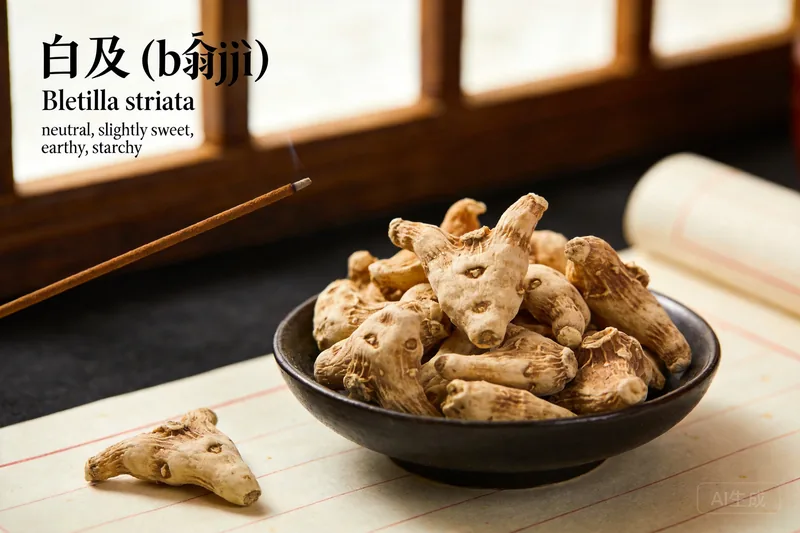
Technical answer: Bletilla — báijí (白及) in Chinese — is the dried tuber of Bletilla striata, a terrestrial orchid of the Orchidaceae family native to East Asia. It is a classical Chinese incense binder: its tuber is rich in mucilage (a water-soluble gum), which makes a natural adhesive that holds incense powders together and helps a stick or cake keep its shape and burn evenly. It is valued for function, not fragrance.
Key facts
| Chinese | 白及 (báijí), also 白芨 |
| Botanical source | Bletilla striata (family Orchidaceae) — the tuber |
| What it is | A mucilaginous root/tuber binder, not a fragrance |
| Aroma | Neutral, faintly sweet, earthy, starchy |
| Traditional role | 合香 binder — the adhesive that forms the incense |
Aroma profile
Bletilla is a binder, not a fragrance. Its dried tuber has a neutral, faintly sweet, earthy, starchy character that contributes almost no scent of its own when burned. This is exactly what a binder should do: it holds the fragrant powders together and burns without imposing its own note on the blend — the same functional logic as makko wood powder and honey in the East Asian incense tradition.
Botanical source and origin
Bletilla striata is a terrestrial orchid of the Orchidaceae family, native to East Asia — China, Japan, and Korea — and cultivated as an ornamental and for its tuber. The part used is the dried tuber, which is rich in a water-soluble mucilage. When the tuber is pounded or soaked and mixed with water, the mucilage forms a natural gum that acts as an adhesive. This is why 白及 is the classical glue of Chinese 合香.
A naming caution: 白及 (also written 白芨) is the orchid tuber Bletilla striata — a mucilaginous binder. It is not a fragrance material, and it should not be confused with fragrant roots or woods. Its role in a formula is the same functional role played by makko wood powder and honey: to bind, not to scent.
In Chinese tradition
- 合香 binder: 白及 is the classical adhesive of blended incense — pounded or soaked into a mucilage that binds loose powders into sticks, cakes, and pills that hold their shape and burn evenly. The 香乘 (Xiang Cheng) recipes specify 白及 paste (白芨作糊) to form the incense into cakes.
- A functional role: in the chief–minister–assistant–guide structure of 合香, 白及 is a guide (使) material — it binds and directs the blend rather than contributing a scent.
- Materia medica: 白及 is recorded in traditional Chinese medicine (本草綱目, 草部). This is traditional materia-medica language, not modern clinical evidence.
Traditional use vs modern evidence
The binder use is documented in the classical recipe record. Medicinal uses are traditional, not established clinical fact, and we make no medical claims. The documented, non-medical facts are botanical identity, the mucilage binder role, and the functional (not aromatic) place of 白及 in 合香.
Quality and sourcing notes
Practical points for buyers:
- Dried bletilla tuber should be clean and firm; the mucilage is released when it is pounded or soaked and mixed with water.
- 白及 is a binder, not a fragrance — judge it by how well it forms and holds an incense shape, not by scent.
- In modern incense, makko wood powder and other natural binders often serve the same role; 白及 is the classical Chinese answer.
Safety
Incense combustion produces smoke and particulate matter. Burn in a well-ventilated space, avoid inhaling concentrated smoke, and keep away from children and pets. This is editorial knowledge content, not medical advice.
FAQ
What is bletilla (白及)? The dried tuber of Bletilla striata, a terrestrial orchid native to East Asia. It is a classical Chinese incense binder: its tuber is rich in water-soluble mucilage, which forms a natural gum that holds incense powders together. It is valued for function, not fragrance — it binds and burns without imposing its own scent.
Why is bletilla used in incense? Because its mucilage is a natural adhesive. When the tuber is pounded or soaked and mixed with water, it forms a gum that binds loose fragrant powders into sticks, cakes, and pills that hold their shape and burn evenly. It is the classical glue of Chinese 合香, and the 香乘 (Xiang Cheng) recipes specify 白及 paste to form the incense. See how the 合香 blending system works.
Does bletilla add a scent to incense? No — it is a binder, not a fragrance. Its dried tuber has a neutral, faintly sweet, earthy, starchy character that contributes almost no scent when burned. That is the point: it holds the fragrant powders together without imposing its own note, the same functional logic as makko wood powder and honey. See natural binders in incense.
What part of the bletilla plant is used? The tuber — the underground storage organ of Bletilla striata. It is rich in mucilage, which is released when the tuber is pounded or soaked and mixed with water. The tuber is the part that matters, not the leaves or the flowers.
How does bletilla relate to other incense binders? It is the classical Chinese binder, playing the same functional role as makko wood powder and honey in the East Asian incense tradition. In the chief–minister–assistant–guide (君臣佐使) structure of 合香, it is a guide (使) material — it binds and directs the blend rather than contributing a scent. Modern incense often uses makko or other natural binders in its place.
See also: sandalwood, the 合香 blending system, natural binders in incense, and the full scent guide.
Evidence & Sources
Botanical identity
Source: Bletilla striata in Flora of China · Bletilla striata on GBIF. Evidence type: Established.
Traditional Chinese use
Source: 白及 as the 合香 binder — 白芨作糊 (bletilla paste) specified in 香乘 (Xiang Cheng) recipes to form incense into cakes; 白及 in the 本草綱目 草部. Evidence type: Historically documented — binder use; medicinal uses are traditional, not modern clinical evidence.
Authenticity / disambiguation
Source: 白及 (Bletilla striata, orchid tuber binder) as a functional binder, not a fragrance — distinct from fragrant woods, roots, and resins. Evidence type: Practical screening.
Safety
Source: incense combustion produces smoke and particulate matter; burn in a well-ventilated space. Evidence type: Established.
Evidence status
| Layer | Status |
|---|---|
| Botanical identity | Established |
| Traditional use | Historically documented (binder) |
| Authenticity test | Practical screening |
| Health claims | Not established |
Sources
Sources: botanical references on Bletilla striata and the 白及 binder role in 合香 (白芨作糊 in the 香乘). Bletilla is recorded as a functional binder; medicinal uses are treated as traditional, not established clinical fact. This is editorial knowledge content, not medical advice.