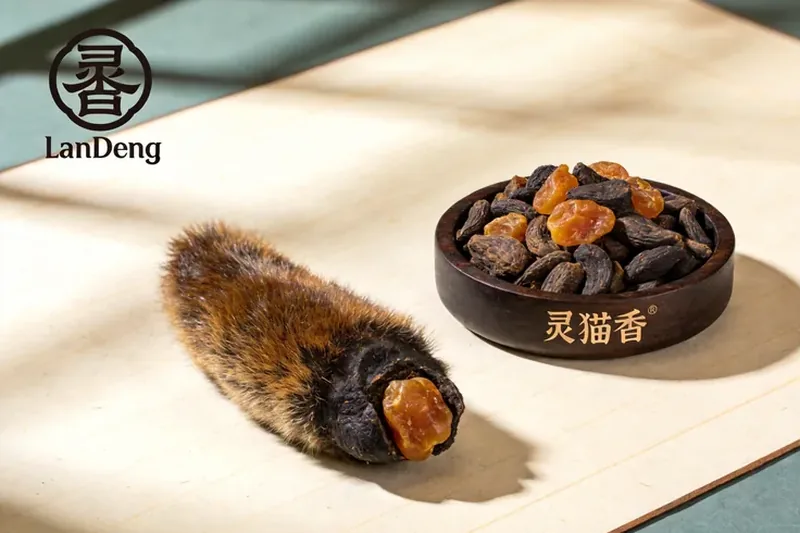
Direct answer: Civet (灵猫香, língmāoxiāng) is the glandular secretion of the civet, a small carnivore of the family Viverridae, most historically from the African civet and the small Indian civet. In classical Chinese incense and perfumery it was used as a fixative with an animalic, musky, sweet-warm scent. Like musk, it is animal-derived, not botanical, and modern perfumery has replaced it with synthetic civetone.
Key facts
| Chinese | 灵猫香 (língmāoxiāng) |
| Source | Civet (Civettictis civetta; Viverricula indica) — a glandular secretion |
| What it is | A dried animal secretion, not a plant, wood, or resin |
| Aroma | Animalic, musky, sweet, warm (aged) |
| Traditional role | Fixative and precious accent in 合香 and perfumery |
Aroma profile
Natural civet is animalic and musky at its base — sometimes described as fecal or leathery when raw — with a sweetness that develops and rounds as it ages and is diluted. Its function is that of a fixative: it does not lead a blend but anchors it from below, adding warmth, depth, and lasting power. This is the same role musk plays, which is why the two are often discussed together as the classical animal fixatives.
The animal-origin point (read this)
Civet is an animal product, which matters in three ways:
- Conservation — the small Indian civet (Viverricula indica) is CITES Appendix III–listed (India) and the African civet (Civettictis civetta) is CITES Appendix III–listed (Botswana); wild populations are subject to national protection in parts of their range.
- Welfare — historical civet collection involved keeping the animals in captivity, a practice that raises serious animal-welfare concerns and is not part of modern practice.
- Context — this page treats civet as a historical and connoisseurship reference only. Modern fragrance and incense use synthetic civetone or botanical musky substitutes, not the animal secretion.
This is a sourcing, conservation, and category fact — not a health claim.
In Chinese tradition
- 合香 (blended incense): 灵猫香 appears in classical Chinese incense and perfumery as a precious animal fixative, used sparingly to round and extend a blend — the same logic as 麝香 (musk).
- Perfume and personal scent: classical records describe civet as a lasting personal and clothing scent, valued for its fixative power.
- Materia medica: 灵猫香 appears in traditional Chinese medicine with described uses. This is traditional materia-medica language, not modern clinical evidence.
Traditional use vs modern evidence
The classical references document civet’s aromatic and fixative role and a traditional medicinal reputation. We treat the medicinal descriptions as traditional, not established clinical fact, and make no medical claims. The documented, non-medical facts are the animal source, the conservation status, and the historical use as a precious fixative. This page describes its aromatic and cultural role only.
Conservation and sourcing notes
Practical points for anyone researching or buying:
- Genuine natural civet is an animal product from wild civets with CITES and welfare implications. This encyclopedia documents it as historical and connoisseurship context only — not as a material to source.
- What is sold as “civet” in contemporary fragrance is almost always synthetic civetone (the principal odor compound of natural civet) or a musky substitute, rather than the animal secretion.
- The label “civet” on a modern product should be read as a scent descriptor, not a claim of animal origin.
Safety
Incense combustion produces smoke and particulate matter. Burn in a well-ventilated space, avoid inhaling concentrated smoke, and keep away from children and pets. Note that most “civet” in modern fragrance is synthetic, which is a sourcing and animal-welfare matter, not a safety claim. This is editorial knowledge content, not medical advice.
FAQ
Is civet a plant? No — civet is animal-derived. It is the glandular secretion of the civet, a small carnivore of the family Viverridae, historically most often the African civet (Civettictis civetta) and the small Indian civet (Viverricula indica). This distinguishes it from the botanical materials that make up most of this encyclopedia, and it is why the distinction matters for sourcing, conservation, and labeling. Most “civet” in modern fragrance is synthetic, not the animal secretion.
Is natural civet still used in incense or perfume? Rarely, and with serious conservation and animal-welfare constraints. The small Indian civet (Viverricula indica) is CITES Appendix III–listed (India) and the African civet (Civettictis civetta) is CITES Appendix III–listed (Botswana), and historical collection involved keeping animals in captivity. As a result, modern perfumery almost entirely uses synthetic civetone — the principal odor compound of natural civet — instead. When a modern product says “civet,” it almost always refers to this synthetic or a musky substitute.
What does civet smell like? Animalic and musky at its base — sometimes described as fecal or leathery when raw — with a sweetness that develops and rounds as it ages and is diluted. Its role is that of a fixative: it anchors and extends a blend from below rather than leading with a bright note. This is the same logic as musk, which is why the two classical animal fixatives are often discussed together.
Why is this page a “historical reference only”? Because genuine natural civet is an animal product from wild civets, with CITES listing and animal-welfare implications that make sourcing it today problematic. The page therefore documents civet as a matter of historical and connoisseurship context — what it was, how it was used, and why it mattered — rather than as a material to buy. This is a transparency choice, not a judgment on historical practice.
How does civet relate to musk? Both are classical animal fixatives: musk is the secretion of the male musk deer (genus Moschus), and civet is the glandular secretion of civets (Civettictis civetta / Viverricula indica). They played the same structural role in classical perfumery — anchoring and extending a blend from below — and both are now almost entirely replaced by synthetics in modern practice. This encyclopedia treats both as historical and connoisseurship references only.
See also: musk, ambergris, castoreum and the full scent guide.
Evidence & Sources
Source identity
Source: Civettictis civetta (African civet) on GBIF · Viverricula indica (small Indian civet) on GBIF · Viverricula indica in the CITES species checklist — civet is an animal secretion, not botanical. Evidence type: Established.
Traditional Chinese use
Source: 灵猫香 recorded as a precious animal fixative in classical Chinese 合香 and perfumery, parallel to 麝香 (musk); 灵猫 in the 本草綱目 獸部. Evidence type: Historically documented — traditional materia-medica language, not modern clinical evidence.
Conservation / sourcing
Source: CITES Appendix III listings (Viverricula indica — India; Civettictis civetta — Botswana) and the natural-vs-synthetic market note (civetone). Evidence type: Trade and regulatory terminology.
Safety
Source: incense combustion produces smoke and particulate matter; burn in a well-ventilated space. Evidence type: Established.
Evidence status
| Layer | Status |
|---|---|
| Source identity | Established (animal, not botanical) |
| Traditional use | Historically documented |
| Conservation status | Established (CITES Appendix III) |
| Health claims | Not established |
Sources
- Civettictis civetta (African civet) on GBIF
- Viverricula indica (small Indian civet) on GBIF
- Viverricula indica in the CITES species checklist
Sources: references on civet (civet secretion, fixative role, CITES Appendix III status, and synthetic civetone substitutes). This page documents civet as historical and connoisseurship context only, not as a material to source. Medicinal uses are treated as traditional, not established clinical fact. This is editorial knowledge content, not medical advice.