At a glance: A 香方 (xiāngfāng) is a classical Chinese incense recipe — a structured formula for a compound incense (合香), recorded in the canonical manuals (香谱). The recipes name the ingredients and their proportions, and the best ones reveal the 君臣佐使 (chief–minister–assistant–guide) structure behind the blend.
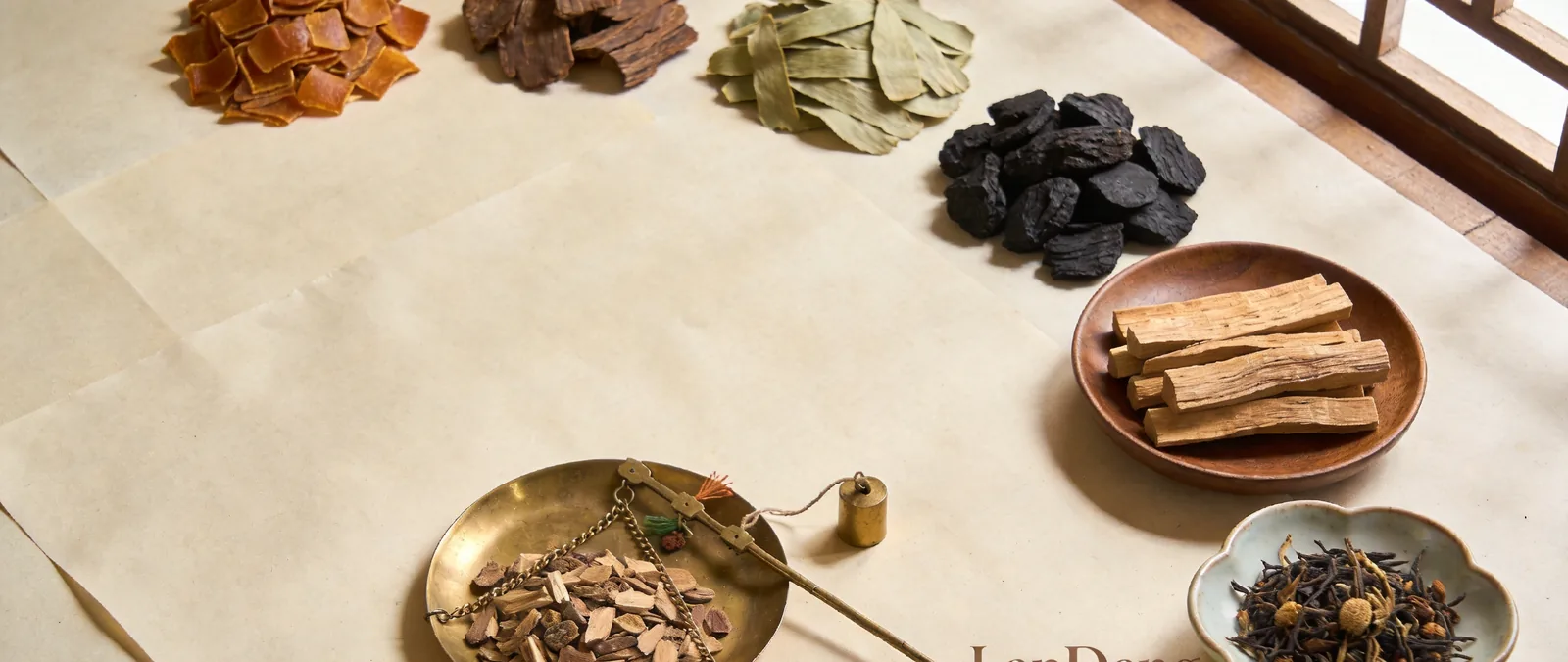
Key facts: This cluster translates a selection of classical and revival recipes into English — most of which have almost no English coverage anywhere. That is the point: the manuals are the deepest, least-translated part of Chinese incense culture.
What a 香方 Actually Is
A 香方 is not a marketing description of a scent. It is a recipe — a list of materials, their proportions, and the processing method (grinding, steaming, aging, forming). The classical canon (陈氏香谱, 洪芻香谱, 香乘) is essentially a recipe book, hundreds of entries long.
The English internet almost entirely misses this. Searching for “Chinese incense recipe” returns modern DIY blends, not the classical canon. This cluster is a small, honest bridge.
The Recipes in This Cluster
| Recipe | Attributed to | Signature note |
|---|---|---|
| 雪中春信 (Snow in Spring) | 苏轼 (legend) | Camphor’s cool “snow” against warm woods |
| 江南李主帐中香 (The Lord of Jiangnan’s Bedchamber) | 李煜 (Li Yu) | Goose-pear steamed into agarwood |
| 寿阳公主梅花香 (Shouyang Princess’s Plum) | 寿阳公主 (legend) | Plum and herbal notes over sandalwood |
| 花蕊夫人衙香 (Huarui Furen’s Court Incense) | 花蕊夫人 | Rich agarwood–sandalwood–musk court blend |
| 柏子香 (Cypress-Seed Incense) | — (folk/scholarly) | Humble roasted cypress seed |
| 荷香 (Lotus Incense) | 花蕊夫人 (legend) | Lotus over agarwood and sandalwood |
| 二苏旧局 (The Two Sus’ Old Gathering) | 陈云君 (contemporary) | A modern revival of a scholar’s study |
How to Read a Recipe Honestly
Three rules apply to every page in this cluster:
- Attribution is usually legend. “苏轼,” “寿阳公主,” “花蕊夫人” are cultural markers, not documented authorship. Treat the name as the recipe’s title, not its author.
- Proportions vary by dynasty. The historical weights (两, 钱) had different gram values over time, and the same recipe survives in multiple versions. Read the ratios, not the exact grams.
- Some are modern, not ancient. 二苏旧局 is a contemporary revival, written in the classical idiom. It is not a 香谱 original.
Historical Weights and Unit Conversion
The classical recipes weigh ingredients in historical Chinese units:
| Unit | Relation | Approx. gram value (Song–Ming) |
|---|---|---|
| 两 (liǎng) | the base unit | on the order of 37 g |
| 钱 (qián) | 1/10 of a 两 | about 3.7 g |
| 分 (fēn) | 1/10 of a 钱 (1/100 of a 两) | about 0.37 g |
Some recipes also count pieces (枚) — as in “一百枚白梅” (a hundred white plums) — while others use the open-ended “不计多少” (however many), as 柏子香 does. At least one recipe in this cluster (二苏旧局) is contemporary and records no fixed ratio at all.
The crucial caveat: the gram value of the 两 was not constant. It varied by dynasty — roughly 31–41 g across periods — and by region and purpose, so any gram conversion is an approximation. The ratios between ingredients are the reliable part of a recipe: “一两沉香, 一钱檀香” is a 10:1 ratio, and that ratio — not the gram count — is the recipe’s real content. Every recipe page in this cluster states its proportions (or marks them unverified) and applies this same conversion note.
How to Read the 君臣佐使 Structure
Every recipe here is deconstructed by role — 君 (chief), 臣 (minister), 佐 (assistant), 使 (guide) — the same logic as a Chinese herbal formula. Four questions reveal the structure of any 合香 recipe:
- What carries it? (the chief — almost always a wood)
- What rounds it? (the minister — a smaller wood or resin)
- What names it? (the assistant — the signature note)
- What binds it? (the guide — often a binder or a process)
For the full framework, see the 合香 blending system.
The Author’s Take
Position: The classical recipe canon is the single most under-served topic in English-language incense content — and translating it honestly is a moat no product-site competitor will bother to cross.
Reasoning:
- Competitors sell products and attach wellness claims; the 香谱 canon is a body of technical and cultural knowledge they have no incentive to translate.
- Honest translation — attribution flagged, proportions marked as variable — is harder and rarer than romanticized retellings, which is exactly why it is worth doing.
This is the author’s editorial view and experience — not a verified fact.
Verification Notes
- Recipes are drawn from 香乘 (Xiang Cheng, Ming) and related manuals, with attribution and version-variation flagged where sources conflict.
- These are cultural-historical records, not therapeutic formulas — no recipe here makes a health claim.
See How Incense Is Made: From Wood and Resin to Stick and Coil for the full guide.
Cluster directory
- 柏子香 (Cypress-Seed Incense): The Humble Scholar’s Incense
- 二苏旧局 (The Two Sus’ Old Gathering): A Modern Revival Recipe
- 花蕊夫人衙香 (Huarui Furen’s Court Incense): Recipe
- 江南李主帐中香 (The Lord of Jiangnan’s Bedchamber Incense): Recipe
- 荷香 (Lotus Incense): The Symbol Over the Flower
- 寿阳公主梅花香 (Shouyang Princess’s Plum Incense): Recipe
- 雪中春信 (Snow in Spring): The Recipe and Its Cool ‘Snow’ Note
FAQ
Q: What is a 香方?
A 香方 (xiāngfāng) is a classical Chinese incense recipe — a structured formula for a compound incense (合香) recorded in the canonical manuals (香谱). Unlike a modern scent description, a 香方 is a working recipe: it names the ingredients, gives their proportions, and specifies the processing — grinding, steaming, aging, and forming. The best examples also reveal the 君臣佐使 (chief–minister–assistant–guide) structure behind the blend, the same logic as a Chinese herbal formula. The classical canon — 陈氏香谱, 洪芻香谱, and 《香乘》 — is essentially a recipe book hundreds of entries long, and almost none of it has been translated into English.
Q: Are these recipes real or invented?
The recipes are real, recorded in the classical manuals, but the famous attributions attached to them are usually legend. Names like 苏轼 (Su Shi), 寿阳公主 (Shouyang Princess), and 花蕊夫人 (Huarui Furen) function as cultural markers and recipe titles rather than documented authorship — there is rarely a reliable record that the named person actually composed the formula. The proportions also vary: the same recipe survives in multiple versions, and the historical weights (两, 钱) had different gram values across dynasties. So the honest reading treats the name as a title and the ratios as the reliable content, while flagging the attribution as traditional.
Q: Can I actually make these at home?
In principle, yes, the recipes are reproducible, but with important caveats. The historical weights are not fixed gram values — the 两 varied across dynasties, so you should read the ratios between ingredients rather than trying to convert to exact grams. Some materials are also scarce or restricted: genuine musk and 奇楠-grade agarwood are rare, expensive, and in some cases subject to trade controls. A few recipes are contemporary revivals rather than classical originals. For these reasons, the cluster treats the recipes primarily as historical and cultural study — a way to understand the blending structure — rather than as a precise modern do-it-yourself specification.
Q: Why is there almost no English coverage of this?
The manuals are extensive works of classical Chinese that have never been systematically translated into English, and the task is substantial: hundreds of entries across 陈氏香谱, 洪芻香谱, and 《香乘》, written in a dense classical idiom with specialized terminology (合香, 奇楠, 沉水) that has no canonical English rendering. Product-focused competitors have no incentive to do this work — they sell scents and attach wellness claims, not translate a technical canon. As a result, an English search for “Chinese incense recipe” mostly returns modern DIY blends, not the classical record. That gap is exactly the opportunity this cluster addresses.
Sources
- 香乘 (Xiang Cheng), 周嘉胄 (Ming) — the primary recipe source. Full text on Wikisource.
- 洪芻香谱 (Hong Chu’s Manual), Song — the canonical manual. Full text on Wikisource.
- 陈氏香谱 (Chen’s Incense Manual) — the Song-dynasty canon.
- 燕居香语 (陈云君) — the contemporary manual source for 二苏旧局.
- Compendium of Materia Medica (本草綱目) on ctext.org
Related Resources
Natural next step: learn the structure that every recipe here uses — see the 合香 blending system.