Data summary: 柏子香 is the everyman’s incense of the Chinese tradition — made from the seeds of the oriental arborvitae (Platycladus orientalis, 侧柏), briefly blanched, soaked in wine and honey, and dried. It is deliberately cheap and simple, the scholar’s counterpoint to the court’s expensive 沉檀麝 blends.
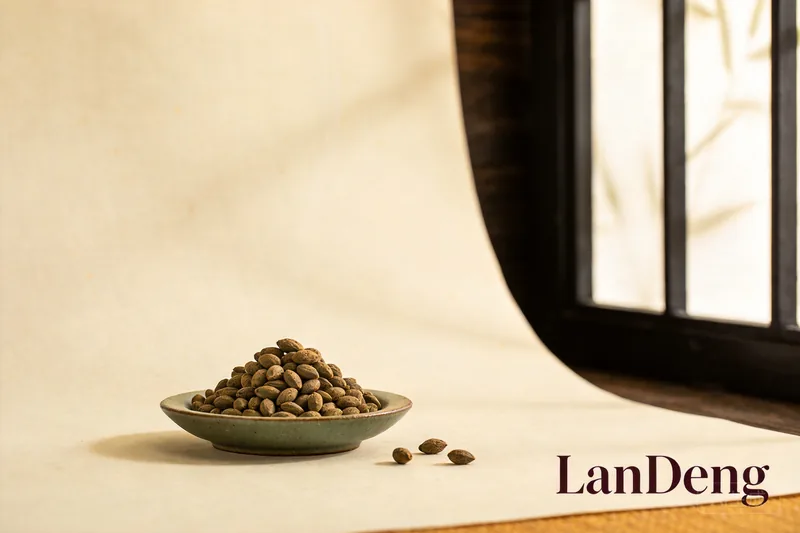
Key facts: 柏子香 is a single-material (or near-single-material) incense, unlike the complex 合香 blends. Su Shi famously paired it with simple food: “铜炉烧柏子,石鼎煮山药” — a bronze burner of cypress seed, a stone pot of yam.
The Recipe (香乘 version)
柏子实不计多少,带青色,未开破者 — cypress seeds, however many, still green and unopened. Scald in boiling water (沸汤焯), soak in wine, seal with honey for seven days (蜜封七日), take out, and dry in the shade before burning.
| Role | Ingredient | Job in the blend |
|---|---|---|
| 君 (chief) | 柏子 cypress seed | The whole scent — a single humble material |
| 臣 (minister) | — | (none — this is a single-material incense) |
| 佐 (assistant) | honey + wine soak | Softens and sweetens the roasted-seed character |
| 使 (guide) | roasting / drying | The processing that develops the aroma |
Proportions: Deliberately Unmeasured
The 香乘 records 柏子香 with no fixed quantity: 柏子实不计多少 — “cypress seeds, however many.” This is not a gap in the surviving text; it is the point. The recipe is the tradition’s most un-fussy formula, so the manual does not bother to weigh it. There is no 两/钱 ratio to recover, and none should be invented — the honest rendering is “as many green, unopened seeds as you have, scalded, wine-soaked, honey-sealed, and dried.”
Where a quantity does appear in related folk versions, it is the honey-and-wine treatment rather than the seed count that varies. Treat 柏子香 as proportions unverified by design — the source deliberately gives none, so there is nothing to convert.
Unit conversion (for the recipes that do weigh): classical Chinese incense recipes use historical weights — one 两 (liǎng) on the order of 37 g in the Song–Ming period, divided into 10 钱 (qián) of about 3.7 g each, each 钱 into 10 分 (fēn) of about 0.37 g. The gram value of the 两 varied by dynasty, so read the ratios, not the grams. See the recipe library for the full note.
The Point: Not Everything Was Expensive
柏子香 matters precisely because it is not precious. It is the reminder that Chinese incense was not only agarwood and musk — it was also a scholar burning roasted seeds in a quiet study. Su Shi, the figure most associated with 雪中春信’s legend, is also the one recorded burning 柏子 with a humble meal.
The contrast — 花蕊夫人’s opulent court blend on one side, a scholar’s cypress seed on the other — is the full social range of the tradition in two recipes.
The Honest Caveats
- The method survives with regional variation (some soak in 黄酒/rice wine, some add nothing but honey).
- Modern DIY sources add ingredients (柏木粉, binders) to form sticks; the classical version is loose roasted seed.
- “柏子” here is oriental arborvitae seed (侧柏), not the unrelated “cypress” of other traditions.
The Author’s Take
Position: 柏子香 is the most instructive recipe for a modern reader, because it proves the tradition was a practice, not a luxury.
Reasoning:
- A scent made from a tree seed, wine, and honey requires no rare material — only patience and process.
- It is the honest antidote to the “agarwood or nothing” framing of most English incense content.
This is the author’s editorial view and experience — not a verified fact.
Verification Notes
- The formula is drawn from 香乘 (Xiang Cheng) via ctext.org and 识典古籍.
- The Su Shi line (“铜炉烧柏子”) is a well-attested literary reference; no therapeutic claim is made.
See Chinese Incense Recipes (香方): Translated from the Classical Manuals for the full guide.
FAQ
Q: What is 柏子香?
柏子香 (bǎi zǐ xiāng, “cypress-seed incense”) is the humble, deliberately simple incense of the Chinese tradition, made from the seeds of the oriental arborvitae (Platycladus orientalis, 侧柏). The classical recipe scalds the green, unopened seeds in boiling water, soaks them in wine, seals them with honey for about seven days, and then dries them in the shade before burning. It is the scholar’s counterpoint to the court’s expensive 沉檀麝 blends — a single, cheap material transformed by patience and process. Su Shi famously paired it with a simple meal: “铜炉烧柏子,石鼎煮山药” (a bronze burner of cypress seed, a stone pot of yam).
Q: Is it a single-material incense?
Yes, essentially. The cypress seed is the whole scent, and the honey and wine are a processing treatment — a soak that softens and sweetens the roasted-seed character — rather than co-formulated scent materials. This makes it very different from a complex 合香 blend, which combines several ingredients in a structured 君臣佐使 arrangement with a chief, ministers, assistants, and guides. 柏子香 has no such layering; it is one humble material with a simple, honest preparation. That simplicity is precisely the point: the tradition’s most un-fussy formula, with the source itself declining to specify a fixed quantity.
Q: Why does it matter?
It matters because it proves Chinese incense was a practice, not a luxury. The same tradition that produced 花蕊夫人’s opulent agarwood-and-musk court blend also produced a scholar burning roasted tree seeds in a quiet study, and both are equally part of the record. 柏子香 is the reminder that incense did not require rare or expensive materials — only a common seed, wine, honey, and the patience to process them. For a modern reader it is the honest antidote to the “agarwood or nothing” framing that dominates much English-language incense content, showing the full social range of the tradition in a single recipe.
Q: Can I make it?
In principle, yes — the method is straightforward: scald the green, unopened seeds in boiling water, soak them in wine, seal with honey for about seven days, and dry in the shade before burning. Two caveats apply. First, this is a loose roasted material, not a modern stick; you would burn the seeds on charcoal or an electric heater rather than light a pressed stick. Second, the source gives no fixed quantity (“however many” seeds), and regional versions vary in the wine-and-honey treatment, so treat the proportions as flexible by design. It is an easy, honest entry into the classical method for anyone with access to the seeds.
Sources
- 香乘 (Xiang Cheng), 周嘉胄 (Ming) — the 柏子香 formula. Full text on Wikisource.
- 苏轼 (Su Shi), 《十月十四日以病在告独酌》 — “铜炉烧柏子,石鼎煮山药.”
- Compendium of Materia Medica (本草綱目) on ctext.org
- Platycladus orientalis in Flora of China
Related Resources
Natural next step: see the opulent counterpoint in 花蕊夫人衙香.