Direct answer: 江南李主帐中香 is a classical 合香 attributed to 李煜 (Li Yu), the last ruler of the Southern Tang — hence “江南李主” (“Lord of Jiangnan”). Its most famous version steams agarwood and a trace of sandalwood inside hollowed goose pears, infusing the wood with a clean, sweet fruit note.
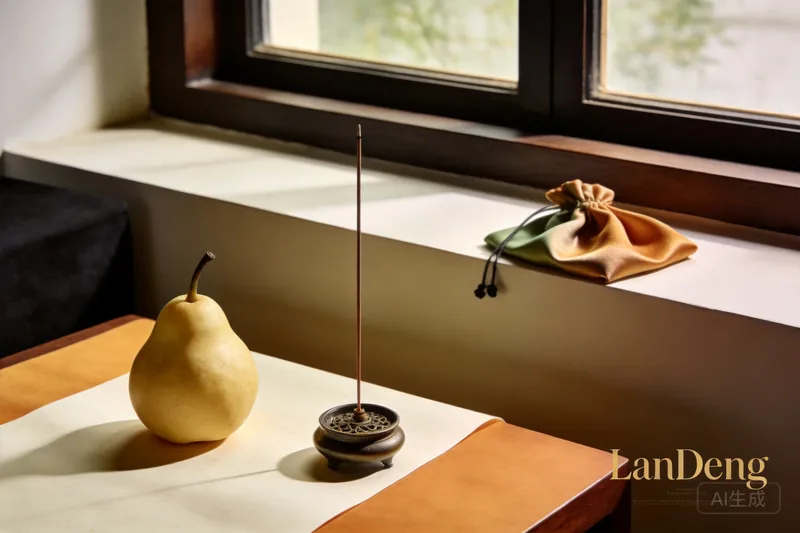
Key facts: This is one of the best-documented classical recipes, with several versions in the 香乘. Its “assistant” is a fruit, and its “guide” is a process (steaming and aging) rather than an ingredient.
The Recipe (鹅梨 / goose-pear version)
沉香末一两,檀香末一钱,鹅梨十枚 — one liǎng agarwood powder, one qián sandalwood powder, ten goose pears. Hollow each pear like a jar, fill with the powders, seal with the pear’s top, steam three times (蒸三溜), strip the peel, grind and blend, then age (久窨) before burning.
| Role | Ingredient | Job in the blend |
|---|---|---|
| 君 (chief) | 沉香 agarwood | The deep, resinous backbone — the formula exists to carry it |
| 臣 (minister) | 檀香 sandalwood | A trace (1/10 by weight) that warms and rounds the agarwood |
| 佐 (assistant) | 鹅梨 goose pear | The fruit’s juice lends a clean, sweet top note |
| 使 (guide) | steaming + aging | The process that fuses the fruit into the wood |
Other Recorded Versions (with Proportions)
The 香乘 records several 帐中香 recipes. The goose-pear version above is the most famous; the manual also gives these, with full proportions:
Version 2 — pear juice steamed into agarwood (又方一): 沉香一两 (1 liǎng agarwood, cut to wick-sized pieces), 鹅梨一窗 (one goose pear, minced to juice). Steam in a silver vessel three times until the pear juice is dry.
Version 3 — the resin-and-spice form (又方二):
| Ingredient | Quantity |
|---|---|
| 沉香 (agarwood) | 四两 (4 liǎng) |
| 檀香 (sandalwood) | 一两 (1 liǎng) |
| 麝香 (musk) | 一两 (1 liǎng) |
| 龙脑 (borneol) | 半两 (0.5 liǎng) |
| 马牙香 (a resin/aromatic) | 一分 (1 fēn) |
Cut fine without sieving, bind with refined honey, and burn. A further 香乘 entry soaks agarwood in storax oil (苏合油) for a hundred days and finishes it with rose water (蔷薇水).
The three versions show the same formula idea — agarwood as the body — realized three ways: fruit-infused, juice-steamed, or resin-and-spice. The goose-pear version is the most famous because its 10:1:10 ratio (one 两 agarwood, one 钱 sandalwood, ten pears) makes the chief’s dominance concrete.
Unit conversion: one 两 (liǎng) was on the order of 37 g in the Song–Ming period — the exact gram value varied by dynasty, roughly 31–41 g across periods — divided into 10 钱 (qián) of about 3.7 g each, each 钱 into 10 分 (fēn) of about 0.37 g. Read the ratios, not the grams: the famous goose-pear version is a 10:1 agarwood-to-sandalwood ratio, and Version 3 is a 4:1 agarwood-to-sandalwood ratio with musk equal to the sandalwood.
Why the Ratio Matters
Note the economy: ten pears and a full 两 of agarwood, against a single 钱 of sandalwood. The chief dominates; the minister is a trace. This is the disciplined logic of 合香 — a little support, not a chorus.
The Honest Caveats
- The 李煜 attribution is traditional, widely repeated, but not a signed historical document.
- The historical 两/钱 weights varied by dynasty — read the ratio, not the grams.
- 鹅梨 refers to an old pear variety (likely a type of 鸭梨); the exact cultivar is not fixed today.
The Author’s Take
Position: This recipe is the single best teaching example of 合香 — because the “assistant” is a pear and the “guide” is a steaming step, it makes the role system impossible to romanticize away.
Reasoning:
- When the signature note is a fruit, the formula’s structure becomes visible instead of hidden behind “precious woods.”
- The 10:1:1 pear-to-wood ratio is a concrete, memorable illustration of the chief’s dominance.
This is the author’s editorial view and experience — not a verified fact.
Verification Notes
- The formula is drawn from 香乘 (Xiang Cheng) and the Song-dynasty 香谱, via ctext.org, 识典古籍, and secondary Chinese sources (Jiemian, Sohu).
- The attribution is flagged as traditional; no therapeutic claim is made.
See Chinese Incense Recipes (香方): Translated from the Classical Manuals for the full guide.
FAQ
Q: What is 江南李主帐中香?
A bedchamber incense attributed to 李煜 (Li Yu), the last ruler of the Southern Tang — “江南李主” means “the Lord of Jiangnan.” Its most famous version steams agarwood powder and a trace of sandalwood inside hollowed goose pears, so the wood absorbs a clean, sweet fruit note before it is burned. The 香乘 records several versions of the formula, which is why it is one of the best-documented classical recipes. The Li Yu attribution is traditional and widely repeated, but not a signed historical document, so the page treats it as a label rather than verified authorship.
Q: Why use a pear?
The pear is the formula’s assistant (佐), and it works by infusion rather than by adding its own note. The agarwood powder is packed into hollowed pears, the fruit is sealed and steamed three times, and the juice carries a clean, sweet, slightly cool character into the wood. It is an early and unusually clear example of fruit used as an incense ingredient — showing that an assistant can be a fruit, not another precious wood or resin. The pear also lets the recipe’s structure show through: the agarwood chief stays dominant, with the fruit shaping only the top note.
Q: What are the other versions?
The 香乘 gives several. One steams minced goose-pear juice into agarwood wick pieces three times in a silver vessel. A second uses a resin-and-spice base — four liǎng agarwood, one liǎng sandalwood, one liǎng musk, half a liǎng borneol, and a trace of a resin called 马牙香, bound with refined honey. Another entry soaks agarwood in storax oil (苏合油) for a hundred days and finishes it with rose water (蔷薇水). All three realize the same idea — agarwood as the body — through different processes: fruit-infused, juice-steamed, or resin-and-spice.
Q: Is the Li Yu attribution certain?
No. It is traditional and widely repeated, but there is no signed, verifiable document proving Li Yu authored the recipe. The connection is plausible — Li Yu was the last Southern Tang ruler and a famous poet, and “江南李主” clearly points to him — but the formula survives in Ming-era manuals like the 香乘, compiled centuries after his death. The page therefore treats the attribution as a well-established label rather than confirmed authorship, and notes the same caution applies to the pear variety, which is not fixed today.
Sources
- 香乘 (Xiang Cheng), 周嘉胄 (Ming) — the 帐中香 recipes (multiple recorded versions). Full text on Wikisource.
- 陈氏香谱 (Chen’s Incense Manual) — the “江南李主帐中香” second formula.
- 本草綱目 — the materia medica documenting agarwood, sandalwood, and the other materials in the formula. Full text on ctext.org.
Related Resources
Natural next step: see how fakes exploit agarwood’s value in the authentication database.