Key takeaway: 寿阳公主梅花香 is a classical plum-blossom 合香 attributed to 寿阳公主 (Princess Shouyang) of the Southern Dynasties — a legendary figure tied to the “梅花妆” (plum-blossom makeup) story. The recipe builds a plum note from sandalwood, herbal tones, and 白梅 (white plum), not from the flower’s scent alone.
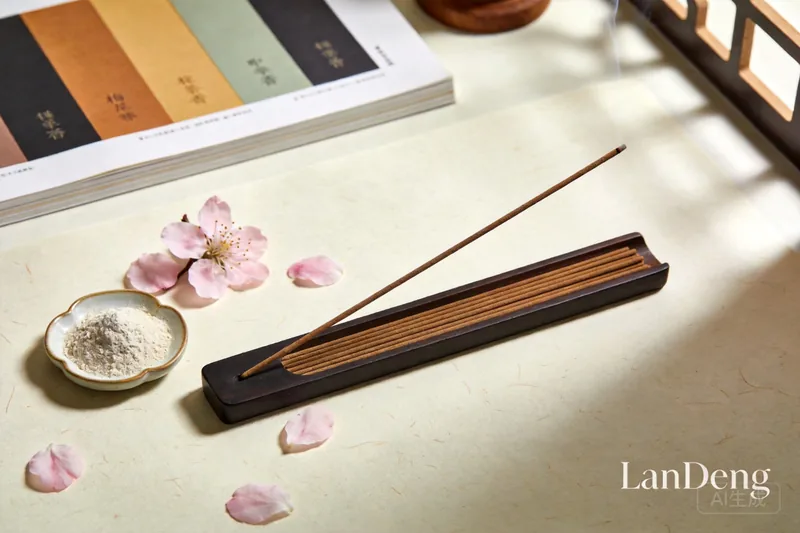
Key facts: “梅花香” (plum incense) survives in many versions in the 香乘; 寿阳公主梅花香 is the most famous named one. The plum character is an accord — built from layered ingredients — not a single flower.
The Recipe (香乘 version)
甘松半两、白芷半两、牡丹皮半两、藁本半两、茴香一两、丁皮一两、檀香一两、降真香二钱、白梅一百枚 — spikenard (甘松), angelica (白芷), peony bark (牡丹皮), lovage (藁本), fennel (茴香), clove bark (丁皮), sandalwood (檀香), rosewood (降真香), and a hundred white plums (白梅). Except the clove bark, roast everything dry, grind to a coarse powder, and age (窨) in a sealed vessel for a month before burning.
| Role | Ingredient | Job in the blend |
|---|---|---|
| 君 (chief) | 檀香 sandalwood | The warm woody body |
| 臣 (minister) | 甘松 / 白芷 / 藁本 spikenard, angelica, lovage | Herbal, slightly medicinal middle tones |
| 佐 (assistant) | 白梅 + 牡丹皮 white plum, peony bark | The tart-sweet “plum” character — the accord’s signature |
| 使 (guide) | 茴香 / 丁皮 / 降真香 fennel, clove bark, rosewood | Spice and fixative notes that bind and lift |
Proportions and Unit Conversion
The recorded proportions (香乘, 卷十八):
| Ingredient | Quantity |
|---|---|
| 甘松 (spikenard) | 半两 (0.5 liǎng) |
| 白芷 (angelica) | 半两 (0.5 liǎng) |
| 牡丹皮 (peony bark) | 半两 (0.5 liǎng) |
| 藁本 (lovage) | 半两 (0.5 liǎng) |
| 茴香 (fennel) | 一两 (1 liǎng) |
| 丁皮 (clove bark) | 一两 (1 liǎng) |
| 檀香 (sandalwood) | 一两 (1 liǎng, 不见火 not fired) |
| 降真香 (rosewood/lakawood) | 二钱 (2 qián) |
| 白梅 (white plum) | 一百枚 (100 pieces) |
The ratio reads clearly: the four herbal top-and-middle ingredients run at half a 两 each, the spice-and-wood backbone at a full 两 each, the accent resin at two 钱, and the plum counted in pieces rather than weight.
Unit conversion: one 两 (liǎng) was on the order of 37 g in the Song–Ming period — the exact gram value varied by dynasty, roughly 31–41 g across periods — and it divides into 10 钱 (qián) of about 3.7 g each, each 钱 into 10 分 (fēn) of about 0.37 g. Because the gram value of the 两 shifted over time, read the ratios, not the grams: here the 1:1:1:1 backbone against the 半两 herbs, and the 2-钱 降真香 as the smallest weighed accent.
The Plum Is an Accord, Not a Flower
The recipe does not rely on plum flowers alone. The “plum” character is constructed — a tart-sweet note from 白梅 (pickled/dried plum) over warm wood and herbal tones. This is the same compositional logic as a perfumer building a “floral” accord from materials that are not the flower.
This is why 梅花香 has so many versions: each is a different construction of the same idea.
The Honest Caveats
- The 寿阳公主 attribution is legend. The plum-blossom-makeup story (《太平御览》) is a romantic origin tale, not authorship.
- Many versions. The 香乘 records 梅花香一/二/三 and 寿阳公主梅花香 separately; sources do not agree on one formula.
- Historical weights vary — read the ratios, not the grams.
The Author’s Take
Position: 寿阳公主梅花香 teaches the most important lesson in classical incense — that a “floral” scent is built, not picked.
Reasoning:
- The plum character is an accord of plum, peony bark, and warm woods — exactly how modern perfumery works, centuries earlier.
- The romantic princess attribution is charming but beside the point; the craft is in the construction.
This is the author’s editorial view and experience — not a verified fact.
Verification Notes
- The formula is drawn from 香乘 (Xiang Cheng), 卷十八, via ctext.org, 识典古籍, and wikisource.
- Attribution and version-variation are flagged; no therapeutic claim is made.
See Chinese Incense Recipes (香方): Translated from the Classical Manuals for the full guide.
FAQ
Q: What is 寿阳公主梅花香?
A classical plum-blossom compound incense attributed, legendarily, to 寿阳公主 (Princess Shouyang) of the Southern Dynasties. The recipe builds its plum character as an accord rather than from plum flowers: sandalwood forms the warm woody body, spikenard, angelica, and lovage supply herbal middle tones, and 白梅 (white plum) with peony bark gives the tart-sweet plum signature. The 香乘 records the formula with proportions, and it exists alongside several other 梅花香 versions. The princess attribution is a romantic legend tied to the plum-blossom makeup story, not documented authorship.
Q: Does it use real plum flowers?
Not as the source of the scent. The “plum” character is constructed — an accord of 白梅 (dried or pickled white plum) over warm wood and herbal tones. Plum flowers themselves are too delicate to carry a scent through burning, so the recipe reaches for the tart-sweet fruit note instead. This is the same compositional logic as a perfumer building a floral impression from materials that are not the flower. The result is recognizable as “plum” because the accord is engineered that way, which is why the page’s central lesson is that a floral scent in this tradition is built, not picked.
Q: Why are there so many “plum incense” recipes?
Because “梅花香” (plum incense) is an idea, not one fixed formula, and each version is a different construction of that idea. The 香乘 records several — 梅花香一, 二, and 三, alongside 寿阳公主梅花香 — and the sources do not agree on a single recipe. Each version arranges a slightly different set of woods, herbs, and plum materials to reach the same plum impression. This variation is normal in the classical manuals: a named incense was a flexible theme that makers adapted, not a standardized product with one authoritative formula.
Q: Did Princess Shouyang really make it?
The attribution is traditional legend, not documented fact. Princess Shouyang is famous for the 梅花妆 (plum-blossom makeup) origin story, in which a plum blossom stuck to her forehead and became a fashion; that tale comes from the Song-era encyclopedia 《太平御览》. The incense recipe borrows her name to evoke romance and court elegance, but there is no historical evidence she composed the blend. The page treats the princess as the legendary namesake — the craft and the accord are the real subject, and the charming attribution is beside the point.
Sources
- 香乘 (Xiang Cheng), 周嘉胄 (Ming), 卷十八 — the 寿阳公主梅花香 formula. Full text on Wikisource.
- 《太平御览》 — the 梅花妆 origin legend.
- 本草綱目 — the materia medica documenting sandalwood, angelica, peony bark, and the formula’s other materials. Full text on ctext.org.
Related Resources
Natural next step: see the full recipe library in Chinese Incense Recipes (香方).