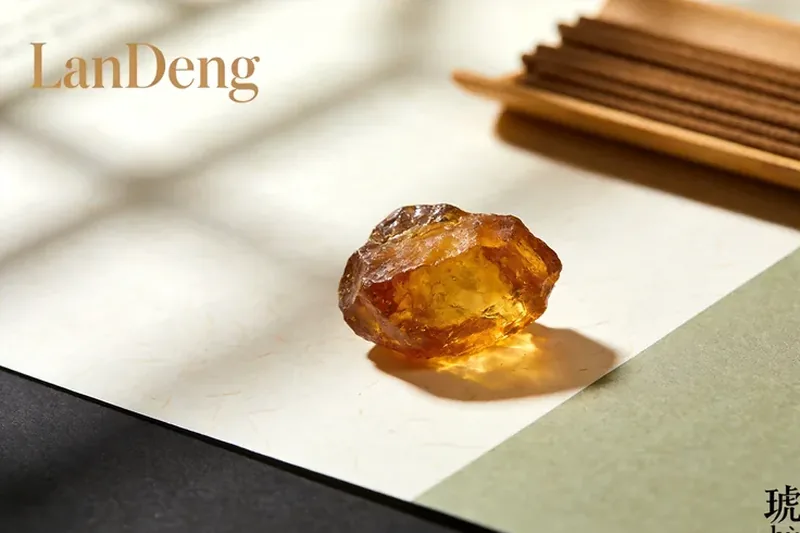
Direct answer: Amber (琥珀, hǔpò) is the fossilized resin of ancient trees — a fossil resin, not a botanical material. It appears in classical Chinese incense and materia medica; the Bencao Gangmu records the belief that “pine resin, given a thousand years, transforms into amber” (千年松脂化為琥珀), and the Ming Xiangcheng (香乘) records amber’s use alongside other aromatics. Its origin is geological, not the living plant.
Key facts
| Chinese | 琥珀 (hǔpò) |
| Source | fossil resin — fossilized resin of ancient trees (not botanical) |
| What it is | A fossil resin, not a living plant material |
| Aroma | Resinous, warm, sweet, balsamic (when heated) |
| Traditional role | Classical aromatic; materia medica; ornament |
Aroma profile
Direct answer: Amber is resinous and warm, sweet and balsamic, with a smooth, rounded character. As a fossil resin it does not carry the fresh, piney note of living resin — instead it has a dry, warm sweetness that emerges when gently heated. Note the distinction from the perfumery “amber” accord, which is not the fossil material.
Amber is resinous and warm, sweet and balsamic, with a smooth, rounded character. As a fossil resin it does not carry the fresh, piney note of living resin — instead it has a dry, warm sweetness that emerges when gently heated. Note the distinction between true amber (fossil resin) and “amber” as a perfumery accord: the latter is a warm, sweet, resinous accord built from labdanum, benzoin, and vanilla, not the fossil material. Classical Chinese 琥珀 is the fossil resin.
What amber is (and is not)
Direct answer: Amber is fossilized tree resin — a geological material formed over millions of years from ancient tree resin that hardened and polymerized underground. It is not a living botanical, not a mineral in the strict sense, and not the perfumery “amber” accord. This page classifies it as “fossil resin, not botanical” and states that plainly.
琥珀 must be understood for what it is: fossil resin, not a botanical material. It does not belong to the living plant kingdom in the way that frankincense or pine resin do. The classical sources understood its origin as a transformation:
- The Bencao Gangmu (本草纲目) records that “pine resin, given a thousand years, transforms into amber” (千年松脂化為琥珀), and that the resin of the sweetgum “enters the earth and in a thousand years becomes amber” — a folk explanation of fossilization.
- The Xiangcheng (香乘) records amber among aromatics and ornaments — its static-electric attraction (“amber attracts mustard seeds,” 琥珀拾芥) is noted as a classical observation of its property.
This page describes 琥珀 = amber = fossil resin. It is not a botanical, and we state that plainly rather than filing it under a living plant.
Source and origin
Direct answer: Amber is fossilized tree resin, formed over millions of years from the resin of ancient trees — often conifers or, in some deposits, leguminous trees — which hardened and polymerized underground. Chinese 琥珀 was obtained from deposits and trade, valued both as an aromatic material and as a gemstone.
Amber is fossilized tree resin, formed over millions of years from the resin of ancient trees — often conifers or, in some deposits, leguminous trees — which hardened and polymerized underground. Chinese 琥珀 was obtained from deposits and trade, and was valued both as an aromatic material and as a gemstone. Because it is a fossil product, its botanical identity is not a single living species, which is why this entry classifies it as “fossil resin, not botanical.”
Amber among the non-botanical resins
Direct answer: Amber sits in a small group of incense materials that are not living-plant products: fossil resin (琥珀), insect lac resin (紫草茸 / shellac), and animal ambergris (龙涎香). They share a resin-like character but come from geology, insects, and animals respectively — a classification worth keeping explicit.
Amber is best understood as part of a small, distinctive group of incense materials that are not living botanicals:
- 琥珀 (amber) — fossil resin, geological in origin. This entry.
- 紫草茸 (shellac) — lac resin, a secretion of the lac insect (Kerria lacca), not a plant. See shellac.
- 龙涎香 (ambergris) — an animal secretion from the sperm whale, not a plant. See ambergris.
These three share a warm, resinous, sweet register in incense, but their origins — geological, insect, and animal — set them apart from the living plant resins like pine resin and frankincense. Keeping the classification explicit matters for both accuracy and sourcing.
Why is it used in incense?
Direct answer: Amber was used in classical incense as an aromatic resin and ornament, valued for its warm, sweet, balsamic character when gently heated. The Ming Xiangcheng (香乘) records it among aromatics. Its use is historical and aromatic, not a modern bulk-incense role.
Amber’s role in incense is historical and aromatic: the Xiangcheng (香乘) records amber among aromatics and ornaments, and it was valued for its warm, sweet, balsamic character when gently heated. It is not a bulk incense material in the modern sense — as a gemstone and fossil it is too costly and too limited in supply to be a routine blend ingredient — but its classical aromatic use is documented. Its static-electric property (琥珀拾芥, “amber attracts mustard seeds”) was noted as a classical observation of its physical character.
How is it processed?
Direct answer: Amber is not processed like a living botanical — it is mined or gathered from fossil deposits, then cut, polished, or, for aromatic use, gently heated. It is not ground into a bulk incense powder the way a living resin would be; its value is as a gemstone and a historical aromatic.
Amber is obtained from fossil deposits and trade, then worked as a gemstone — cut and polished — or gently heated for its aromatic character. It is not processed through the harvesting-and-drying sequence of a living botanical, and it is not produced as a bulk incense powder in the modern sense. Its value is concentrated in its gemstone quality and its historical aromatic use, not in a routine blending role.
What determines amber quality?
Direct answer: Amber quality is a gemstone matter — clarity, color, and freedom from fracture — rather than an incense-grade matter. The commercial question is also one of identity: true amber (fossil resin) must be distinguished from the perfumery “amber” accord and from imitation or younger resins.
The quality points are gemmological rather than incense-related:
- Clarity and color — clear, well-colored amber beats cloudy or fractured material.
- Identity — true amber (fossil resin) vs the perfumery “amber” accord (labdanum, benzoin, vanilla) vs imitation or younger resins.
- Age and polymerization — genuine amber is fully fossilized and hardened; younger or treated resins are not the same material.
Amber carries no incense grading ladder — it is a gemstone and fossil, so quality is a gemmological and identity question rather than an aromatic-grade question.
Common forms
Direct answer: Amber is encountered as cut and polished gemstone pieces and, less commonly, as small fragments for aromatic use. It is not a bulk incense form like frankincense or pine resin; its primary form is ornamental.
| Form | Typical use |
|---|---|
| Polished gemstone | Ornament, jewelry |
| Fragments | Historical aromatic use; gentle heating |
In Chinese tradition
- Materia medica: 琥珀 is recorded in traditional Chinese medicine. This is traditional materia-medica language, not modern clinical evidence.
- Classical aromatic: the Xiangcheng (香乘) records amber among aromatics and ornaments, and notes its static-electric property (琥珀拾芥).
- Folk origin: the Bencao Gangmu (本草纲目) records the belief that pine resin, over a thousand years, transforms into amber (千年松脂化為琥珀).
Traditional use vs modern evidence
Direct answer: Amber’s classical aromatic and ornament use is documented, and its folk-origin explanation is recorded as a traditional belief about fossilization. Its medicinal uses are traditional, not established clinical fact, and this page makes no medical claims. The documented non-medical facts are its fossil-resin identity, the classical records, and its warm resinous character.
- Traditional Use — amber is a classical aromatic and ornament, valued for its warm, sweet resinous character.
- Historical Record — the Bencao Gangmu records the folk belief 千年松脂化為琥珀; the Ming Xiangcheng (香乘) records amber among aromatics and notes 琥珀拾芥.
- Scientific Evidence — amber’s geological origin (fossilized resin) is established; but we present no clinical or medical efficacy claims.
The classical aromatic and ornament use is documented. Medicinal uses are traditional, not established clinical fact, and we make no medical claims.
What buyers should look for
Direct answer: Buyers should first establish what they are buying: true amber (fossil resin), the perfumery “amber” accord (labdanum, benzoin, vanilla), or an imitation. Then, for true amber, check clarity, color, and identity as a gemstone. Amber is not a bulk incense material, so the buyer’s question is one of identity, not grade.
For a buyer:
- Identity — true amber (fossil resin) vs the perfumery “amber” accord vs imitation; the word “amber” alone does not identify the material.
- Clarity and color — for true amber, a clear, well-colored gemstone beats cloudy or fractured material.
- Use — amber is a gemstone and historical aromatic, not a bulk incense ingredient; confirm what role you intend before buying.
Our Industry View
Direct answer: Amber’s commercial lesson is classification honesty: it is fossil resin, not a living botanical, and the word “amber” in fragrance usually means a labdanum-benzoin-vanilla accord, not the fossil. A buyer’s first question is therefore “which amber?” — the geological material or the perfumery character — because the two are entirely different products.
From a manufacturing perspective, amber is a material where the name hides two different products. Two points follow:
- “Amber” in fragrance is usually not amber. The warm, sweet, resinous “amber” note in perfumery and incense is overwhelmingly a accord built from labdanum, benzoin, and vanilla — not fossil resin. A formulator asking for “amber” almost always wants the accord; a collector asking for “amber” wants the gemstone. The word must be resolved to which is meant.
- Classification honesty is a sourcing discipline. Amber is fossil resin — geological, not botanical — and it belongs with the other non-botanical resins (shellac, ambergris) rather than with living plant resins like pine resin or frankincense. Stating that plainly is more useful to a buyer than filing amber under a living plant, because it changes how the material is sourced, priced, and regulated.
In our view, amber is a historical aromatic and a gemstone whose chief commercial lesson is disambiguation: ask “which amber — fossil or accord?” before anything else, and keep its geological origin explicit rather than blurring it into the living-plant resins.
Summary
Amber (琥珀) is fossilized tree resin — a geological material, not a living botanical — valued in classical Chinese incense as an aromatic and ornament, and in modern fragrance mostly as the “amber” accord of labdanum, benzoin, and vanilla. It belongs with the other non-botanical resins (shellac, ambergris) rather than the living plant resins. Its value is gemmological and historical, and its medicinal uses are traditional language, not clinical evidence.
FAQ
What is 琥珀 (amber)? Amber, the fossilized resin of ancient trees — a fossil resin, not a botanical material. It appears in classical Chinese incense and materia medica, and the Ming-dynasty Xiangcheng (香乘) records its use alongside other aromatics. Its origin is geological, not a living plant.
Is amber a botanical? No. Amber is fossil resin, formed over millions of years from the resin of ancient trees. It is not a living plant material, and this encyclopedia states that plainly rather than filing it under a living species.
What does amber smell like? Resinous and warm, sweet and balsamic, with a dry, rounded character that emerges when gently heated. As a fossil resin it lacks the fresh, piney note of living resin. Note that perfumery “amber” is a warm, sweet accord of labdanum, benzoin, and vanilla — not the fossil material.
How did the classical Chinese explain amber’s origin? As a transformation of resin over time. The Bencao Gangmu (本草纲目) records that “pine resin, given a thousand years, transforms into amber” (千年松脂化為琥珀), and that sweetgum resin entering the earth becomes amber — a folk explanation of fossilization.
What is the difference between amber and the “amber” perfumery accord? True amber (琥珀) is fossil resin. The perfumery “amber” accord is a warm, sweet, resinous blend built from labdanum, benzoin, and vanilla, used to suggest an amber-like warmth. Classical Chinese 琥珀 is the fossil resin, not the accord.
What other non-botanical resins are there? Amber belongs to a small group of incense materials that are not living-plant products: shellac (紫草茸, an insect lac resin from Kerria lacca) and ambergris (龙涎香, an animal secretion from the sperm whale). They share a warm, resinous register but come from geology, insects, and animals respectively.
See also: pine-resin, styrax-resin, shellac, ambergris, and the full scent guide.
Evidence & Sources
Identity
Source: amber as fossil resin — fossilized resin of ancient trees, not a living botanical. Evidence type: Established — geological, not botanical.
Traditional Chinese use
Source: the Bencao Gangmu (本草纲目) records “千年松脂化為琥珀” (pine resin over a thousand years transforms into amber); the Ming-dynasty Xiangcheng (香乘) records amber among aromatics and notes 琥珀拾芥. Evidence type: Historically documented — aromatic and cultural use; medicinal uses are traditional, not modern clinical evidence.
Authenticity / disambiguation
Source: amber (fossil resin) vs the perfumery “amber” accord (labdanum, benzoin, vanilla) vs living resins (pine resin, frankincense); and the non-botanical resin group (shellac, ambergris). Evidence type: Practical screening.
Safety
Source: incense combustion produces smoke and particulate matter; burn in a well-ventilated space. Evidence type: Established.
Evidence status
| Layer | Status |
|---|---|
| Identity | Established (fossil resin) |
| Traditional use | Historically documented |
| Authenticity test | Practical screening |
| Health claims | Not established |
Sources
Sources: the Bencao Gangmu (本草纲目) record of amber’s folk origin (千年松脂化為琥珀) and the Ming-dynasty Xiangcheng (香乘) record of amber among aromatics. Amber is fossil resin, not a botanical; no medical claims are made. This is editorial knowledge content, not medical advice.