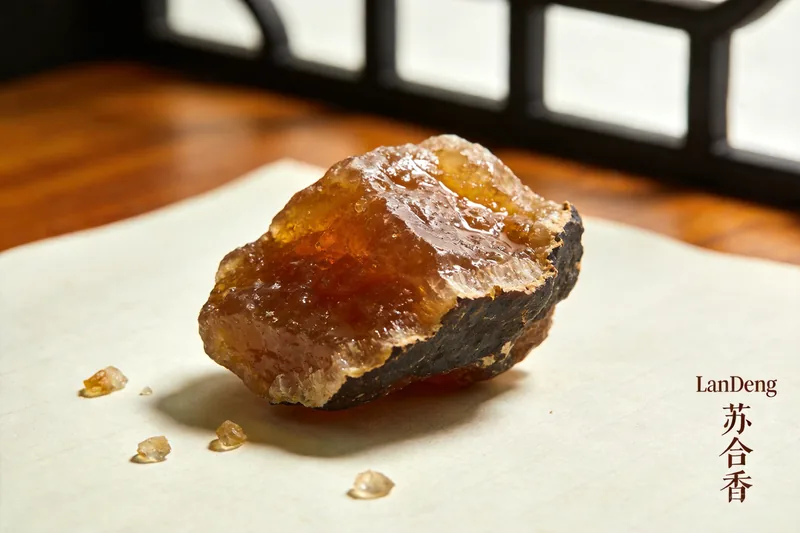
Technical answer: Storax — sūhéxiāng (苏合香) in Chinese — is an aromatic balsam produced from the inner bark of Liquidambar orientalis, the Oriental sweetgum of Asia Minor. In classical Chinese incense it was a prized imported resin, distinct from the native Chinese sweetgum (枫香, Liquidambar formosana), with a sweet, balsamic, cinnamon-like warmth.
Key facts
| Chinese | 苏合香 (sūhéxiāng) |
| Botanical source | Liquidambar orientalis (Oriental sweetgum) — the balsam/resin |
| What it is | An aromatic balsam, not a wood or root |
| Aroma | Sweet, balsamic, resinous, warm, faintly cinnamon-like |
| Traditional role | Imported incense resin; classical materia medica |
Aroma profile
Storax has a sweet, balsamic, resinous scent with a warm, faintly cinnamon-vanilla character. It is a softening resin — it rounds and sweetens a blend rather than adding a sharp or smoky edge, which is why classical sources valued the “aromatic, oily” grade over a woody, scentless one.
Botanical source and the naming distinction
Liquidambar orientalis is the Oriental sweetgum, native to southwestern Asia Minor, whose wounded bark yields storax balsam. This is not the same tree as the Chinese sweetgum:
- 苏合香 (storax) — Liquidambar orientalis, the imported balsam of classical texts.
- 枫香 (Chinese sweetgum) — Liquidambar formosana, the native Chinese tree, treated on this site as a separate material (see sweetgum).
The two are related trees with related resins, but the classical 苏合香 was specifically the imported storax. The Song-dynasty Xiangpu (香譜) traces the name to 苏合国 (“Sogdiana”) and gives the Sanskrit name 咄鲁瑟剑 (duruṣka, “storax”).
In Chinese tradition
- Incense: 苏合香 was a valued imported resin, described as dense (“heavy as stone”) and aromatic, with the best grade burning to white ash (烧之灰白者好).
- The oil note: classical texts specify that only the oily, resinous storax is genuinely aromatic — 药中只用有膏油者极芳烈 — and record that producers extracted the fragrant balsam first, leaving a woody residue of little scent. This is a useful buyer-intelligence point even today.
- Materia medica: storax appears in classical Chinese medicine (most famously the 苏合香丸 formula). We treat any such use as traditional, not established clinical fact.
Traditional use vs modern evidence
The classical descriptions of storax — its origin, appearance, and the “oily grade is the aromatic grade” distinction — are historical and observational. The medicinal uses are traditional, not established clinical fact, and we make no medical claims. The documented, non-medical facts are botanical identity and storax’s long role as an imported aromatic resin.
Quality and sourcing notes
Practical points for buyers:
- Storax is a balsam/resin, distinct from benzoin (安息香, a Styrax genus resin that is actually a different family — see the note below) and from the native 枫香 (Liquidambar formosana).
- The aromatic value is in the oily/resinous fraction; a dry, woody, low-resin “storax” has little scent — the same point classical sources made.
- “Storax” in English can be confused with “styrax” (the Styrax genus, which yields benzoin, not storax). The naming overlap is a classic source of confusion.
Safety
Incense combustion produces smoke and particulate matter. Burn in a well-ventilated space, avoid inhaling concentrated smoke, and keep away from children and pets. This is editorial knowledge content, not medical advice.
FAQ
Is storax the same as benzoin? No, and the naming overlap is a classic trap. Storax (苏合香) comes from Liquidambar orientalis, the Oriental sweetgum. Benzoin (安息香) comes from trees in the Styrax genus — despite the confusing fact that the English word “styrax” resembles “storax.” They are different resins from different plants with different scents: storax is sweet-balsamic and cinnamon-like, benzoin is sweet-vanilla. See our benzoin page.
What is the difference between 苏合香 and 枫香? Both are sweetgum resins, but from different trees. 苏合香 (storax) is Liquidambar orientalis, the imported balsam of classical Chinese texts; 枫香 (Chinese sweetgum) is Liquidambar formosana, the native tree. The classical 苏合香 was specifically the imported storax, which is why the two are treated as separate materials on this site.
What does storax smell like? Storax is sweet, balsamic, and resinous, with a warm, faintly cinnamon-vanilla character. It is a softening resin that rounds and sweetens a blend. Classical sources emphasize that only the oily, resinous grade is genuinely aromatic — the woody, low-resin material has little scent — a distinction that still matters for buyers.
Where does storax come from? Storax balsam comes from the wounded inner bark of Liquidambar orientalis, the Oriental sweetgum native to southwestern Asia Minor. In classical Chinese texts it was an imported resin, traced to 苏合国 (Sogdiana) with the Sanskrit name 咄鲁瑟剑 (duruṣka). Its import status is part of its identity — it was a prized foreign aromatic, distinct from native Chinese resins.
Why do classical texts emphasize the “oily” grade of storax? Because the aromatic compounds are concentrated in the resinous, oily fraction. Classical sources record that producers extracted the fragrant balsam first and sold the spent woody residue — 大秦国人采得苏合香先煎其汁以为香膏乃卖其滓 — leaving a material with little scent. The same principle applies today: a dry, low-resin “storax” is not the aromatic grade.
See also: sweetgum, benzoin, and the full scent guide.
Evidence & Sources
Botanical identity
Source: Liquidambar orientalis on GBIF · Liquidambar formosana (枫香, for the distinction) on GBIF. Evidence type: Established.
Traditional Chinese use
Source: the Song-dynasty Xiangpu (香譜) and Ming-dynasty Xiangcheng (香乘) record 苏合香 as an imported resin (苏合国 / Sanskrit 咄鲁瑟剑 duruṣka), “heavy as stone,” with the best grade burning to white ash and only the oily grade being aromatic. Evidence type: Historically documented — traditional, not modern clinical evidence.
Authenticity / disambiguation
Source: storax (Liquidambar orientalis) vs 枫香 (Liquidambar formosana) vs benzoin (Styrax genus) distinction. Evidence type: Practical screening.
Safety
Source: incense combustion produces smoke and particulate matter; burn in a well-ventilated space. Evidence type: Established.
Evidence status
| Layer | Status |
|---|---|
| Botanical identity | Established |
| Traditional use | Historically documented |
| Authenticity test | Practical screening |
| Health claims | Not established |
Sources
Sources: botanical references on Liquidambar orientalis (storax) and the native Liquidambar formosana (枫香), plus the Song-dynasty Xiangpu (香譜) and Ming Xiangcheng (香乘) records of 苏合香. The storax / benzoin / 枫香 disambiguation is recorded as practical screening. Medicinal uses (苏合香丸) are treated as traditional, not established clinical fact. This is editorial knowledge content, not medical advice.