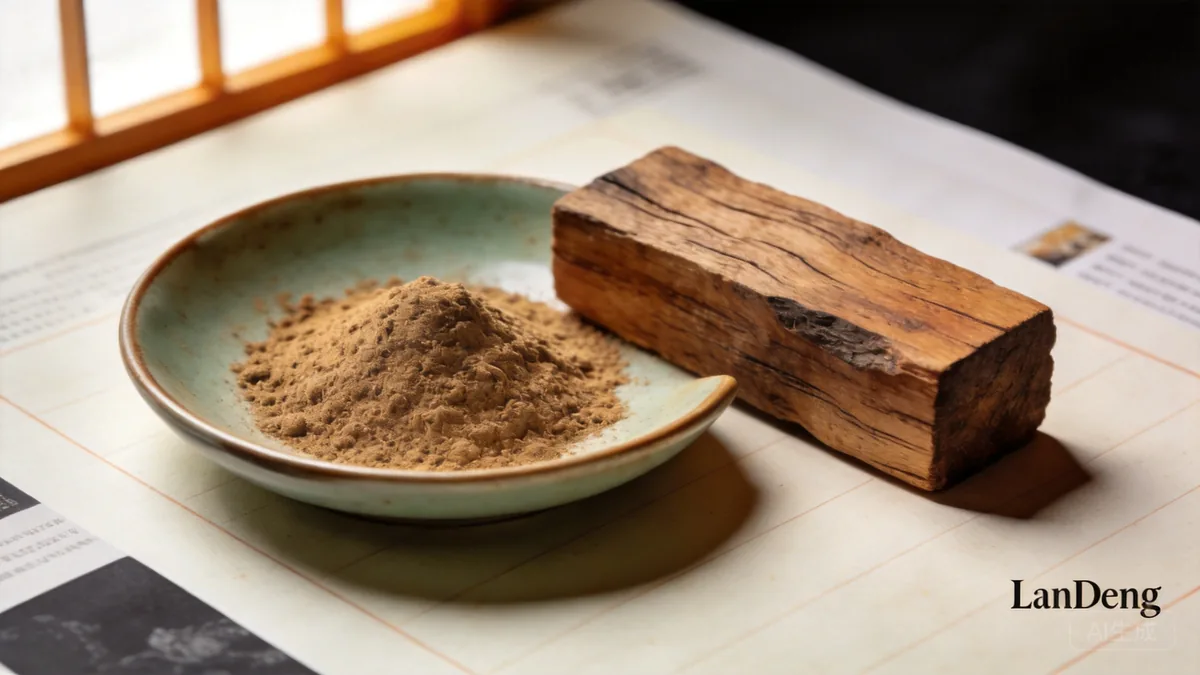
Direct answer: Incense powder is made by taking dried botanical material — woods, resins, flowers, and spices — grading it, grinding it to a fine powder, sieving it to a controlled particle size, and then blending the powders in proportion. The powder is either burned loose, heated, or — more commonly — mixed with a binder and water to form the paste that becomes sticks, coils, and cones.
Key facts: Powder is the raw state of almost all formed incense. Everything downstream — blending, binding, shaping, burning — depends on how well the powder was ground and how consistently it is sized.
Key Takeaways
- Incense powder is the foundation of both loose incense and every formed stick, coil, and cone.
- The chain is grading → grinding → particle-size control → sieving → blending.
- Particle size and moisture are not fixed numbers — they depend on the material and the formulation.
- Different materials grind differently — resins smear, woods are fibrous, oily material clogs.
- Powder quality is judged by uniformity and purity, not by a single spec.
Raw Materials: Grading Before Grinding
Direct answer: Before grinding, the raw material is graded — sorted by species, part, and quality — because what goes into the mill determines what comes out. The powder cannot be better than the material it was ground from.
The first step in making incense powder is not grinding but grading — confirming the material is what it claims to be and separating the good from the rest. This matters because the mill faithfully preserves whatever it is fed: adulterated or misidentified material becomes adulterated powder.
Grading runs on the same principles a buyer should already know:
- Species — is the wood actually the sandalwood or agarwood it is sold as? See incense authentication.
- Part — heartwood versus sapwood, bark versus leaf, resin versus wood, all behave and smell differently in the mill.
- Condition — moisture content, age, and freedom from contamination all affect how the material grinds.
The honest framing: grading is where the material question is settled, before any technique is applied. A good mill cannot rescue a mislabeled material.
Processing: Grinding
Direct answer: Grinding reduces the graded material to a powder by mechanical reduction — milling, crushing, or pounding — and it is where each material’s own character shows up, because resins, woods, and oily botanicals all respond to the mill differently.
Grinding is where the craft stops being abstract. The practical reality is that different materials grind differently, and the maker must adjust to the material rather than force a single setting:
| Material type | Behavior in the mill | What the maker does |
|---|---|---|
| Woods (sandalwood, agarwood) | Fibrous, grinds cleanly to a fine powder | Mill steadily; coarse fibers may need re-grinding |
| Resins (frankincense, benzoin) | Soft, can soften or smear under heat | Keep the mill cool; resins may be chilled or ground with care |
| Flowers & leaves | Light, brittle, crumble easily | Grind gently to avoid dusting away the volatiles |
| Oily materials (some seeds, spices) | Can clog a mill or turn pasty | Grind in small batches; some are better pounded or crushed |
A key trade-off runs through this stage: heat is the enemy. Friction from grinding generates heat, and heat drives off the volatile aromatic compounds — the very thing the powder is supposed to preserve. A maker who grinds slowly and coolly preserves more aroma than one who grinds fast and hot.
The fineness of the grind is a choice, not a spec. Finer powder packs more densely and burns slower and cooler; coarser powder burns faster and looser. Exactly what “fine” means — in microns, mesh, or feel — depends on the material and the formulation the maker is targeting. There is no single correct particle size across all incense, and this page deliberately does not invent one.
Particle-Size Control and Sieving
Direct answer: After grinding, the powder is sieved to a uniform particle size, because a stick burns only as evenly as its powder is consistent. Sieving separates fine, uniform powder from coarse fragments and oversize bits that would cause an uneven burn.
Uniformity, not absolute fineness, is the real goal of this stage. A powder that contains a mix of fine dust and coarse fragments will:
- Burn unevenly — coarse bits smolder longer, fine dust flashes faster.
- Blend unevenly — a coarse fragment carries more of one ingredient than the fine portion around it.
- Pack unevenly — inconsistent particles make a stick of inconsistent density.
Sieving is how the maker removes this variation. The powder is passed through a screen (or a series of screens) of a chosen aperture, and the oversize fraction is set aside for re-grinding. The aperture chosen is the maker’s decision, matched to the material and the intended product — a loose powder for heating may be screened differently from a powder destined to be bound into a stick.
Again, the discipline holds: the actual particle size is material- and formulation-dependent, and no universal micron number is asserted here. What is universal is the principle — uniformity before blending.
Formulation: Blending the Powders
Direct answer: Blending combines the individually ground powders in proportion, and — in the Chinese tradition — this is where the formula lives: 合香, composed on a 君臣佐使 principle, with each ingredient assigned a role rather than just a scent.
Once each material is a uniform powder, the maker combines them. This is the stage where “how powder is made” becomes “how a blend is composed”:
- In a single-material powder (pure sandalwood, pure agarwood), the craft is entirely in the grading and grinding — the blend is one ingredient.
- In a blended powder (合香), the craft is in the proportion and the roles: chief (君), minister (臣), assistant (佐), guide (使). See the blending system.
Blending technique matters as much as the formula. Powders of different densities and particle sizes tend to separate if simply stirred, so a maker works to keep the blend homogeneous — otherwise the top of the jar smells and burns differently from the bottom. A well-blended powder is uniform not just within each ingredient but across ingredients.
The exact proportions of any proprietary formula are not published — that is the maker’s craft. What is shared is the structure: each ingredient has a role, and the blend is designed so the roles balance.
Manufacturing and Final Product: From Powder to Form
Direct answer: The finished powder goes one of two ways — burned or heated loose, or mixed with a binder and water to form the paste that is shaped into sticks, coils, and cones and dried. Powder is therefore both a finished product and an intermediate.
Incense powder is unusual in being both an end and a means:
- As a finished product, it is burned or heated loose — the pure-material format described in incense powder & resin.
- As an intermediate, it is mixed with a combustible binder (makko) and water into a paste, formed, and dried — the process at the heart of how incense is made.
The distinction that follows a buyer through both uses: whether the powder is real botanical material or a fragrance carrier. A sandalwood powder can be ground sandalwood heartwood, or a neutral powder scented with sandalwood fragrance oil. The two look similar and behave differently, and the same material-vs-fragrance test applies. See incense powder vs wood chips and what makes incense “natural”.
Common Mistakes
- Assuming “fine powder” has one universal meaning. Fineness is matched to the material and product, not a fixed number.
- Ignoring heat during grinding. A hot mill drives off the volatiles the powder exists to carry.
- Skipping sieving. Inconsistent particle size is the most common cause of an uneven burn.
- Treating powder as a synonym for “pure material.” A scented neutral powder is not the same as ground wood — check the label.
- Storing powder open. Powder absorbs moisture faster than a formed stick, which dulls scent and ruins the burn (see storage).
The Author’s Take
Position: The powder is where incense quality is actually decided — and it is the stage most buyers never see.
Reasoning:
- Everything downstream (blend, bind, shape, burn) inherits from the grind; a bad powder cannot become a good stick.
- The two questions I would ask any maker are not “how fine” but “how uniform” and “how cool.”
- A buyer who understands grinding and sieving reads a stick completely differently — as the tip of a process, not the whole product.
This is the author’s editorial view and experience — not a verified fact.
Verification Notes
- The grading → grinding → sieving → blending sequence is a standard description of botanical powder production.
- The claim that different materials (woods, resins, oily botanicals) grind differently reflects general material properties, not a measured specification.
- No specific particle-size, moisture, or throughput numbers are asserted; quantitative parameters are explicitly described as material- and formulation-dependent.
- No proprietary formulas, factory experience, capacity, certification, or test data are claimed.
- No health or medical claims are made.
FAQ
Q: How is incense powder made?
Incense powder is made by grading dried botanical material (woods, resins, flowers, spices) for species and quality, then grinding it to a powder and sieving it to a uniform particle size before blending the powders in proportion. The powder is either burned or heated loose, or mixed with a combustible binder and water to form the paste that becomes sticks, coils, and cones. The two things that determine powder quality are the material it was ground from and how uniformly it is sized.
Q: What particle size should incense powder be?
There is no single correct particle size — it depends on the material and the formulation. Finer powder packs more densely and burns slower and cooler, while coarser powder burns faster and looser, and a maker chooses the grind to match the intended product. The more important property than absolute fineness is uniformity: a powder with a mix of fine dust and coarse fragments burns and blends unevenly, which is why sieving is a standard step.
Q: Why do some incense materials grind differently?
Because they are physically different. Woods such as sandalwood and agarwood are fibrous and grind cleanly, while resins such as frankincense and benzoin are soft and can soften or smear under the heat of the mill, and oily seeds and spices can clog a mill or turn pasty. A maker adjusts the grinding to the material — keeping the mill cool for resins, grinding flowers gently, and taking oily materials in small batches — rather than forcing one setting.
Q: Is incense powder the same as “pure material”?
Not necessarily. Incense powder can be genuine ground botanical material — sandalwood heartwood, for example — or it can be a neutral powder scented with a fragrance oil and sold under the same name. The two look similar but smell and burn differently. The label is the best clue: reputable makers state whether the scent is real material or fragrance. When in doubt, treat the powder the same way you would a stick — ask what the aromatic material actually is.
Q: How should I store incense powder?
Store it sealed, cool, dry, and dark. Powder absorbs moisture and competing odors faster than a formed stick because it has far more exposed surface area, so damp air dulls the scent and makes it hard to burn, and an open jar picks up ambient smells. A sealed jar or tin in a cupboard, with a desiccant packet in humid climates, is the standard practice. See incense storage & longevity for the full guidance.
Sources
- Editorial synthesis of established botanical powder production (grading, grinding, sieving, blending).
- Botanical references on the makko binder tree, Machilus thunbergii: Machilus in Flora of China and Machilus thunbergii on GBIF.
- EPA indoor air quality — background on smoke from burning incense powder.
- American Lung Association indoor air pollutants — on particulate matter and indoor burning.
Related Resources
Natural next step: see the powder become a product in how incense is made, or the pure-material format in incense powder & resin.