At a glance: Kōdō (香道, “the Way of Fragrance”) is Japan’s formal art of appreciating incense, counted alongside the tea ceremony (sadō) and flower arranging (kadō) as one of the three classical arts of refinement. It centers on “listening” to fragrant woods — chiefly agarwood (jinkō 沈香) — through codified ritual and incense-comparing games. Crucially, kōdō is not the origin of the art: it descended from Chinese incense culture, specifically the Song-dynasty technique of 隔火焚香 (indirect-fire incense), which reached Japan with Buddhism and tea.
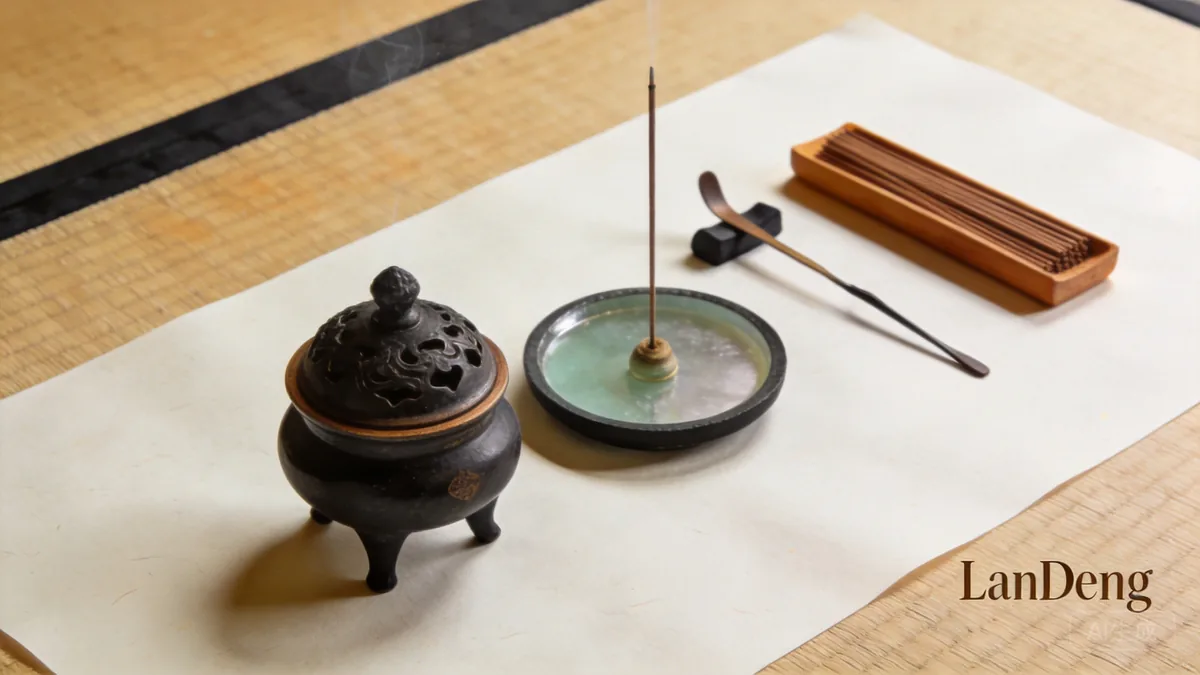
Key facts: Incense entered Japan in the 6th century CE with Buddhism. Kōdō was codified as an art in the Muromachi period (c. 1336–1573), around the 8th shogun Ashikaga Yoshimasa. It survives in two main schools — Oie-ryū (aristocratic) and Shino-ryū (warrior) — and its vocabulary (monkō, kumikō, genjikō, rikkoku gomi) is precise and still in use.
Key Takeaways
- 香道 (kōdō) is Japanese in form but Chinese in origin — it evolved from Song-dynasty 隔火焚香, the same refined “scent, not smoke” technique described in what Chinese incense is.
- The core verb is “listen” (聞, kiku), not “smell” — monkō (聞香) is “listening to fragrance,” a subtle but defining mindset.
- Kōdō is built on agarwood (jinkō), graded by the classic rikkoku gomi (六国五味) system — “six countries, five tastes.”
- It is low-smoke and almost flameless at its most refined — an aesthetic of restraint, distinct from India’s bold agarbatti and warmer than modern Chinese sticks.
- Materials are scarce and costly, which is a major reason kōdō is less widely practiced than tea or flower arranging.
The Correction That Matters
English-language writing frequently treats incense appreciation as an essentially Japanese art, because kōdō is the most thoroughly documented form in English. The historical record runs the other direction:
- Chinese incense culture is documented centuries before kōdō existed as a named practice.
- The refined technique at kōdō’s heart — 隔火焚香 (gé huǒ fén xiāng), burying hot charcoal in ash and resting the fragrant wood on a plate above it so aroma releases with almost no smoke — is a Song-dynasty Chinese technique.
- Kōdō inherited this method along with tea and Buddhism, then systematized and preserved it as a codified art.
Precise framing: China is the historical source; Japan formalized and conserved the form. Neither side “invented” it in a vacuum — the honest statement is that the refined technique Japan codified came from China’s Song-era practice. See the history of Chinese incense for the Chinese side of the timeline.
A Short History of Kōdō
| Period | What happened |
|---|---|
| 6th century CE (Asuka) | Incense arrives with Buddhism; agarwood imported for temple use (ritual offering, 焚香 funkō) |
| Nara–Heian | Incense used in Buddhist ritual and court life |
| Muromachi (c. 1336–1573) | Kōdō codified as an art. Shogun Ashikaga Yoshimasa and his advisor Sanetaka Sanjōnishi classify incense and devise appreciation games |
| Edo (1603–1868) | Two main schools (Oie-ryū, Shino-ryū) formalize; classic incense houses founded — Baieido (1657), Kyukyodo (1663), Shoyeido (1705) |
| Modern | Kōdō persists as a minority, specialized art alongside tea and flower arranging |
The Vocabulary of Kōdō
- 香道 (kōdō) — “the Way of Fragrance.”
- 聞香 (monkō) — “listening to incense.” The verb is 聞 (hear/listen), not 嗅 (smell): you attend to the fragrance the way you would attend to a piece of music.
- 組香 (kumikō) — incense-comparing games, where participants distinguish between several woods according to set rules.
- 源氏香 (genjikō) — a famous kumikō game based on The Tale of Genji, distinguishing five fragrant woods into fifty-two possible patterns.
- 沈香 (jinkō) — agarwood, the central material; 白檀 (byakudan) is sandalwood, the secondary wood.
- 香道具 (kōdōgu) — the specialized tools (ash press, charcoal, mica plate, chopsticks) used to prepare the flameless heat.
Rikkoku Gomi (六国五味): “Six Countries, Five Tastes”
Kōdō’s most distinctive intellectual tool is the rikkoku gomi — a traditional classification of agarwood into six “countries” and five “tastes.” It is the foundation of how kōdō practitioners describe and compare aromatic woods.
The six (traditional names and associations):
| Name | Kanji | Traditional association |
|---|---|---|
| Kyara | 伽羅 | Vietnam — the finest, most prized (cognate with Chinese 奇楠) |
| Rakoku | 羅国 | Thailand |
| Manaka | 真那伽 | Malacca |
| Manaban | 真南蛮 | “Southern barbarian” — unlocalized/imported |
| Sasora | 佐曽羅 | Western/Indian region |
| Sumotara | 寸門多羅 | Sumatra |
The five tastes (五味): sweet (甘), spicy (辛), sour (酸), salty (鹹), bitter (苦).
Honest caveat: the “countries” are traditional labels, not reliable modern geography. The names encode historical trade routes and origins, and the precise mapping is debated among sources. Treat rikkoku gomi as a classical descriptive framework, not a modern provenance system — much like the Chinese 奇楠 color grades are traditional rather than settled taxonomy.
What Kōdō Values (and Why It Feels Different)
Kōdō is an aesthetic of restraint. At its most refined, almost nothing is burned — a small piece of agarwood is warmed over buried charcoal so it releases pure aroma with barely a wisp of smoke. The point is the quality of the fragrance, not the volume of smoke.
This positions it distinctly:
| Tradition | Character | Style |
|---|---|---|
| Indian agarbatti | Bold, smoky, expressive | Thick stick on a bamboo core, room-filling |
| Chinese 香 | Warm, layered, elegant | Wood/resin, often low-smoke (隔火焚香) |
| Japanese kōdō | Minimalist, meditative | Almost no smoke; pure warmed-wood aroma |
The “listen, don’t smell” mindset and the rikkoku gomi vocabulary turn fragrance appreciation into something closer to a connoisseurship practice — like tea tasting — than a household air-freshening habit.
The Two Schools: Oie-ryū and Shino-ryū
Kōdō survives today in two main schools, descended from the Edo-period formalization:
- Oie-ryū (御家流) — the “aristocratic” lineage, associated with the court and the Sanjōnishi family tradition. Its forms are considered refined and restrained, emphasizing etiquette and the classical dimension.
- Shino-ryū (志野流) — the “warrior” (samurai) lineage, associated with the Shino family. Its forms are considered more austere and practical, reflecting a martial household’s discipline.
The split is a reminder that kōdō, like tea ceremony, is a practice with lineages — not a single standardized hobby. Each school codified its own procedures, which is one reason the art can feel opaque to an outsider: the “right way” is defined within a lineage, not by a universal rulebook.
The Tools of Kōdō (香道具)
The preparation of the flameless heat is a ritual in itself, using a small kit of specialized tools (香道具, kōdōgu):
- Ash (灰) — a bed of fine ash in the censer, in which the charcoal is buried.
- Charcoal (炭) — a small piece, lit and buried in the ash so only gentle radiant heat reaches the surface.
- Ash press (灰押) — shapes and compacts the ash into a tidy cone.
- Mica plate (銀葉/雲母板) — the thin plate laid over the ash; the fragrant wood rests on it.
- Chopsticks/tweezers (火箸/香筯) — for handling the charcoal and the wood.
The point of the tools is control: the practitioner manages exactly how much heat reaches the wood, so the aroma releases slowly and with almost no smoke. This is the physical basis of the “scent, not smoke” aesthetic.
Monkō and the “Listening” Mindset
The core verb of kōdō is 聞 (kiku, “to listen/hear”), not 嗅 (kagu, “to smell”). Monkō (聞香) — “listening to incense” — is the practice of attending to a fragrance with the focused attention one gives to music.
This is not mere metaphor. “Listening” implies sustained, attentive reception rather than a quick sniff for identification. The kōdō practitioner is not asking “what is this?” and moving on; they are attending to how the aroma opens, holds, and fades. It turns fragrance into an object of contemplation — which is exactly what separates kōdō from household air-freshening, even though both involve a pleasant smell.
Kumikō and Genjikō: Incense as Game
Kōdō is unusual among the classical arts for turning appreciation into structured games:
- Kumikō (組香) — “incense-comparing” games, where participants are given several fragrant woods and must distinguish them according to set rules.
- Genjikō (源氏香) — the most famous kumikō, based on The Tale of Genji. Five woods are burned in sequence, and players record which ones they judge to be the same or different; the possible answer patterns — fifty-two in all — are each named after a chapter of the Genji.
The games make kōdō a social and intellectual practice, not a solitary one: you are testing discrimination and memory against a codified answer key. This is why kōdō has a vocabulary and a literature of its own, and why it survived as a codified art rather than dissolving into a hobby.
Kōdō vs Chinese 香道: Where They Part Ways
The two traditions share a name (香道) and an origin, but they developed in different directions:
| Dimension | Chinese 香道 | Japanese kōdō |
|---|---|---|
| Center of gravity | Materials and blends (合香) | A single precious wood (jinkō) |
| Method | Heating and burning; many forms | Almost flameless heating (monkō) |
| Vocabulary | 隔火焚香, 合香, 香谱 | monkō, kumikō, rikkoku gomi |
| Character | Warm, layered, compositional | Minimalist, meditative, codified |
China is the historical source; Japan systematized and conserved a specific, refined slice of it. Neither “invented” the art in a vacuum. See the history of Chinese incense for the fuller timeline.
Common Mistakes
- Assuming kōdō is the origin of incense appreciation. It is a Japanese formalization of a Chinese tradition (Song 隔火焚香).
- Treating rikkoku gomi as literal geography. “Six countries” are traditional labels, not verified origins.
- Expecting smoke. Refined kōdō is deliberately low-smoke and near-flameless.
- Overlooking the cost barrier. Premium agarwood is scarce and expensive, which is why kōdō remains a specialized art.
The Author’s Take
Position: Kōdō is Japanese in form but Chinese in origin — I would state it firmly but not defensively, because it is well supported and rarely said in English.
Reasoning:
- The deeper value is the mindset: kōdō teaches you to “listen” to fragrance rather than smell it.
- The honest caveat about rikkoku gomi — traditional labels, not verified geography — is the precision that earns trust.
This is the author’s editorial view and experience — not a verified fact.
Verification Notes
- Historical dates (6th-century arrival with Buddhism; Muromachi codification; the two schools and their founders) follow standard English- and Japanese-language accounts of kōdō and are consistent across sources.
- The rikkoku gomi “countries” are presented as traditional classification, not settled geography — sources differ on the precise mapping, and this is disclosed.
- The “香道 originated in China; kōdō descended from Song 隔火焚香” claim is stated as a high-confidence historical interpretation (multiple secondary sources), not a single primary-source “fact.”
- No health or therapeutic claims are made anywhere in this article.
See World Incense Traditions: China, Japan, India, Tibet & the Middle East for the full guide.
FAQ
Q: Is kōdō the same as Chinese 香道?
They share the name 香道 and a common origin, but they developed differently. Chinese incense culture is the historical source, documented centuries before kōdō existed as a named practice; Japanese kōdō is a later, formalized art built on the Song-dynasty 隔火焚香 technique. In character, Chinese 香道 is warmer and more compositional, centered on materials and blended 合香 formulas; kōdō is minimalist and codified, centered on a single precious wood appreciated through ritual and games. The honest statement is that China provided the source and technique, and Japan systematized and conserved a refined slice of it. See what Chinese incense is.
Q: What does “listening to incense” mean?
Kōdō uses the verb 聞 (kiku, “listen/hear”) rather than 嗅 (kagu, “smell”). Monkō means attending to a fragrance with focused, sustained attention — appreciating it as you would a piece of music — rather than taking a quick sniff to identify it and moving on. The mindset is contemplative: the practitioner follows how the aroma opens, holds, and fades. This distinction is subtle but defining, because it turns fragrance appreciation from a household habit into a discipline, and it is why kōdō is described as “listening” rather than merely smelling.
Q: What is rikkoku gomi?
“Six countries, five tastes” — the traditional kōdō classification of agarwood into six named types (kyara, rakoku, manaka, manaban, sasora, sumotara) and five taste qualities (sweet, spicy, sour, salty, bitter). It is the foundation of how kōdō practitioners describe and compare aromatic woods. The “countries” are traditional labels encoding historical trade routes and origins, not verified modern geography, and the precise mapping is debated among sources. Treat rikkoku gomi as a classical descriptive framework — useful for comparing aroma character — rather than a modern provenance system, much like the Chinese 奇楠 color grades are traditional rather than settled taxonomy.
Q: Why is kōdō less common than tea ceremony?
Primarily cost and scarcity. Premium agarwood (jinkō, and especially the top grade kyara) is expensive and limited, so the central material of kōdō is a scarce luxury, unlike tea leaves. The practice also requires specialized tools — ash, charcoal, a mica plate, an ash press — and formal training within a lineage, which raises the barrier to entry. Tea ceremony, by contrast, uses a more affordable and abundant material and has been more widely popularized. Kōdō survives as a minority, specialized art precisely because its material and its codification both sit at the expensive, formal end.
Q: What’s the difference between kyara and ordinary agarwood?
Kyara (伽罗) is the top grade, cognate with Chinese 奇楠 — the “oil-wraps-wood” agarwood whose fiber is so thoroughly resin-transformed that the material is soft, pliable, and aromatic at room temperature. Ordinary agarwood (jinkō 沈香) is “wood-wraps-oil”: harder wood with resin veins. Kyara sits at the top of the rikkoku gomi classification and commands the highest prices; the same material is called 奇楠 in Chinese, and the term carries the same ambiguity about its ultimate origin. See the agarwood guide for the full distinction.
Sources
- 周嘉胄《香乘》(Ming) — 隔火焚香 technique and the Chinese source tradition. Full text on Wikisource.
- 洪芻《香谱》(Song) — the Song-dynasty incense canon behind 隔火焚香. Full text on Wikisource.
- 吴自牧《梦粱录》 — the Four Leisure Arts frame (incense among the refined pastimes). Full text on Wikisource.
- Koju / Nippon Kodo — official kōdō culture pages (history, schools, monkō/kumikō/genjikō, rikkoku gomi).
- Wikipedia — Kōdō (history, etymology, major houses).
- Research synthesis: docs/research/chinese-incense-pillar-notes.md (R-003) — Chinese-origin correction.
Related Resources
Natural next step: kōdō’s core material is agarwood — read the agarwood guide to understand 奇楠, grading, and how to tell real from fake.