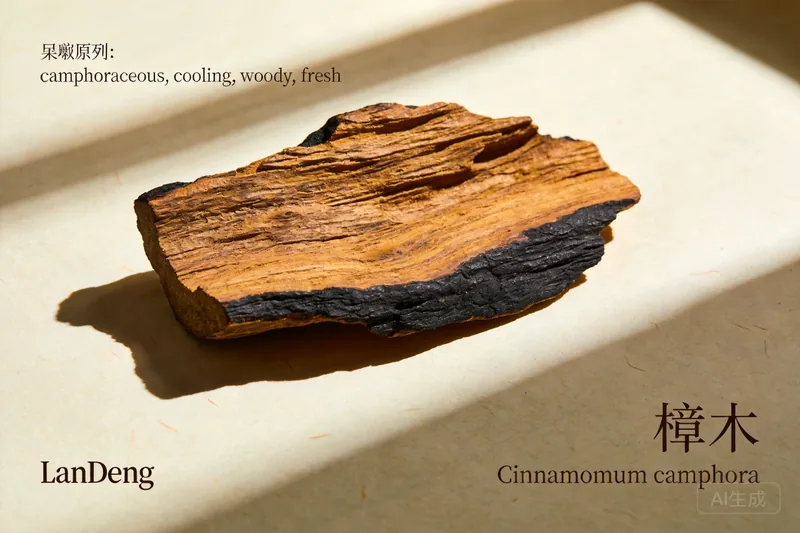
Technical answer: Camphor — zhāngmù (樟木) for the wood, zhāngnǎo (樟脑) for the crystallized aromatic — is the fragrant wood and crystalline extract of Cinnamomum camphora, the camphor laurel, a large evergreen tree native to southern China, Japan, and Taiwan. The wood is strongly, penetratingly aromatic with a cool, medicinal, slightly minty “camphoraceous” scent that also wards off insects. It is used in Chinese incense mainly as a fresh, cooling top note and as a traditional insect-repelling aromatic, distinct from the related but different material 龙脑 (borneol).
Key facts
| Chinese | 樟木 (zhāngmù) wood; 樟脑 (zhāngnǎo) camphor crystal |
| Botanical source | Cinnamomum camphora (family Lauraceae) — wood and extract |
| What it is | An aromatic wood and its crystalline camphor extract |
| Aroma | Camphoraceous, cooling, fresh, slightly minty-woody |
| Traditional role | Cooling aromatic, insect-repellent, incense top note |
Aroma profile
Camphor is sharp, cool, and penetrating — a “medicinal-fresh” scent familiar from moth repellents and liniments. The wood itself is strongly aromatic, and the crystallized camphor (樟脑) distilled from it is more intense and pure. In incense this is a top note: it lifts a blend with a bright, cooling edge. Used alone and heavily, it can dominate a formula, which is why classical blends use it sparingly.
Botanical source and origin
Cinnamomum camphora is a large evergreen of the laurel family (Lauraceae), native to warm regions of southern China, Taiwan, Japan, and Vietnam. The whole tree is aromatic; camphor is concentrated in the wood, from which it is steam-distilled as a white crystalline substance. The same genus yields cinnamon/cassia (Cinnamomum cassia, 桂皮), but camphor laurel is valued for its wood and camphor content rather than its bark.
A naming caution: 樟脑 (camphor) and 龙脑 (borneol) are different crystalline aromatics from different plants, though both smell “camphoraceous.” Camphor comes from Cinnamomum camphora; borneol comes from Dryobalanops aromatica and Blumea balsamifera. A label saying “camphor” or “borneol” names distinct materials.
In Chinese tradition
- Cooling aromatic: camphor’s cool, penetrating scent is used in traditional practice for its perceived clearing and insect-repelling qualities.
- Insect repellent: camphor wood and camphor crystals have long been placed with clothing and books to keep insects away — one of its most durable practical uses.
- Incense context: camphor appears in Chinese incense as a fresh top note, though classical huxiang (合香) manuals treat the intense camphoraceous materials as accents, not bases.
- Materia medica: 樟脑 is recorded in traditional Chinese medicine for external, cooling applications. This is traditional materia-medica language, not modern clinical evidence.
Traditional use vs modern evidence
The insect-repelling and aromatic roles are well documented. Medicinal uses are traditional, not established clinical fact, and we make no medical claims. Camphor is also a potent substance — concentrated camphor is not for internal use — and this page describes its aromatic and historical roles only.
Quality and sourcing notes
Practical points for buyers:
- Camphor wood should be clean, dense, and strongly aromatic; camphor crystals should be white and strongly, penetratingly scented.
- Natural camphor is often replaced by cheaper synthetic camphor in commerce; if natural origin matters, confirm the source.
- Camphor is intense — in incense it is a small accent, not a base.
Safety
Incense combustion produces smoke and particulate matter; burn in a well-ventilated space and avoid inhaling concentrated smoke. Camphor is a strong aromatic; concentrated camphor products are not for ingestion and should be kept away from children and pets. This is editorial knowledge content, not medical advice.
FAQ
What is the difference between camphor and borneol? They are different aromatic crystals from different plants, though both smell “camphoraceous.” Camphor (樟脑) is distilled from the wood of the camphor laurel, Cinnamomum camphora. Borneol (龙脑) comes from Dryobalanops aromatica (Borneo camphor tree) or Blumea balsamifera. The two are distinct materials with distinct botanical sources, and the English words should not be used interchangeably.
What does camphor smell like? Sharp, cool, penetrating, and medicinal-fresh — the familiar scent of moth repellents and liniments, with a slightly minty, woody undertone in the natural wood. It is a bright top note that lifts a blend but easily dominates one if over-used. The crystallized camphor (樟脑) is more intense and pure than the aromatic wood itself.
Is camphor an insect repellent? Yes — this is one of its most durable and well-documented uses. Camphor wood and camphor crystals have long been placed with clothing, books, and stored goods to repel insects, and the scent is still used this way today. This practical role is separate from any medicinal claim, which this page does not make.
How is camphor used in Chinese incense? As a fresh, cooling top note, usually in small amounts. Because camphor is so intense, classical blended-incense practice treats strong camphoraceous materials as accents that lift a formula rather than as the base. The wood and the crystalline extract are both aromatic, with the crystal being the more concentrated form.
Is natural camphor different from synthetic camphor? Yes. Natural camphor is distilled from Cinnamomum camphora wood, while synthetic camphor is manufactured and widely used as a cheaper replacement in commerce. Both are strongly aromatic, but if natural origin matters for incense or traditional use, the source should be confirmed, since the two are not always distinguished on labels.
See also: borneol, cinnamon, and the full scent guide.
Evidence & Sources
Botanical identity
Source: Cinnamomum camphora in Flora of China · Cinnamomum camphora on GBIF. Evidence type: Established.
Traditional Chinese use
Source: camphor’s cooling aromatic and insect-repelling uses; 樟脑 in the traditional materia medica for external applications. Evidence type: Historically documented — traditional materia-medica language, not modern clinical evidence.
Authenticity / disambiguation
Source: camphor (樟脑) vs borneol (龙脑) — distinct crystals from distinct plants. Evidence type: Practical screening.
Safety
Source: incense combustion produces smoke and particulate matter; concentrated camphor is a strong aromatic not for ingestion. Evidence type: Established.
Evidence status
| Layer | Status |
|---|---|
| Botanical identity | Established |
| Traditional use | Historically documented |
| Authenticity test | Practical screening |
| Health claims | Not established |
Sources
Sources: botanical references on Cinnamomum camphora and the camphor-vs-borneol distinction. Camphor’s aromatic and insect-repelling uses are documented; medicinal uses are treated as traditional, not established clinical fact. This is editorial knowledge content, not medical advice.