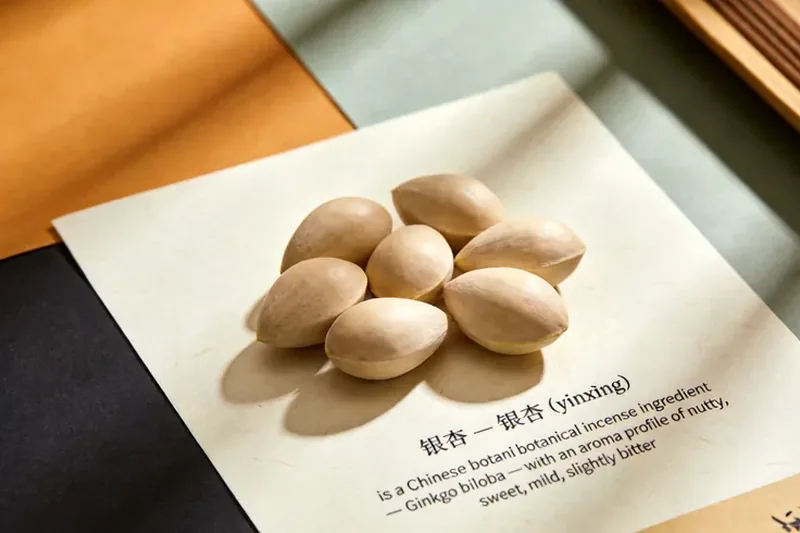
Direct answer: Ginkgo (银杏, yínxìng) is the seed of Ginkgo biloba, a “living fossil” tree that is the sole surviving species of its division, native to China. The seed, called 白果 (báiguǒ, “white fruit”), is a mild, nutty, faintly bitter food seed. The Bencao Gangmu records it under 白果 and 鸭脚子, noting it entered tribute in the Song dynasty.
Key facts
| Chinese | 银杏 (yínxìng); the seed 白果 (báiguǒ); also 鸭脚子 |
| Botanical source | Ginkgo biloba (family Ginkgoaceae) — the seed |
| What it is | A food seed from a “living fossil” tree |
| Aroma | Nutty, sweet, mild, slightly bitter |
| Traditional role | Food; 白果 in materia medica |
Aroma profile
Direct answer: Ginkgo nut is nutty and mild, with a faint sweetness and a slightly bitter, starchy edge — a quiet, food-like scent closer to a roasted chestnut or bean than to any spice or flower. The scent is subtle and secondary to its culinary role, so it is eaten far more than it is used for fragrance.
Ginkgo nut is nutty and mild, with a faint sweetness and a slightly bitter, starchy edge — a quiet, food-like scent closer to a roasted chestnut or bean than to any spice or flower. The scent is subtle and secondary to its culinary role; the seed is eaten (roasted, boiled, or in savory and sweet dishes) far more than it is used for fragrance. In aromatics its value is negligible — a gentle food note, not a lead or supporting incense material. This page records it honestly as a food seed, not as a 香材.
Botanical source and origin
Direct answer: Ginkgo biloba is a deciduous tree to 40 m tall and the only living member of the division Ginkgophyta — a “living fossil” whose leaves turn bright yellow in autumn. Its seed is 2.5–3.5 × 1.6–2.2 cm, with a fleshy outer coat that has a rancid odor when ripe and a white inner shell. It is perhaps native to northwestern Zhejiang (Tianmu Shan) and now widely cultivated.
Ginkgo biloba is a deciduous tree and the only living member of the division Ginkgophyta — a “living fossil” whose lineage predates the flowering plants and once ranged worldwide. Flora of China records it as a tree to 40 m tall, trunk to 4 m diameter, with fan-shaped leaves that turn bright yellow in autumn, and a seed 2.5–3.5 × 1.6–2.2 cm whose outer coat (sarcotesta) is yellow or orange-yellow with a rancid odor when ripe, enclosing a white shell (sclerotesta) with 2–3 longitudinal ridges. It is recorded as perhaps native in northwestern Zhejiang (Tianmu Shan), now widely and long cultivated across China and beyond. The seed (白果) is enclosed in that fleshy, malodorous outer coat, which is removed to reach the edible kernel. See Ginkgo biloba in Flora of China.
Chinese name and terminology
Direct answer: 银杏 (yínxìng, “silver apricot”) is the tree’s name; the seed is 白果 (báiguǒ, “white fruit”); and 鸭脚子 (“duck-foot seed”) is an older name from the leaf’s shape. The Bencao Gangmu explains the Song-dynasty tribute origin of 银杏. The seed and the leaf are different parts with different reputations.
The Chinese terminology separates the tree, the seed, and the leaf:
- 银杏 (yínxìng) — “silver apricot,” the tree’s name, from the seed’s silvery-white shell and apricot-like shape.
- 白果 (báiguǒ) — “white fruit,” the seed — the food and materia-medica part.
- 鸭脚子 (yājiǎozǐ) — “duck-foot seed,” an older name from the fan-shaped leaf.
The Bencao Gangmu records 银杏 as 白果 and 鸭脚子, explaining the Song-dynasty tribute origin of the name 银杏. A naming caution for modern buyers: the seed (白果) and the leaf (银杏叶, Ginkgo biloba leaf) are different parts with different uses and very different reputations — the leaf is famous for its extract, the seed is a food — and they should not be conflated.
The “living fossil” framing (read this)
Direct answer: Ginkgo is botanically famous — the sole survivor of its entire division, a lineage older than the flowering plants — but that fame is a botanical fact, not an aromatic one. Its seed is a food, not an incense material, and this page keeps the two claims separate: the fame is real, the incense role is not.
Ginkgo’s botanical fame deserves a precise framing, because it is the most common source of inflation around this material:
- The fame is botanical. Ginkgo biloba is the only living member of the division Ginkgophyta, a lineage that predates the flowering plants and once ranged worldwide. Every other species in its group is extinct. That is a genuine, well-documented fact.
- The incense role is not real. Despite that fame, the ginkgo seed is a mild, food-like nut with negligible aromatic value, and it is not a classical 香乘 ingredient. The leaf’s modern fame is for its extract, not for burning.
The point for this encyclopedia: botanical celebrity and aromatic value are not the same thing. Ginkgo is catalogued for its real identity and its real (culinary, materia-medica) record, with the incense absence stated plainly rather than inflated.
In Chinese tradition
- Food (Historical Record): the seed 白果 is eaten roasted or boiled, in both sweet and savory dishes — the documented primary use.
- Materia medica (Traditional Use): 白果 appears in traditional Chinese medicine. This is traditional materia-medica language, not modern clinical evidence.
- A naming record (Historical Record): the Bencao Gangmu (本草纲目) records 银杏 as 白果 and 鸭脚子, explaining the Song-dynasty tribute origin of the name 银杏 (“silver apricot”).
Traditional use vs modern evidence
Direct answer: The food use is unambiguous and well documented; the medicinal uses are traditional, not established clinical fact. The documented, non-medical facts are botanical identity, the Ginkgoaceae placement, and the food-seed record.
- Traditional Use — 白果 in traditional Chinese medicine. Traditional materia-medica language, not modern clinical evidence.
- Historical Record — the Bencao Gangmu record of 银杏/白果/鸭脚子 and the Song-dynasty tribute origin; the long cultivation of the ginkgo for its seed.
- Scientific Evidence — the botanical identity of Ginkgo biloba (Ginkgoaceae, sole living member of Ginkgophyta) is established. We present no clinical or medical efficacy claims.
The food use is unambiguous and well documented. Medicinal uses are traditional, not established clinical fact, and we make no medical claims.
How is it processed?
Direct answer: Ginkgo seed is processed by removing the fleshy, malodorous outer coat to reach the kernel, which is then roasted, boiled, or otherwise cooked. There is no incense-processing record; processing is culinary, and the outer coat must be handled for its rancid odor.
The processing of 白果 is culinary:
- Dehusk — the fleshy, malodorous outer coat (sarcotesta) is removed to reach the white shell and kernel.
- Shell — the hard white shell is cracked to extract the kernel.
- Cook — the kernel is roasted, boiled, or otherwise cooked.
The practical point is that the outer coat carries a rancid odor (Flora of China notes it directly), which is why it is removed before use — a processing step that separates the edible kernel from the unpleasant husk. There is no classical incense-processing record.
What determines quality?
Direct answer: Quality is judged as a food seed — a clean, sound kernel, well-filled and properly husked, with a mild, nutty character. There is no incense-grading standard, because ginkgo is not an incense material.
The quality factors are culinary:
- Kernel soundness — a clean, well-filled kernel without damage.
- Proper husking — the malodorous outer coat fully removed.
- Freshness — no rancidity or off-notes.
Because 白果 is a food seed, it is graded as food, not as an aromatic — the same honest positioning applied to torreya and other food seeds in this database.
Common forms
Direct answer: Ginkgo seed is sold fresh or dried, whole (in shell), as shelled kernels, and cooked. It is a food form, not an incense form, and is used in cooking rather than burned.
| Form | Typical use |
|---|---|
| Whole seed (in shell) | Food, sold fresh or dried |
| Shelled kernel | Cooking (roasted, boiled) |
| Cooked 白果 | Ready-to-eat in dishes |
The forms are entirely culinary, reinforcing that 白果 is a food seed rather than a 香材.
What buyers should look for
Direct answer: Buyers should understand that 银杏 is the ginkgo seed (白果, Ginkgo biloba), a food seed with a mild, nutty, faintly bitter character — not a burned incense material and not a classical 香乘 ingredient. The raw seed carries a fleshy, malodorous outer coat that must be removed; the edible part is the kernel.
For a food or sourcing buyer:
- Part — confirm 白果 is the seed kernel, not the leaf (银杏叶) and not the unhusked seed with its malodorous coat.
- Role — understand it is a food and materia-medica seed, not an incense material.
- Condition — clean, sound kernels, properly husked, without rancidity.
- Disambiguation — distinguish it from other seeds in this database (torreya, cypress seed) by its food role and its Ginkgoaceae identity.
Safety
Incense combustion produces smoke and particulate matter. Burn in a well-ventilated space, avoid inhaling concentrated smoke, and keep away from children and pets. This is editorial knowledge content, not medical advice.
Ginkgo nut vs torreya vs cypress seed
Direct answer: Three seeds sit in this database with three different roles: ginkgo (白果) is a Ginkgoaceae food seed; torreya (香榧) is a Taxaceae culinary nut; cypress seed (柏子) is a Cupressaceae seed that is a genuine incense material (柏子香). The seed category thus spans food and incense, and the family tells you which is which.
| Seed | Botanical source | Role |
|---|---|---|
| Ginkgo nut (白果) | Ginkgo biloba (Ginkgoaceae) | Food seed; 白果 in materia medica |
| Torreya (香榧) | Torreya grandis (Taxaceae) | Culinary nut; 榧实 in materia medica |
| Cypress seed (柏子) | Platycladus orientalis (Cupressaceae) | Incense seed of 柏子香 |
The seed category in this encyclopedia deliberately spans food and incense, and the plant family is the key to the role: the Ginkgoaceae and Taxaceae seeds are food, while the Cupressaceae seed 柏子 is the incense material. See torreya (香榧) and cypress seed (柏子).
Our Industry View
Direct answer: Ginkgo is the clearest case of botanical fame outrunning aromatic reality. Its “living fossil” status makes it a temptation to inflate — but the seed is a food with negligible incense value, and a credible knowledge base states that plainly. The editorial lesson is that celebrity is not a specification, and honesty about absence protects authority more than any invented role.
From an editorial and sourcing perspective, ginkgo is a test case for a specific discipline: botanical fame must not be converted into an aromatic claim it cannot support.
Three points follow:
- Fame and fragrance are different variables. Ginkgo is botanically extraordinary — a living fossil, the sole survivor of its division — but that says nothing about its value as an incense material. The seed is a mild food nut; the leaf’s fame is extract, not burning. Treating the two variables as one is the error this page corrects.
- Honesty about absence is itself authority. A knowledge base that says “this famous plant is not an incense material, and here is its real role” is more trustworthy than one that invents a 香材 role to fill a template. For AI-citation and E-E-A-T purposes, the honest negative is an asset.
- The seed category is a boundary exercise. Placing ginkgo beside torreya (food) and cypress seed (incense) makes the food-versus-incense boundary visible by contrast — and that contrast, keyed to plant family, is the real information a reader takes away.
In our view, ginkgo’s value here is procedural: it demonstrates that a correctly identified, honestly positioned food seed — famous or not — belongs in a credible botanical-incense knowledge base precisely because its incense absence is stated rather than papered over.
Summary
Ginkgo (银杏) is the seed of Ginkgo biloba, the “living fossil” tree that is the sole surviving species of the division Ginkgophyta, native to China (perhaps Tianmu Shan) and now widely cultivated. Its seed, 白果 (“white fruit”), is a mild, nutty, faintly bitter food seed enclosed in a fleshy, malodorous outer coat, recorded in the Bencao Gangmu under 白果 and 鸭脚子 with a Song-dynasty tribute origin for the name 银杏. It is a food and materia-medica seed, not a burned incense material, and it is catalogued here honestly — its botanical fame is real, but its incense role is not — alongside torreya (food) and cypress seed (incense) to make the seed-category boundary visible.
FAQ
What is 银杏 (ginkgo nut)? The seed of the ginkgo, Ginkgo biloba, a “living fossil” tree that is the sole surviving species of its entire division and is native to China. The seed, called 白果 (“white fruit”), is a mild, nutty, faintly bitter food seed eaten roasted or boiled, and recorded in traditional materia medica.
Why is ginkgo called a living fossil? Because it is the only living member of the division Ginkgophyta, a lineage that predates the flowering plants and once ranged worldwide. Every other species in its group is extinct, leaving Ginkgo biloba as a solitary survivor of an ancient plant lineage, native to China and now widely planted for its fan-shaped leaves and edible seeds.
Does 银杏 appear in the Bencao Gangmu? Yes. The Bencao Gangmu (本草纲目) records 银杏 under the names 白果 and 鸭脚子, explaining that it entered tribute in the Song dynasty and was renamed 银杏 — “silver apricot” — for its shape and white kernel. The food use is documented, while medicinal uses are traditional, not established clinical fact.
What does ginkgo nut smell like? Nutty and mild, with a faint sweetness and a slightly bitter, starchy edge — a quiet, food-like scent closer to a roasted chestnut or bean than to any spice or flower. The scent is subtle and secondary to its culinary role, which is why it is eaten far more than it is used for fragrance.
Is ginkgo a classical incense ingredient? No. Ginkgo is a food seed, not a burned incense material and not part of the 香乘 incense canon. Its role is culinary and, traditionally, materia-medica, and its scent is a gentle food note rather than a lead or supporting fragrance in 合香. Its botanical fame (a “living fossil”) is real, but its incense role is not.
What part of the ginkgo is used? The seed kernel — 白果 — is the food and materia-medica part, and the fleshy, malodorous outer coat that encloses it must be removed first. The leaf (银杏叶) is a different part of the same tree, famous for its extract, and should not be conflated with the seed. This part-level distinction is the key to using the plant correctly.
See also: torreya (香榧), cypress-seed (柏子), kumquat (金橘), and the full scent guide.
Evidence & Sources
Botanical identity
Source: Ginkgo biloba in Flora of China · Ginkgo biloba on GBIF. Evidence type: Established.
Traditional Chinese use
Source: the Bencao Gangmu (本草纲目), 果之二, records 银杏 as 白果 and 鸭脚子, explaining the Song-dynasty tribute origin of the name 银杏. Evidence type: Historically documented — food; medicinal uses are traditional, not modern clinical evidence.
Authenticity / disambiguation
Source: 银杏 (ginkgo seed, Ginkgo biloba) — a food seed, positioned as such, not an incense material. Evidence type: Practical screening.
Safety
Source: incense combustion produces smoke and particulate matter; burn in a well-ventilated space. Evidence type: Established.
Evidence status
| Layer | Status |
|---|---|
| Botanical identity | Established |
| Traditional use | Historically documented (food) |
| Authenticity test | Practical screening |
| Health claims | Not established |
Sources
Sources: botanical references on Ginkgo biloba and the Bencao Gangmu (本草纲目) 果之二 record of 银杏/白果. 银杏 is documented as a food seed; medicinal uses are treated as traditional, not established clinical fact. This is editorial knowledge content, not medical advice.