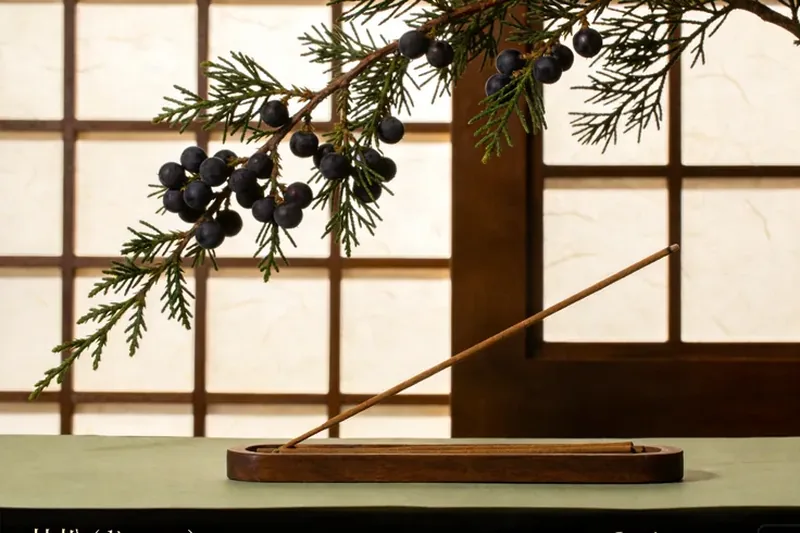
Direct answer: Juniper (杜松, dùsōng) is the common juniper, Juniperus communis, an evergreen conifer of the cypress family (Cupressaceae). It is best known in the West as the source of juniper berries — the flavor of gin — and as a clean, piney aromatic wood and needle material. In Chinese incense it is a modern crossover, absent from the Ming Xiangcheng (香乘) and the Bencao Gangmu.
Key facts
| Chinese | 杜松 (dùsōng) — “juniper” |
| Botanical source | Juniperus communis (family Cupressaceae) — wood, needles, berries |
| What it is | An evergreen conifer, a modern aromatic wood |
| Aroma | Woody, piney, resinous, fresh |
| Traditional role | None in classical Chinese incense — modern cross-over |
Aroma profile
Direct answer: Juniper is woody and piney, resinous and fresh, with a clean, bracing, slightly camphoraceous lift. It is brighter and drier than cedarwood, and less smoky than cypress. The berries carry a sharper, culinary green-pine note; the wood and needles give the familiar evergreen warmth.
Juniper is woody and piney, resinous and fresh, with a clean, bracing, slightly camphoraceous lift. It is brighter and drier than cedarwood, and less smoky than cypress. The berries carry a sharper, more culinary green-pine note; the wood and needles give the familiar evergreen warmth. In incense the wood reads as a clear, northern conifer — a clean-burning base or mid note in modern and Western-style blends.
Botanical identity
Direct answer: Juniperus communis is the most widely distributed conifer in the world, native across the cool-temperate and subarctic Northern Hemisphere. It is a shrub or small tree whose fleshy blue-black “berries” are botanically modified cones, and whose aromatic material is the wood, the needles, and those berries — all carrying the volatile oils that give juniper its clean, piney-resinous character.
Juniperus communis is the most widely distributed conifer in the world, native across the cool-temperate and subarctic Northern Hemisphere — Europe, Asia, and North America — though it is not a Flora of China species. It is a shrub or small tree with sharp, needle-like leaves and, on female plants, the fleshy, blue-black “berries” (botanically modified cones) that flavor gin. The aromatic material is the wood, the needles, and the berries. See Juniperus communis on GBIF.
Chinese name and terminology
Direct answer: The name 杜松 means “juniper” — 松 (the pine/conifer character) + 杜 (a qualifier). The 松 character, like 柏, names a broad conifer class, which is why 杜松 (juniper) and 雪松 (cedar) and the pines get run together in casual use despite naming different plants.
The name 杜松 (dùsōng) joins 松, the character for the pine/conifer class, with the qualifier 杜. As with 柏 in 崖柏 and 柏子, the 松 character is a category marker — “conifer” — not a species name. This is why 杜松 (juniper) sits confusingly near 雪松 (cedar) and the true pines in Chinese naming: they share a conifer register but are unrelated plants with different uses.
A modern cross-over, honestly stated (read this)
Direct answer: 杜松 is a modern aromatic borrowed from Western perfumery, not a classical Chinese incense material. Common juniper does not appear in the 香乘 or the 本草 incense tradition, and Flora of China does not record Juniperus communis among its native junipers. The honest, useful fact is this absence: any claim of an antique 杜松 lineage should be treated with skepticism.
杜松 must be understood for what it is: a modern aromatic, not a classical Chinese incense material. The common juniper Juniperus communis does not appear in the classical Chinese incense compendium 香乘, nor is it a documented 本草 incense ingredient, and Flora of China does not record the species among the native junipers it treats (FOC lists J. formosana, J. chinensis, J. rigida, and others, but not J. communis). Its presence in Chinese-language incense culture is a contemporary borrowing from Western perfumery and botanical aromatics, where juniper — through gin, bath products, and wood-based incense — is deeply familiar.
This page describes 杜松 = common juniper as a modern cross-over. We do not invent a classical origin for it. That honesty is itself the useful fact: if a product or formula claims an antique 杜松 lineage, treat the claim with skepticism.
Where does juniper come from?
Direct answer: Common juniper comes from the cool-temperate and subarctic Northern Hemisphere — Europe, Asia, and North America — where it is the world’s most widely distributed conifer. It is not a native Flora-of-China species, which is consistent with its absence from the classical Chinese aromatic canon.
Juniperus communis spans the cool-temperate and subarctic Northern Hemisphere across three continents, growing as a shrub or small tree in open, often rocky or poor soils. Because it is not a Flora of China species, its entry into Chinese-language incense is a borrowing of a plant familiar elsewhere — a fact that reinforces, rather than contradicts, its status as a modern cross-over rather than a native classical material.
Why is it used in incense?
Direct answer: Juniper is used as a clean, piney, resinous evergreen note — a bright, bracing conifer that works as a base or mid note in modern and Western-style incense. Its function is the familiar evergreen freshness, the same character that makes it a staple of Western room fragrance and bath products.
Juniper’s role in incense is the clean, bracing evergreen note: a bright, resinous, piney character that sits in the base-to-mid register of modern and Western-style blends. It is not a classical Chinese 香材 and is not burned in traditional 合香; it enters Chinese incense as a modern aromatic, carrying the same function it holds in Western incense, room fragrance, and aromatherapy. The wood gives the familiar evergreen warmth, while the berries and needles contribute a sharper, fresher lift.
How is it processed?
Direct answer: Juniper is used as the wood, the needles, and the berries, each carrying the plant’s volatile oils. The wood is dried and cut or ground; the needles are dried and crushed; the berries are dried whole or crushed. No resin tapping or distillation step is needed for the incense forms — though juniper berry oil is a separate distilled product.
The three aromatic parts — wood, needles, and berries — are handled by drying and, where needed, grinding:
- Wood — dried, then cut into chips or ground to powder for blending and burning.
- Needles — dried and crushed, contributing a sharper, fresher green note.
- Berries — dried whole or crushed; the culinary part, best known for gin, and a distinct aromatic from the wood.
Juniper berry oil, obtained by distillation, is a separate commercial product from the dried plant material used in incense.
What determines juniper quality?
Direct answer: Quality turns on freshness of the piney-resinous aroma and the condition of the material — clean, well-dried wood, needles, and berries that retain their volatile oils. Juniper volatiles fade with age, so a fresh, bracing batch beats a flat, woody one.
The quality factors, in rough order:
- Aroma freshness — a clean, bracing, piney-resinous character; juniper’s volatiles fade with age and poor storage.
- Condition — clean, well-dried material free of mold, dust, and excess stem.
- Part identity — wood, needles, and berries carry different balances of the same character; specify the part when sourcing.
- Species clarity — common juniper (Juniperus communis), distinct from “cedarwood” junipers such as J. virginiana.
Common forms
Direct answer: Juniper is sold as wood (chips and powder), dried needles, and dried whole or crushed berries, plus a distilled berry oil. Wood and needles serve incense blending; the berries serve culinary and distilled-oil use; the oil is a separate fragrance product.
| Form | Typical use |
|---|---|
| Wood chips / powder | Incense base or mid note |
| Dried needles | Fresh green conifer accent |
| Dried berries | Culinary, gin, and crushed aromatic use |
| Juniper berry oil | Perfumery and scented products (distilled) |
In modern incense and aromatics
- Western aromatic staple (Modern Industry Practice): juniper is a familiar clean, evergreen note in Western incense, room fragrance, and bath products, and the defining botanical of gin.
- Wood and needle use (Modern Industry Practice): the wood burns clean and piney; the needles and berries contribute a sharper, fresher lift.
- Not a classical Chinese material (Historical Record): 杜松 has no documented role in the 香乘 or 本草 incense tradition, and this entry records that absence honestly.
Traditional use vs modern evidence
Direct answer: There is no classical Chinese incense tradition for common juniper to describe; its aromatic use is modern and Western in origin, and well documented in that context. This page makes no medical claims. The documented facts are botanical identity, the Cupressaceae placement, and the modern aromatic use of wood, needles, and berries.
- Traditional Use — none in the classical Chinese incense canon; this page records that absence.
- Historical Record — juniper’s long Western use (gin, aromatic wood, bath products) is a documented modern practice, not a Chinese classical tradition.
- Scientific Evidence — the botanical identity of Juniperus communis (Cupressaceae) and its near-global cool-temperate distribution are documented. We present no clinical or medical efficacy claims.
What buyers should look for
Direct answer: Buyers should expect a woody, piney, resinous, fresh character, confirm the species (Juniperus communis rather than a “cedarwood” juniper), and check freshness of the volatile aroma. It is a modern aromatic, not a classical Chinese material — so verify any claim of antique provenance.
For an incense maker or sourcing buyer:
- Species — 杜松 is common juniper (Juniperus communis); distinguish it from the Juniperus species traded as “cedarwood” (such as J. virginiana).
- Freshness — a clean, bracing, piney-resinous note; reject flat, faded material.
- Part — specify wood, needles, or berries, as they carry different balances of the same character.
- Provenance honesty — it is a modern cross-over; treat any claim of antique Chinese lineage with skepticism.
Safety
Incense combustion produces smoke and particulate matter. Burn in a well-ventilated space, avoid inhaling concentrated smoke, and keep away from children and pets. This is editorial knowledge content, not medical advice.
Juniper vs cedar vs thuja
Direct answer: These are three conifer materials with woody aromas but different identities and sourcing profiles. Juniper is Juniperus communis, a modern cross-over; cedar is true cedar (Cedrus) or trade “cedarwood” (Juniperus virginiana); thuja is the scarce endemic wood of Thuja sutchuenensis. Juniper is the bright, fresh, widely available one of the three.
| Juniper (杜松) | Cedar (雪松) | Thuja (崖柏) | |
|---|---|---|---|
| Botanical source | Juniperus communis | Cedrus spp., or Juniperus virginiana in trade | Thuja sutchuenensis |
| Character | Woody, piney, resinous, fresh | Woody, clean, slightly sweet | Woody, cedar-like, slightly smoky |
| Status | Modern cross-over, widely available | Widely available; name confusion | Scarce, endemic, protected |
| Sourcing concern | Provenance honesty | “cedarwood” = juniper confusion | Substitution + legality |
See cedar, thuja, and the material comparison matrix.
Our Industry View
Direct answer: Juniper’s commercial lesson is that a material can enter a tradition from outside it and still be fully legitimate — provided the label is honest about that entry. It is a bright, cheap, reliable conifer note; the buyer’s real risk is not quality but provenance inflation, where a modern Western aromatic is dressed up as a classical Chinese 香材.
From a manufacturing perspective, juniper is a case in provenance honesty rather than sourcing difficulty:
- It is abundant and cheap, and that is its strength. As the world’s most widely distributed conifer, juniper is a dependable, low-cost evergreen note. A manufacturer can build a repeatable product on it without the scarcity anxiety of agarwood or 崖柏.
- The risk is narrative, not material. The temptation with any modern aromatic is to attach an invented antique lineage to justify a premium. With 杜松, that would be fabrication — it has no classical Chinese incense history. The disciplined approach is to present it as what it is: a modern, Western-origin conifer note, and let it earn its place on aroma and cost rather than story.
- Know the “cedarwood” trap. Because trade “cedarwood” often means a Juniperus, juniper and cedar are routinely confused in sourcing. Pinning down the species is the practical first step.
In our view, juniper is a clean, bright, reliable conifer whose honest framing is itself the useful discipline: buy it by species, price it by its real abundance, and resist the temptation to invent a classical origin it never had.
Summary
杜松 (Juniperus communis) is the common juniper, the world’s most widely distributed conifer, best known for the berries that flavor gin and as a clean, piney, resinous aromatic wood and needle material. It is a modern cross-over into Chinese incense — absent from the 香乘 and the 本草 canon, and not a native Flora-of-China species — so its value is a bright, abundant evergreen note rather than any classical lineage. For a buyer the practical checks are species (versus “cedarwood” junipers), freshness of the volatile aroma, and an honest framing that does not inflate a Western aromatic into a Chinese classical 香材.
FAQ
What is 杜松 (juniper)? The common juniper, Juniperus communis, an evergreen conifer of the cypress family (Cupressaceae) native across the cool-temperate Northern Hemisphere. It is the source of juniper berries — the flavor of gin — and a clean, piney aromatic wood and needle material. In Chinese incense it is a modern cross-over, not a classical ingredient.
Is juniper a classical Chinese incense material? No. Common juniper does not appear in the Ming-dynasty Xiangcheng (香乘) or the Bencao Gangmu (本草纲目), and Flora of China does not record Juniperus communis among the junipers it treats. Its presence in Chinese-language incense is a contemporary borrowing from Western aromatics. Any antique 杜松 lineage claim should be treated with skepticism.
What does juniper smell like? Woody and piney, resinous and fresh, with a clean, bracing, slightly camphoraceous lift. It is brighter and drier than cedarwood and less smoky than cypress. The berries are sharper and more culinary; the wood and needles give the familiar evergreen warmth.
What part of the juniper is used? The wood, the needle-like leaves, and the fleshy blue-black “berries” (botanically modified cones). All three carry the volatile oils that give juniper its clean, piney-resinous character. The berries are best known for flavoring gin.
Is juniper the same as cedar? Not botanically. Juniper is Juniperus (Cupressaceae); true cedar is Cedrus (Pinaceae). But in trade, “cedarwood” often means a Juniperus such as J. virginiana, which is why the two are frequently confused. Juniper is brighter and drier than true cedarwood.
How should I buy juniper for incense? Confirm the species (Juniperus communis rather than a “cedarwood” juniper), specify the part (wood, needles, or berries), and check for a fresh, bracing, piney-resinous aroma. It is abundant and inexpensive, so price it by its real availability — and do not accept a premium justified by an invented classical Chinese lineage.
See also: cedar, thuja, and the full scent guide.
Evidence & Sources
Botanical identity
Source: Juniperus communis on GBIF. Evidence type: Established. Note: not a Flora of China species; FOC treats other junipers but not J. communis.
Traditional Chinese use
Source: absence from the Ming-dynasty Xiangcheng (香乘) and Bencao Gangmu (本草纲目) — common juniper is a modern cross-over, not a classical Chinese incense material. Evidence type: Honest absence record — no classical use is claimed.
Authenticity / disambiguation
Source: Juniperus communis (common juniper) vs true cedar (Cedrus, Pinaceae) vs trade “cedarwood” (often Juniperus virginiana). Evidence type: Practical screening.
Safety
Source: incense combustion produces smoke and particulate matter; burn in a well-ventilated space. Evidence type: Established.
Evidence status
| Layer | Status |
|---|---|
| Botanical identity | Established |
| Traditional use | None (modern cross-over) |
| Authenticity test | Practical screening |
| Health claims | Not established |
Sources
Sources: botanical references on Juniperus communis. 杜松 (common juniper) is a modern cross-over aromatic, not a classical Chinese incense material, and no classical use is claimed; no medical claims are made. This is editorial knowledge content, not medical advice.