Direct answer: Spearmint (留兰香, liúlánxiāng) is the herb Mentha spicata, a perennial of the mint family (Lamiaceae) native to Europe and Asia and widely cultivated. Its leaves carry a sweet, cooling, minty-fresh scent, and it is a modern culinary and fragrance crossover, not a classical Chinese incense ingredient. It is distinct from the Chinese mint 薄荷 (Mentha haplocalyx) and peppermint 胡椒薄荷 (Mentha × piperita).
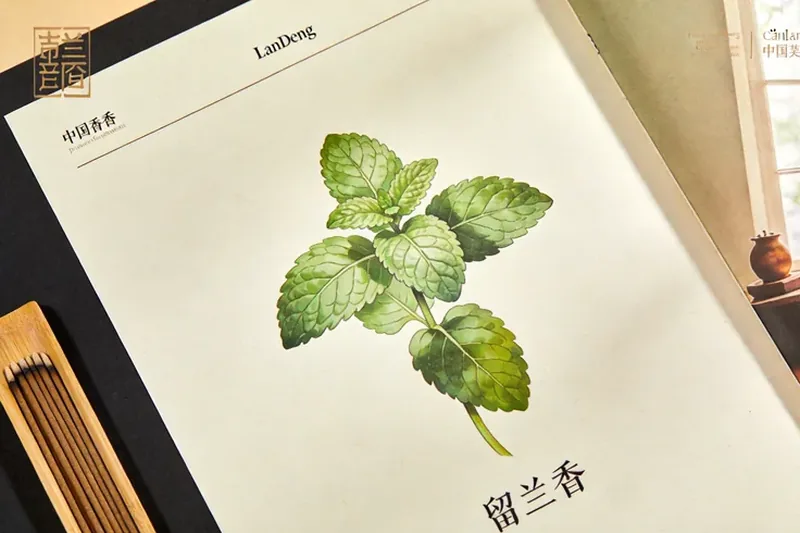
Key facts
| Chinese | 留兰香 (liúlánxiāng); spearmint |
| Botanical source | Mentha spicata (family Lamiaceae) — the aerial herb |
| What it is | A sweet mint, distinct from 薄荷 and peppermint |
| Aroma | Cooling, minty, sweet, fresh, green |
| Traditional role | None in classical Chinese incense; modern culinary/herbal |
Aroma profile
Direct answer: Spearmint is sweet and cooling, with a fresh, green, gently minty character — softer and sweeter than peppermint’s sharp camphoraceous bite. Its sweetness comes chiefly from the compound carvone rather than the menthol that dominates peppermint, which is why it reads as sweet-mint rather than hot-mint.
留兰香 (spearmint) is sweet and cooling, with the fresh, green, gently minty character of the culinary herb — softer and sweeter than the sharp, camphoraceous bite of peppermint. Its sweetness comes chiefly from the compound carvone, rather than the menthol that dominates peppermint, which is why it reads as sweet-mint rather than hot-mint. This single chemical difference — carvone versus menthol — is the whole story of how two green mints end up smelling so differently, and it is the most reliable way to tell them apart at the organ.
A provenance note (read this)
Direct answer: Spearmint is a modern culinary and fragrance crossover, not a classical Chinese 香材. The species is European and Asian and recorded by Flora of China largely as cultivated or naturalized, but “spearmint” as a named herb is a European and modern tradition. The Chinese pharmacopoeial mint is the separate species 薄荷 (Mentha haplocalyx).
留兰香 (spearmint) is a modern culinary and fragrance crossover, not a classical Chinese 香材:
- Mentha spicata is a European and Asian species recorded by Flora of China (largely cultivated/naturalized in China). But “spearmint” as a named culinary and fragrance herb is a European and modern tradition.
- The Chinese pharmacopoeial mint is 薄荷 (Mentha haplocalyx, syn. M. canadensis), a different species with its own entry; 留兰香 is a separate, sweeter mint.
- Spearmint’s incense and fragrance use is modern and Western-influenced, absent from the classical 香材 canon.
This page records it honestly as a modern culinary and fragrance herb — no classical Chinese incense origin is claimed, and none is fabricated.
The mint trio (read this)
Direct answer: Three distinct mints appear in this encyclopedia: 薄荷 (mint, Mentha haplocalyx), 留兰香 (spearmint, Mentha spicata), and 胡椒薄荷 (peppermint, Mentha × piperita). They share a minty family character but differ in species, chemistry, and aroma — spearmint is the sweet, carvone-dominant one, sitting between the pharmacopoeial mint and the menthol-dominant hybrid.
The Mentha genus supplies three distinct mints in this encyclopedia:
- 薄荷 (mint) — Mentha haplocalyx (syn. M. canadensis), the East Asian pharmacopoeial mint, the “mint” of Chinese tradition. Its own entry.
- 留兰香 (spearmint) — Mentha spicata, the sweet, carvone-dominant mint. This entry.
- 胡椒薄荷 (peppermint) — Mentha × piperita, the sharp, menthol-dominant hybrid mint. Its own entry.
All three share a minty family character, but they are different species (or a hybrid) with different aromas and chemistry. Spearmint is a true species; peppermint is a hybrid of spearmint and watermint, which is a detail that matters for understanding why their chemistry diverged.
Botanical source and origin
Direct answer: Mentha spicata is a perennial herb of the mint family (Lamiaceae), native to Europe and temperate Asia and widely cultivated. Flora of China records the species largely as cultivated or naturalized. The fragrant part is the aerial herb — leaves and flowering tops — used fresh or dried, and the key chemistry is the carvone-dominant oil.
Mentha spicata is a perennial herb of the mint family (Lamiaceae), native to Europe and temperate Asia and widely cultivated. Flora of China records the species, largely as a cultivated or naturalized plant. The fragrant part is the aerial herb — the leaves and flowering tops — used fresh or dried. The mint family also includes 薄荷 (Mentha haplocalyx) and the hybrid peppermint (Mentha × piperita).
The mint family’s habit of freely hybridizing is worth noting for buyers, because it means “mint” is often a loose commercial category. Spearmint’s identity rests on being Mentha spicata specifically — a carvone-dominant sweet mint — rather than the menthol-dominant peppermint or the East Asian 薄荷.
Where does spearmint come from?
Direct answer: Mentha spicata is native to Europe and temperate Asia and has been spread worldwide by cultivation, so it is now grown and naturalized across much of the temperate world. It is a garden and field crop, not a wild-harvested aromatic, and its supply is ordinary rather than scarce.
Spearmint is a robust, widely cultivated herb whose natural range has been massively extended by human planting. Native to Europe and temperate Asia, it is now grown and naturalized across the temperate world, in gardens and as a commercial herb crop. Unlike a wild aromatic such as agarwood or a restricted species such as red sandalwood, spearmint is an easy, renewable garden crop — its supply is unremarkable, and its commercial value rests entirely on its aroma character rather than on any scarcity or regulatory constraint.
In modern use
Direct answer: Spearmint is a classic culinary mint, used in teas, sauces, and confectionery, and it appears in modern fragrance and, occasionally, incense as a sweet, cooling green note. It has no place in the classical 香材 canon; its named use is modern and European-influenced.
- Cooking and tea: spearmint is a classic culinary mint, used in teas, sauces, and confectionery.
- Fragrance and incense: spearmint appears in modern fragrance and, occasionally, incense as a sweet cooling green note.
- Not classical Chinese incense: spearmint has no place in the classical 香材 canon; its named use is modern and European-influenced.
Traditional use vs modern evidence
Direct answer: Spearmint carries no classical Chinese incense record and no traditional materia-medica role in this encyclopedia’s scope; its position is modern. The documented facts are botanical identity, the Lamiaceae placement, and the modern culinary-and-fragrance role, plus the established carvone-dominant chemistry of its oil.
- Traditional Use — none in classical Chinese incense; spearmint is not a 香材, and no traditional aromatic or materia-medica role is claimed for 留兰香 here.
- Historical Record — the botanical record places Mentha spicata as a European and Asian mint recorded by Flora of China largely as cultivated or naturalized; the “spearmint” culinary tradition is modern and European, not a Chinese classical record.
- Scientific Evidence — botanical identity (Lamiaceae) and the carvone-dominant essential oil are established; no medical claims are made.
There is no classical Chinese incense record for 留兰香 (spearmint) as a distinct 香材; its position is modern. We make no medical claims. The documented facts are botanical identity, the Lamiaceae placement, and its modern culinary and fragrance role.
How is spearmint used in incense?
Direct answer: Spearmint is not a classical incense material, so in incense it appears only as a modern fragrance note — usually an essential oil or accord — rather than as a burned herb. Its sweet, cooling carvone character lends a soft green-mint lift to fresh blends, distinct from peppermint’s harsher menthol bite.
Because spearmint has no classical Chinese incense role, its incense use is entirely modern and borrowed from perfumery and culinary mint. Where it appears, it is as a sweet, cooling green-mint note, delivered as an essential oil or an accord rather than as dried herb to be burned. The practical distinction for a formulator is that spearmint’s carvone sweetness blends softly — it cools and freshens a composition without the sharp, medicinal edge that menthol (peppermint) can impose. This makes it a gentler fresh accent, better suited to delicate or sweet blends than its harsher cousin.
What buyers should look for
Direct answer: A buyer should specify the species — Mentha spicata, not 薄荷 or peppermint — because the three mints differ in chemistry and aroma. Expect a sweet, carvone-dominant, soft cooling note rather than a sharp menthol bite, and for fragrance use expect an essential oil or accord rather than a burned herb.
For a formulator or sourcing buyer, the checks are:
- Species — confirm Mentha spicata and distinguish it from 薄荷 (Mentha haplocalyx / M. canadensis) and peppermint (Mentha × piperita); the three are different mints with different aromas.
- Aroma — the tell is a sweet, soft, carvone-mint character; a sharp, camphoraceous, menthol-driven note indicates peppermint, not spearmint.
- Format — for fragrance, expect an essential oil or a synthetic accord; the dried culinary herb is not an incense material.
- Purpose — spearmint cools and freshens gently; if a harsher cooling bite is wanted, that is peppermint’s role, and the two should not be treated as interchangeable.
Our Industry View
Direct answer: Spearmint’s lesson is a chemistry lesson: the difference between spearmint and peppermint is not “mint” versus “mint” but carvone versus menthol — one molecule that changes the entire sensory and blending character. For the incense formulator, “mint” is therefore never a sufficient specification; the molecule that dominates is the real order.
Spearmint is the clearest demonstration in this encyclopedia that a single aroma molecule can define a material’s identity and its proper use. Spearmint and peppermint are both “mint,” yet one is sweet and soft and the other sharp and medicinal — a difference that reduces almost entirely to carvone versus menthol. The implication for anyone blending botanicals is direct:
- Name the molecule, not just the plant. A formulator who wants a soft green-mint accent should specify carvone-dominant spearmint; one who wants a piercing cooling note should specify menthol-dominant peppermint. “Mint” alone guarantees nothing about which effect will arrive.
- Sweetness is a blending asset, not a flaw. Spearmint’s carvone sweetness is precisely why it suits delicate, sweet, or fresh compositions — it cools without the medicinal harshness that menthol can impose. Choosing the “sweeter” mint is sometimes the more sophisticated move.
- Modern crossover herbs carry a provenance obligation. Like tarragon, spearmint earns its place honestly — as a modern fragrance herb with no classical Chinese incense pedigree. Stating that absence plainly is better than borrowing a tradition it does not have.
In our view, spearmint is a minor material with a major teaching point: in botanical incense, the aroma molecule is the specification, and the plant name is only the starting point.
Summary
Spearmint (留兰香) is the perennial mint Mentha spicata, a sweet, cooling, carvone-dominant herb that sits between the pharmacopoeial 薄荷 (Mentha haplocalyx) and the menthol-dominant hybrid peppermint (Mentha × piperita) in this encyclopedia’s mint trio. It is a modern culinary and fragrance crossover with no classical Chinese incense record, stated plainly rather than fabricated. Commercially, its value rests entirely on its carvone-sweet aroma character, and the practical lesson is that “mint” is not a sufficient specification — the dominant molecule is.
FAQ
What is 留兰香 (spearmint)? The herb Mentha spicata, a perennial of the mint family (Lamiaceae) native to Europe and temperate Asia and widely cultivated. Its leaves carry a sweet, cooling, minty-fresh scent. It is a modern culinary and fragrance crossover, not a classical Chinese incense ingredient.
How is spearmint different from 薄荷 (mint)? They are different species of the same mint family. 留兰香 is Mentha spicata, the sweet, carvone-dominant mint; 薄荷 is Mentha haplocalyx (syn. M. canadensis), the East Asian pharmacopoeial mint of Chinese tradition. Both are mints, but they are distinct plants with different aromas and identities.
How is spearmint different from peppermint? Spearmint (Mentha spicata) is sweet and cooling, dominated by carvone; peppermint (Mentha × piperita) is sharp and camphoraceous, dominated by menthol. Spearmint is a species; peppermint is a hybrid of spearmint and watermint. Spearmint reads sweet-mint, peppermint reads hot-mint.
What does spearmint smell like? Sweet and cooling, with a fresh, green, gently minty character — softer and sweeter than the sharp camphoraceous bite of peppermint. Its sweetness comes chiefly from carvone rather than menthol, which is why it reads sweet-mint rather than hot-mint.
How is spearmint used? Primarily as a classic culinary mint in teas, sauces, and confectionery, and in modern fragrance and, occasionally, incense as a sweet cooling green note. It is a modern, European-influenced use, not a classical Chinese incense material.
Why is spearmint sweeter than peppermint? Because their dominant aroma molecules differ. Spearmint’s oil is dominated by carvone, a compound that reads as a sweet, soft mint; peppermint’s is dominated by menthol, which reads as sharp, camphoraceous, and cooling. One molecule’s difference explains the entire sensory gap between the two mints.
See also: mint (薄荷), peppermint (胡椒薄荷), and the full scent guide.
Evidence & Sources
Botanical identity
Source: Mentha spicata in Flora of China · Mentha spicata on GBIF. Evidence type: Established.
Modern use
Source: spearmint as a culinary herb and modern sweet cooling fragrance note; a modern crossover with no classical Chinese incense record. Evidence type: Modern culinary/herbal — no classical Chinese record; none claimed.
Authenticity / disambiguation
Source: 留兰香 (Mentha spicata) vs 薄荷 (M. haplocalyx) vs 胡椒薄荷 (M. × piperita). Evidence type: Practical screening.
Safety
Source: incense combustion produces smoke and particulate matter; burn in a well-ventilated space. Evidence type: Established.
Evidence status
| Layer | Status |
|---|---|
| Botanical identity | Established |
| Traditional use | None (modern culinary/herbal) |
| Authenticity test | Practical screening |
| Health claims | Not established |
Sources
Sources: botanical references on Mentha spicata and the spearmint-vs-mint-vs-peppermint distinction. 留兰香 (spearmint) is a modern culinary and fragrance herb with no classical Chinese incense record; no such origin is claimed. This is editorial knowledge content, not medical advice.