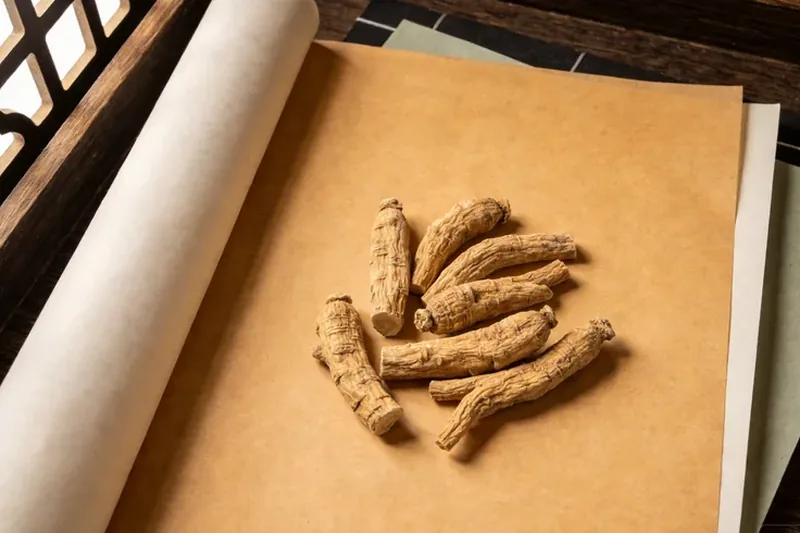
Direct answer: Aromatic turmeric (郁金, yùjīn) is the dried rhizome of Curcuma aromatica, a ginger-family (Zingiberaceae) perennial native to South and Southeast Asia and cultivated in southern China. It is a warm, camphoraceous, earthy rhizome sometimes called “wild turmeric,” and its name (郁金) literally means “aromatic gold.” It is one of three closely related Curcuma rhizomes that are routinely confused.
Key facts
| Chinese | 郁金 (yùjīn) — “aromatic gold” |
| Botanical source | Curcuma aromatica (family Zingiberaceae) — the dried rhizome |
| What it is | A dried rhizome, not a wood or resin |
| Aroma | Earthy, camphoraceous, warm, slightly bitter |
| Traditional role | Materia medica; aromatic rhizome in the turmeric group |
Aroma profile
Direct answer: 郁金 is earthy and camphoraceous, warm with a slightly bitter edge — it sits close to turmeric but is less brightly earthy and more medicinal-camphoraceous in character. Like the other Curcuma rhizomes, its scent is grounded and warm, a base accent in the ginger-family register.
郁金 is earthy and camphoraceous, warm with a slightly bitter edge — it sits close to turmeric but is less brightly earthy and more medicinal-camphoraceous in character. Like the other Curcuma rhizomes, its scent is grounded and warm, a base accent in the ginger-family register. Its rhizome, like turmeric’s, carries aromatic compounds and, in the wild-type form, a milder color than the vivid yellow-orange of culinary turmeric.
Botanical identity
Direct answer: Curcuma aromatica is a rhizomatous perennial of the ginger family (Zingiberaceae), native to South and Southeast Asia and cultivated in southern China. The part used is the dried rhizome. The genus Curcuma also includes 姜黄 (Curcuma longa) and the zedoary group, and the ginger family more broadly includes galangal and sand ginger.
Curcuma aromatica is a rhizomatous perennial of the ginger family (Zingiberaceae), native to South and Southeast Asia and cultivated in southern China. The part used is the dried rhizome. The genus Curcuma also includes 姜黄 (Curcuma longa) and the zedoary group (Curcuma zedoaria / C. phaeocaulis), and the ginger family more broadly includes 高良姜 (galangal) and 山柰 (sand ginger). See Curcuma aromatica in Flora of China.
Chinese name and terminology
Direct answer: The name 郁金 (yùjīn) literally means “aromatic gold” — 郁 (fragrant/lush) + 金 (gold). But the same two characters also name the tulip (郁金香, “aromatic-gold fragrance”), and this collision is a classic Chinese nomenclature trap: a rhizome and a flower share a name but are unrelated.
The name 郁金 (yùjīn) is a praise-name: 郁 “fragrant, lush” + 金 “gold” — “aromatic gold,” a name of honor for an aromatic rhizome. But here is the trap: the very same characters 郁金 also appear in 郁金香 (yùjīnxiāng), the tulip — literally “aromatic-gold fragrance.” So 郁金 can name:
- 郁金 (the rhizome) — Curcuma aromatica, the “wild turmeric.” This entry.
- 郁金香 (the tulip) — the flower Tulipa, named for its fragrance, not related to the rhizome at all.
The two senses meet only in the characters, not in botany. A label that says 郁金 names a rhizome; a label that says 郁金香 names a flower.
The 郁金香 / 郁金 collision and the three-way Curcuma confusion (read this)
Direct answer: Two confusions sit inside 郁金. First, 郁金香 (tulip) is not 郁金 (the rhizome) — the shared characters name a flower and a rhizome that are unrelated. Second, 郁金 is one of three closely related Curcuma rhizomes — 姜黄 (turmeric), 郁金 (aromatic turmeric), 莪术 (zedoary) — that historical sources have not always kept apart.
Two separate confusions live in 郁金, and both matter:
- The tulip collision. 郁金香 (the tulip, Tulipa) and 郁金 (the rhizome, Curcuma aromatica) are unrelated plants that share two characters. The classical fragrance text 香乘 records 郁金香 as a distinct name — and a reader must not assume the “香” (fragrance) makes the flower and the rhizome the same thing. They are different entries in the classical record.
- The Curcuma three-way confusion. 郁金 is also routinely confused with its genus-mates:
- 姜黄 (Curcuma longa) — “turmeric,” the yellow-orange culinary and coloring rhizome.
- 郁金 (Curcuma aromatica) — “wild turmeric,” a medicinal aromatic; its name means “aromatic gold.” This entry.
- 莪术 (Curcuma zedoaria / C. phaeocaulis) — the zedoary group, the most medicinal of the three.
The confusion arises because all three are Curcuma rhizomes with warm, earthy, camphoraceous characters, and historical sources have not always kept them apart. This page describes 郁金 = Curcuma aromatica = aromatic (wild) turmeric. When a source says 姜黄 or 莪术, it is describing a different material — and when it says 郁金香, it may be describing the tulip. See turmeric and zedoary.
The imported oil record (香乘考据)
Direct answer: The Ming Xiangcheng (香乘) records 郁金油 (aromatic-turmeric oil) and 郁金香, and notes that “in India people anoint the body with various aromatics, namely sandalwood and 郁金” (印度之人身塗諸香所謂旃檀鬱金也) — an imported aromatic-oil use, distinct from the culinary turmeric and from the tulip.
The Xiangcheng (香乘) preserves a distinctive record of 郁金 as an imported aromatic, not a domestic cooking spice:
- 郁金油 (aromatic-turmeric oil) — the text records 郁金油, the aromatic oil of the rhizome, as a fragrance material.
- The body-anointing note — the text observes that “in India people anoint the body with various aromatics, namely sandalwood and 郁金” (印度之人身塗諸香所謂旃檀鬱金也), placing 郁金 beside sandalwood as an anointing aromatic.
This is a meaningful distinction: it records 郁金 in its aromatic register — an oil and an anointing material — rather than as the culinary coloring spice that turmeric (姜黄) became. The imported, fragrant-oil identity is what separates 郁金 from its genus-mates in the classical record.
Where does aromatic turmeric come from?
Direct answer: Aromatic turmeric comes from Curcuma aromatica, a ginger-family perennial native to South and Southeast Asia and cultivated in southern China. The dried rhizome is the material of use, harvested from the plant’s underground stem.
Curcuma aromatica grows across South and Southeast Asia and is cultivated in southern China. The part used is the rhizome, harvested and dried, carrying the warm, camphoraceous, earthy character of the “wild turmeric” group. Its cultivated range in southern China is consistent with its classical record as an imported and then locally grown aromatic.
Why is it used in incense?
Direct answer: 郁金 is used as a warm, earthy, camphoraceous base accent in the ginger-family register — a grounded note that lends depth to a blend. Its classical record is as an aromatic oil (郁金油) and a body-anointing material, not a culinary coloring spice.
郁金’s aromatic role is a warm, earthy, camphoraceous base accent — a grounded note in the ginger-family register that adds depth rather than lift. Its classical record is aromatic rather than culinary: the Xiangcheng records 郁金油 (the oil) and its use as a body-anointing aromatic alongside sandalwood. This separates it from turmeric, whose fame is the yellow-orange culinary and coloring rhizome. In incense, 郁金 is a supporting warm note, not a dominant scent.
How is it processed?
Direct answer: 郁金 is handled as a dried rhizome — harvested and dried, then sliced or ground. Its aromatic oil (郁金油) is obtained by distillation, a separate product from the dried rhizome itself. For the rhizome form, drying preserves the warm, camphoraceous character.
As a rhizome aromatic, 郁金 is handled by drying: the rhizome is harvested, cleaned, and dried, then used whole, sliced, or ground. The aromatic oil (郁金油) recorded in the Xiangcheng is obtained by distillation, and is a distinct product from the dried rhizome. For the dried-rhizome form used in blends, the practical concern is a well-dried rhizome that retains its warm, earthy, camphoraceous character.
What determines aromatic turmeric quality?
Direct answer: Quality turns on species identity and rhizome condition. The buyer’s first job is to distinguish 郁金 (Curcuma aromatica) from 姜黄 (turmeric) and 莪术 (zedoary); then to judge a clean, well-dried rhizome with the warm, earthy, camphoraceous character — more medicinal than culinary turmeric.
The quality factors:
- Species identity — the decisive check: 郁金 (Curcuma aromatica) versus 姜黄 (Curcuma longa) and 莪术 (Curcuma zedoaria / C. phaeocaulis), three distinct rhizomes routinely confused.
- Condition — clean, well-dried rhizome, free of mold and excess soil.
- Aroma — an earthy, camphoraceous, warm character, close to but more medicinal than culinary turmeric.
- Part — the rhizome; distinct from the distilled oil (郁金油).
Common forms
Direct answer: 郁金 is sold as the dried whole rhizome, sliced rhizome, and powder, plus a distilled aromatic oil (郁金油). The dried rhizome forms serve blending; the oil is a separate fragrance material recorded in the classical texts.
| Form | Typical use |
|---|---|
| Dried whole / sliced rhizome | Materia medica; storage |
| Powder | Blending as a warm base accent |
| Aromatic oil (郁金油) | Fragrance; classical anointing oil |
In Chinese tradition
- Materia medica (Traditional Use): 郁金 is recorded in traditional Chinese medicine, classically described as a warming aromatic. This is traditional materia-medica language, not modern clinical evidence.
- Classical aromatic (Historical Record): the name 郁金 appears in classical fragrance texts — the Ming-dynasty Xiangcheng (香乘) records 郁金油 (aromatic-turmeric oil) and 郁金香, and notes that “in India people anoint the body with various aromatics, namely sandalwood and 郁金” (印度之人身塗諸香所謂旃檀鬱金也), an imported aromatic-oil use.
- Not a culinary turmeric (Historical Record): unlike 姜黄, 郁金 is not the standard culinary turmeric, though the two are closely related.
Traditional use vs modern evidence
Direct answer: The aromatic and traditional-medicine use is documented. Medicinal uses are traditional, not established clinical fact, and this page makes no medical claims. The documented, non-medical facts are botanical identity, the Curcuma genus placement, and the aromatic-rhizome use in the turmeric group.
- Traditional Use — 郁金 as a materia-medica warming aromatic.
- Historical Record — the Ming-dynasty Xiangcheng (香乘) record of 郁金油 and 郁金香, and the “sandalwood and 郁金” body-anointing note, placing 郁金 in the aromatic-oil register.
- Scientific Evidence — the botanical identity of Curcuma aromatica (Zingiberaceae) is documented. We present no clinical or medical efficacy claims.
What buyers should look for
Direct answer: Buyers should first distinguish 郁金 (Curcuma aromatica) from 姜黄 (turmeric) and 莪术 (zedoary), then confirm a clean, well-dried rhizome with an earthy, camphoraceous, warm character — more medicinal than culinary turmeric. In incense it is a grounded, warm base accent, not a dominant scent.
For a buyer or formulator:
- Species — 郁金 (Curcuma aromatica) versus 姜黄 (Curcuma longa) and 莪术 (Curcuma zedoaria / C. phaeocaulis).
- Condition — clean, well-dried rhizome.
- Aroma — earthy, camphoraceous, warm; more medicinal than culinary turmeric.
- Role — a grounded, warm base accent in the ginger-family register, not a dominant scent.
Safety
Incense combustion produces smoke and particulate matter. Burn in a well-ventilated space, avoid inhaling concentrated smoke, and keep away from children and pets. This is editorial knowledge content, not medical advice.
Aromatic turmeric vs turmeric vs zedoary
Direct answer: These are three distinct Curcuma rhizomes. 郁金 (Curcuma aromatica) is “wild turmeric,” a medicinal aromatic with a classical oil record; 姜黄 (Curcuma longa) is culinary turmeric, the yellow-orange coloring rhizome; 莪术 (zedoary) is the most medicinal of the three. They share a warm, earthy register but are different species.
| Aromatic turmeric (郁金) | Turmeric (姜黄) | Zedoary (莪术) | |
|---|---|---|---|
| Botanical source | Curcuma aromatica | Curcuma longa | Curcuma zedoaria / C. phaeocaulis |
| Name meaning | “Aromatic gold” | “Ginger-yellow” | (plain medicinal name) |
| Character | Earthy, camphoraceous, aromatic | Earthy, warm, culinary | Earthy, camphoraceous, strongly medicinal |
| Classical note | 郁金油 (aromatic oil), body-anointing | Coloring rhizome | Prepared (vinegar + salt) |
See turmeric, zedoary, and the material comparison matrix.
Our Industry View
Direct answer: 郁金’s commercial lesson is a naming hazard: the same characters name a rhizome and a tulip, and the rhizome is one of three easily-confused Curcuma species. A buyer should fix the species first, then value 郁金 for its aromatic-oil register — a warm, earthy base accent — rather than confuse it with culinary turmeric.
From a manufacturing perspective, 郁金 is a case where naming is the hazard, not quality:
- The name does two jobs at once. 郁金 names a rhizome and, with 香, a tulip. A buyer who does not resolve which 郁金 is meant — rhizome, oil, or flower — has not yet begun the purchase. This is a naming-discipline problem before it is a botanical one.
- The Curcuma fork is real. 郁金, 姜黄, and 莪术 are warm, earthy rhizomes that look alike and are confused in both trade and older texts. The species must be pinned down, because culinary turmeric, aromatic turmeric, and medicinal zedoary are different purchases with different prices and uses.
- Value the aromatic register, not the color. 郁金’s classical identity is an aromatic oil and a body-anointing material — a fragrance, not a coloring spice. A buyer who prices it like culinary turmeric (for its color) is valuing the wrong attribute.
In our view, 郁金 is a warm, earthy, camphoraceous base accent whose real procurement question is which 郁金 — species and form — and whose value sits in the aromatic-oil register, not the culinary one.
Summary
郁金 (Curcuma aromatica) is the “wild turmeric” — a warm, camphoraceous, earthy rhizome of the ginger family, cultivated in southern China, whose name literally means “aromatic gold.” The same characters also name the tulip (郁金香), a classic nomenclature collision, and the rhizome is one of three easily-confused Curcuma species (with 姜黄 and 莪术). Its classical record is aromatic rather than culinary — the Xiangcheng records 郁金油 and its use as a body-anointing oil alongside sandalwood — which is what separates it from the coloring spice turmeric. Its medicinal uses are traditional language, not clinical evidence.
FAQ
What is 郁金 (aromatic turmeric)? The dried rhizome of Curcuma aromatica, a ginger-family (Zingiberaceae) perennial native to South and Southeast Asia and cultivated in southern China. It is a warm, camphoraceous, earthy rhizome sometimes called “wild turmeric,” and its name 郁金 literally means “aromatic gold.” It is one of three closely related Curcuma rhizomes that are routinely confused.
What is the difference between 郁金, 姜黄, and 莪术? All three are distinct Curcuma rhizomes. 姜黄 is Curcuma longa — “turmeric,” the yellow-orange culinary and coloring rhizome. 郁金 is Curcuma aromatica — a distinct medicinal rhizome sometimes called “wild turmeric.” 莪术 is the zedoary group (Curcuma zedoaria / C. phaeocaulis). This page describes 郁金 = Curcuma aromatica; the other two are separate materials.
Is 郁金 the same as turmeric? Not exactly. 郁金 (Curcuma aromatica) is closely related to turmeric (Curcuma longa) — both are Curcuma rhizomes — but they are different species. 郁金 is sometimes called “wild turmeric” and is used in traditional medicine, while 姜黄 is the standard culinary turmeric and coloring material. The shared Curcuma genus is the source of the confusion.
What does 郁金 smell like? Earthy and camphoraceous, warm with a slightly bitter edge — close to turmeric but less brightly earthy and more medicinal-camphoraceous. In incense it reads as a grounded, warm base accent in the ginger-family register, not a dominant scent.
Does 郁金 appear in classical texts? Yes. The Ming-dynasty Xiangcheng (香乘) records 郁金油 (aromatic-turmeric oil) and 郁金香, and notes that “in India people anoint the body with various aromatics, namely sandalwood and 郁金” (印度之人身塗諸香所謂旃檀鬱金也) — an imported aromatic-oil use distinct from the culinary turmeric.
Is 郁金 the same as the tulip (郁金香)? No — this is a naming collision. 郁金 names the rhizome Curcuma aromatica; 郁金香 names the tulip (Tulipa), an unrelated flower. The shared characters 郁金 mean “aromatic gold,” but they name two different plants — a rhizome and a flower — that are unrelated botanically.
See also: turmeric, zedoary, and the full scent guide.
Evidence & Sources
Botanical identity
Source: Curcuma aromatica in Flora of China · Curcuma aromatica on GBIF. Evidence type: Established.
Traditional Chinese use
Source: 郁金 as a materia-medica warming aromatic; the Ming-dynasty Xiangcheng (香乘) records 郁金油 and 郁金香, and the “sandalwood and 郁金” body-anointing note. Evidence type: Historically documented — aromatic use; medicinal uses are traditional, not modern clinical evidence.
Authenticity / disambiguation
Source: 郁金 (Curcuma aromatica) vs 姜黄 (Curcuma longa) vs 莪术 (Curcuma zedoaria / C. phaeocaulis) — three distinct Curcuma rhizomes. Evidence type: Practical screening; historically documented name confusion.
Safety
Source: incense combustion produces smoke and particulate matter; burn in a well-ventilated space. Evidence type: Established.
Evidence status
| Layer | Status |
|---|---|
| Botanical identity | Established |
| Traditional use | Historically documented |
| Authenticity test | Practical screening (name confusion) |
| Health claims | Not established |
Sources
Sources: botanical references on Curcuma aromatica and the 郁金/姜黄/莪术 distinction. 郁金 is recorded as an aromatic and medicinal rhizome in the turmeric group; medicinal uses are treated as traditional, not established clinical fact. This is editorial knowledge content, not medical advice.