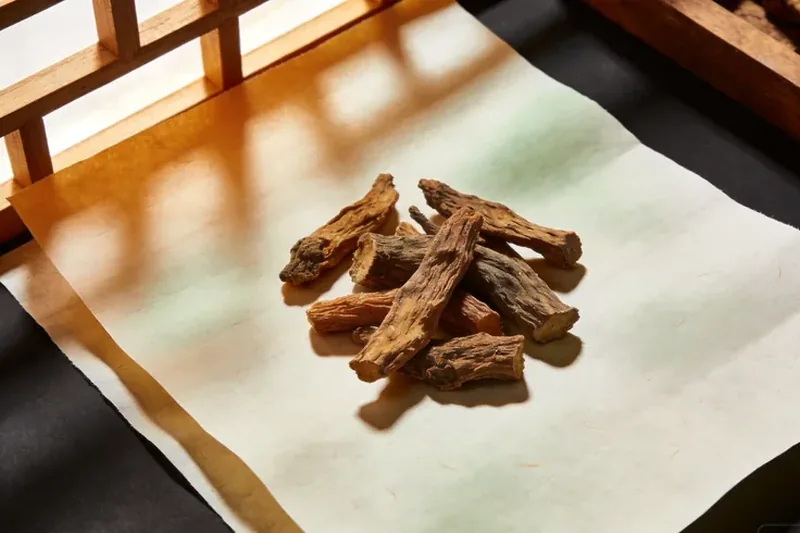
Direct answer: Zedoary (莪术, ézhú) is the dried rhizome of the zedoary group, Curcuma zedoaria (with Curcuma phaeocaulis most often cited for Chinese material), a ginger-family (Zingiberaceae) perennial of South and Southeast Asia. It is a warm, camphoraceous, earthy rhizome in the same genus as turmeric, used primarily in traditional medicine and recorded in classical incense formulas as a minor ingredient. It is one of three closely related Curcuma rhizomes that are routinely confused.
Key facts
| Chinese | 莪术 (ézhú) |
| Botanical source | Curcuma zedoaria (cf. Curcuma phaeocaulis; family Zingiberaceae) — the dried rhizome |
| What it is | A dried rhizome, not a wood or resin |
| Aroma | Earthy, camphoraceous, warm, slightly bitter |
| Traditional role | Materia medica; minor classical incense ingredient |
Aroma profile
Direct answer: 莪术 is earthy and camphoraceous, warm with a slightly bitter, medicinal edge — the most strongly medicinal of the three common Curcuma rhizomes. Like 姜黄 and 郁金 it is a grounded, warm base accent in the ginger-family register, but its character leans more pungent and less sweet than turmeric.
莪术 is earthy and camphoraceous, warm with a slightly bitter, medicinal edge — the most strongly medicinal of the three common Curcuma rhizomes. Like 姜黄 and 郁金 it is a grounded, warm base accent in the ginger-family register, but its character leans more pungent and less sweet than turmeric. In incense it is a minor supporting note rather than a fragrance in its own right.
Botanical identity
Direct answer: The zedoary group belongs to the ginger family (Zingiberaceae), native to South and Southeast Asia. The name Curcuma zedoaria is the long-standing designation for zedoary; Flora of China treats the Chinese material most often under Curcuma phaeocaulis, a closely related species. The part used is the dried rhizome.
The zedoary group belongs to the ginger family (Zingiberaceae), native to South and Southeast Asia. The name Curcuma zedoaria is the long-standing designation for zedoary; Flora of China treats the Chinese material most often under Curcuma phaeocaulis, a closely related species. The part used is the dried rhizome. The genus Curcuma also includes 姜黄 (Curcuma longa) and 郁金 (Curcuma aromatica). See Curcuma phaeocaulis in Flora of China.
Chinese name and terminology
Direct answer: The name 莪术 (ézhú) is a medicinal-rhizome name with no obvious “aromatic” marker — unlike 郁金 (“aromatic gold”) or 姜黄 (“ginger-yellow”). This is itself a signal: 莪术 names a medicinal rhizome in the ginger family, and its place in incense is minor and prepared, not a fragrance in its own right.
The name 莪术 (ézhú) carries no aromatic or color marker — it is a plain materia-medica name for a medicinal rhizome. Contrast this with its two Curcuma relatives: 姜黄 (“ginger-yellow,” naming the color) and 郁金 (“aromatic gold,” naming the fragrance). The plainness of 莪术 is telling: it names a medicinal material, and its appearance in incense is as a minor, prepared additive rather than a named scent.
The 郁金 / 姜黄 / 莪术 confusion (read this)
Direct answer: Three closely related Curcuma rhizomes — 姜黄 (Curcuma longa), 郁金 (Curcuma aromatica), and 莪术 (the zedoary group) — share overlapping Chinese names and warm, earthy, camphoraceous characters, and historical sources have not always kept them apart. This page describes 莪术; the other two are distinct materials.
Three closely related Curcuma rhizomes share overlapping Chinese names and are routinely confused, even in some classical texts. This encyclopedia distinguishes them by species:
- 姜黄 (Curcuma longa) — “turmeric,” the yellow-orange culinary rhizome and coloring material. Its own entry.
- 郁金 (Curcuma aromatica) — a distinct rhizome used in traditional medicine, sometimes called “wild turmeric.” Its own entry.
- 莪术 (Curcuma zedoaria / Curcuma phaeocaulis) — another distinct medicinal rhizome in the zedoary group. This entry.
The confusion arises because all three are Curcuma rhizomes with warm, earthy, camphoraceous characters, and historical sources have not always kept them apart. This page describes 莪术 = the zedoary group (Curcuma zedoaria, cf. C. phaeocaulis). When a source says 姜黄 or 郁金, it is describing a different material. See turmeric and aromatic-turmeric.
The processing note as identity evidence (read this)
Direct answer: The Ming Xiangcheng (香乘) records 莪术 only in a processing note — 莪术醋煮過用鹽水浸出…為末蜜和同甘草膏為餅 — meaning the rhizome is cooked in vinegar, soaked out in salt water, ground, and mixed with honey and licorice paste into cakes. Reading this note tells us 莪术 was a prepared, minor addition, not a principal scent.
Here is a small piece of textual evidence that does real work. The Ming-dynasty Xiangcheng (香乘) records 莪术 not as a fragrance in its own right but only in a processing note:
莪术醋煮過用鹽水浸出…為末蜜和同甘草膏為餅
That is: the rhizome is boiled in vinegar, soaked out in salt water, ground to powder, and mixed with honey and a licorice paste to form cakes. The significance of this note:
- The processing is the identity. A material that must be vinegar-boiled and salt-water-soaked before it enters a formula is being tamed, not showcased. The note tells us 莪术 was a prepared, minor, medicinal-flavored addition — a corrector or balancer in a formula — rather than a named aromatic.
- “Minor ingredient” is read from the recipe, not asserted. This is the difference between saying “莪术 was minor” as a vague claim and reading the processing note that demonstrates it. The note is the evidence.
- It contrasts with 姜黄 and 郁金. Turmeric is a culinary coloring rhizome; 郁金 has its own classical aromatic-oil record. 莪术’s record is a processing instruction — which is exactly what a minor medicinal ingredient leaves behind.
This is how an encyclopedia reads a recipe as evidence: the way a material is processed reveals its rank in the formula.
Where does zedoary come from?
Direct answer: The zedoary group is native to South and Southeast Asia, with the Chinese material treated under Curcuma phaeocaulis. The rhizome is cultivated and harvested for its dried, aromatic underground stem, which carries the warm, camphoraceous character.
Curcuma zedoaria (and its Chinese counterpart Curcuma phaeocaulis) grows across South and Southeast Asia. The part used is the rhizome — the thick underground stem — which is harvested and dried. The dried rhizome is the material of trade, carrying the warm, camphoraceous, slightly bitter character of the zedoary group.
Why is it used in incense?
Direct answer: 莪术 is used in incense as a minor, prepared supporting note — a warm, earthy, camphoraceous accent that is usually processed (vinegar-boiled, salt-soaked) and blended, not burned alone. Its role is corrective and background rather than a fragrance in its own right.
莪术’s role in classical incense is minor and prepared: a warm, earthy, camphoraceous accent that appears as a processed addition rather than a named scent. The Xiangcheng processing note shows it being boiled in vinegar and soaked in salt water before blending — preparation that tames its medicinal edge and relegates it to a background, balancing role. It is not burned alone, and it is not a lead 香材; its value is as a small, warm, slightly bitter support in a formula.
How is it processed?
Direct answer: 莪术 is processed before use — the classical record specifies boiling in vinegar, soaking out in salt water, and grinding, then mixing with honey and licorice paste into cakes. This preparation tames the rhizome’s medicinal edge and marks it as a prepared, minor addition.
The processing of 莪术 is itself the informative detail:
- Vinegar-boiling — the rhizome is boiled in vinegar, a step that alters and softens its sharp, medicinal character.
- Salt-water soaking — the boiled rhizome is soaked out in salt water, further moderating it.
- Grinding and binding — the prepared rhizome is ground to powder and mixed with honey and a licorice paste (甘草膏) into cakes for storage and use.
This multi-step preparation is what marks 莪术 as a prepared, minor ingredient: a material showcased as a fragrance is not treated this way.
What determines zedoary quality?
Direct answer: Quality turns on species identity and rhizome condition. The buyer’s first job is to distinguish the zedoary group (莪术) from 姜黄 and 郁金; then to judge a clean, well-dried rhizome with the warm, camphoraceous, slightly bitter character expected of the material.
The quality factors:
- Species identity — the decisive check: 莪术 (zedoary group) versus 姜黄 (Curcuma longa) and 郁金 (Curcuma aromatica), three distinct rhizomes routinely confused.
- Condition — clean, well-dried rhizome, free of mold and excess soil.
- Aroma — a warm, camphoraceous, slightly bitter medicinal character — the most medicinal of the three common Curcuma rhizomes.
- Preparation state — whether the material is raw or already prepared (vinegar-boiled, salt-soaked) matters for its intended use.
Common forms
Direct answer: 莪术 is sold as the dried whole rhizome, sliced rhizome, and powder, and classically was prepared into honey-and-licorice cakes. The whole and sliced forms suit materia-medica use; powder and prepared cakes suit blending as a minor accent.
| Form | Typical use |
|---|---|
| Dried whole / sliced rhizome | Materia medica; storage |
| Powder | Minor blending accent |
| Prepared cakes (honey + licorice) | Classical prepared form for formulas |
In Chinese tradition
- Materia medica (Traditional Use): 莪术 is recorded in traditional Chinese medicine, classically described as a warming aromatic. This is traditional materia-medica language, not modern clinical evidence.
- Classical incense (Historical Record): 莪术 appears as a minor ingredient in classical incense formulas — the Ming-dynasty Xiangcheng (香乘) records 莪术 in a processing note (莪术醋煮過用鹽水浸出…為末蜜和同甘草膏為餅), indicating a prepared, minor addition rather than a principal scent.
- Not a culinary turmeric (Historical Record): 莪术 is a medicinal rhizome, not the standard culinary turmeric (姜黄).
Traditional use vs modern evidence
Direct answer: The medicinal and minor incense use is documented. Medicinal uses are traditional, not established clinical fact, and this page makes no medical claims. The documented, non-medical facts are botanical identity, the Curcuma genus placement, and the minor aromatic use in the turmeric group.
- Traditional Use — 莪术 as a materia-medica warming aromatic.
- Historical Record — the Ming-dynasty Xiangcheng (香乘) processing note (莪术醋煮過用鹽水浸出…為末蜜和同甘草膏為餅), recording 莪术 as a prepared, minor incense addition.
- Scientific Evidence — the botanical identity of the zedoary group (Curcuma zedoaria / C. phaeocaulis, Zingiberaceae) is documented. We present no clinical or medical efficacy claims.
What buyers should look for
Direct answer: Buyers should first distinguish 莪术 (the zedoary group) from 姜黄 and 郁金, then confirm a clean, well-dried rhizome with the warm, camphoraceous, slightly bitter medicinal character. In incense it is a minor, usually processed supporting note, not a lead scent.
For a buyer or formulator:
- Species — 莪术 (zedoary group) versus 姜黄 (Curcuma longa) and 郁金 (Curcuma aromatica); three distinct rhizomes routinely confused.
- Condition — clean, well-dried rhizome.
- Aroma — warm, camphoraceous, slightly bitter; the most medicinal of the three.
- Role — a minor, usually processed supporting note in incense, not burned alone.
Safety
Incense combustion produces smoke and particulate matter. Burn in a well-ventilated space, avoid inhaling concentrated smoke, and keep away from children and pets. This is editorial knowledge content, not medical advice.
Zedoary vs turmeric vs aromatic turmeric
Direct answer: These are three distinct Curcuma rhizomes. 姜黄 (Curcuma longa) is culinary turmeric, the yellow-orange coloring rhizome; 郁金 (Curcuma aromatica) is “wild turmeric,” a medicinal aromatic; 莪术 (the zedoary group) is the most strongly medicinal of the three. They share a warm, earthy register but are different species with different uses.
| Zedoary (莪术) | Turmeric (姜黄) | Aromatic turmeric (郁金) | |
|---|---|---|---|
| Botanical source | Curcuma zedoaria / C. phaeocaulis | Curcuma longa | Curcuma aromatica |
| Character | Earthy, camphoraceous, strongly medicinal | Earthy, warm, culinary | Earthy, camphoraceous, aromatic |
| Primary role | Materia medica; minor incense additive | Culinary spice + coloring | Materia medica; aromatic oil |
| Classical note | Prepared (vinegar + salt) | — | 郁金油 (aromatic-turmeric oil) |
See turmeric, aromatic-turmeric, and the material comparison matrix.
Our Industry View
Direct answer: 莪术’s commercial lesson is that a material’s processing reveals its rank. It is a medicinal rhizome whose classical incense role is minor and prepared — vinegar-boiled, salt-soaked, bound with honey and licorice. A manufacturer should treat it as a small, corrective background note, and distinguish it from 姜黄 and 郁金 before anything else.
From a manufacturing perspective, 莪术 is a case where the processing is the specification:
- Prepared, not raw, is the point. The classical record shows 莪术 being tamed — boiled in vinegar, soaked in salt water, bound with honey and licorice — before it enters a formula. This is not a material you showcase; it is a material you correct. A manufacturer treating 莪术 as a lead note has misread the recipe.
- Identity is a three-way fork. The Curcuma name confusion (姜黄 / 郁金 / 莪术) is a real sourcing hazard, because all three are warm, earthy rhizomes that look superficially alike. Pinning the species is the entry ticket.
- Minor ingredients still need to be right. A minor, corrective note is easy to overlook, but a wrong or badly prepared 莪术 will throw the whole formula’s balance off — the same logic that makes a small dose of a bitter or medicinal material the hardest thing to get right.
In our view, 莪术 is a minor, medicinal-flavored Curcuma rhizome whose value is corrective and background: buy it by species, respect the classical preparation, and dose it as the small, balancing note the recipe intended it to be.
Summary
莪术 (Curcuma zedoaria, cf. Curcuma phaeocaulis) is the dried rhizome of the zedoary group, a ginger-family perennial whose warm, camphoraceous, slightly bitter character makes it the most strongly medicinal of the three common Curcuma rhizomes. It is recorded in classical incense only as a prepared, minor addition — the Xiangcheng processing note (醋煮, 盐水浸, 蜜和甘草膏为饼) is itself the evidence of its background rank — and it is a distinct species from turmeric (姜黄) and aromatic turmeric (郁金), a three-way name confusion that is the buyer’s first check. Its medicinal uses are traditional language, not clinical evidence.
FAQ
What is 莪术 (zedoary)? The dried rhizome of the zedoary group, Curcuma zedoaria (with Curcuma phaeocaulis as the Flora-of-china species most often cited for Chinese material), a ginger-family (Zingiberaceae) perennial of South and Southeast Asia. It is a warm, camphoraceous, earthy rhizome in the same genus as turmeric, used primarily in traditional medicine and recorded as a minor ingredient in classical incense.
What is the difference between 莪术, 姜黄, and 郁金? All three are distinct Curcuma rhizomes. 姜黄 is Curcuma longa — “turmeric,” the yellow-orange culinary and coloring rhizome. 郁金 is Curcuma aromatica — a distinct medicinal rhizome sometimes called “wild turmeric.” 莪术 is the zedoary group (Curcuma zedoaria / C. phaeocaulis). This page describes 莪术; the other two are separate materials.
What does 莪术 smell like? Earthy and camphoraceous, warm with a slightly bitter, medicinal edge — the most strongly medicinal of the three common Curcuma rhizomes. In incense it reads as a minor supporting note in the ginger-family register rather than a fragrance in its own right.
Is 莪术 the same as turmeric? No. 莪术 is the zedoary group (Curcuma zedoaria / C. phaeocaulis), while turmeric is Curcuma longa. Both are Curcuma rhizomes, which is the source of the confusion, but they are different species with different uses — turmeric is the culinary coloring rhizome, 莪术 is a medicinal rhizome.
Does 莪术 appear in classical incense? Yes, as a minor ingredient. The Ming-dynasty Xiangcheng (香乘) records 莪术 in a processing note — 莪术醋煮過用鹽水浸出…為末蜜和同甘草膏為餅 — indicating a prepared, minor addition rather than a principal scent. The processing (vinegar-boiling, salt-soaking, honey-and-licorice binding) is itself the evidence of its background rank.
How should I buy 莪术 for incense? Distinguish it from 姜黄 (Curcuma longa) and 郁金 (Curcuma aromatica) first, then confirm a clean, well-dried rhizome with the warm, camphoraceous, slightly bitter character. Treat it as a minor, prepared supporting note — usually processed, not burned alone.
See also: turmeric, aromatic-turmeric, and the full scent guide.
Evidence & Sources
Botanical identity
Source: Curcuma phaeocaulis in Flora of China · Curcuma zedoaria on GBIF. Evidence type: Established.
Traditional Chinese use
Source: 莪术 as a materia-medica warming aromatic; the Ming-dynasty Xiangcheng (香乘) records 莪术 in a processing note (莪术醋煮過用鹽水浸出…為末蜜和同甘草膏為餅). Evidence type: Historically documented — aromatic use; medicinal uses are traditional, not modern clinical evidence.
Authenticity / disambiguation
Source: 莪术 (Curcuma zedoaria / C. phaeocaulis) vs 姜黄 (Curcuma longa) vs 郁金 (Curcuma aromatica) — three distinct Curcuma rhizomes. Evidence type: Practical screening; historically documented name confusion.
Safety
Source: incense combustion produces smoke and particulate matter; burn in a well-ventilated space. Evidence type: Established.
Evidence status
| Layer | Status |
|---|---|
| Botanical identity | Established |
| Traditional use | Historically documented |
| Authenticity test | Practical screening (name confusion) |
| Health claims | Not established |
Sources
Sources: botanical references on the zedoary group (Curcuma zedoaria, cf. Curcuma phaeocaulis) and the 莪术/姜黄/郁金 distinction. 莪术 is recorded as a medicinal rhizome with minor classical incense use; medicinal uses are treated as traditional, not established clinical fact. This is editorial knowledge content, not medical advice.