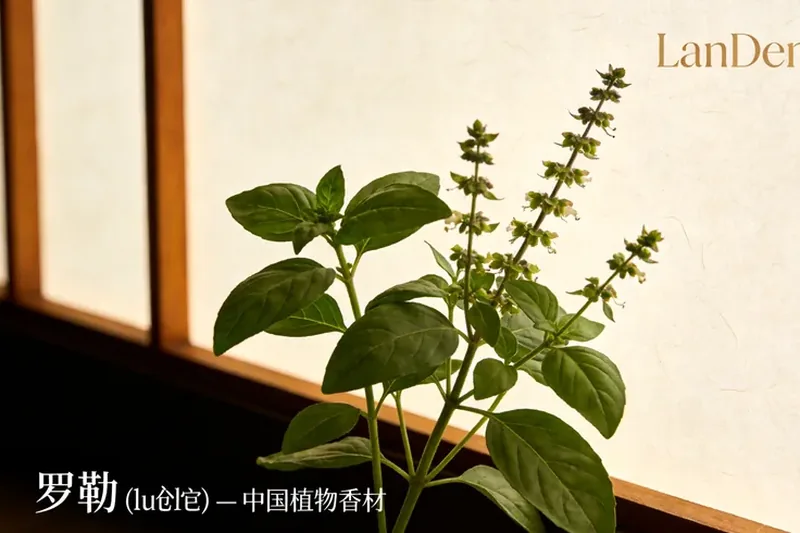
Direct answer: Basil (罗勒, luólè) is sweet basil, Ocimum basilicum, an aromatic herb of the mint family (Lamiaceae). A familiar culinary herb worldwide, it carries the older Chinese name 兰香 (lánxiāng, “orchid fragrance”), which the Bencao Gangmu records as a taboo-name substitution. This classical naming is its genuine connection to the Chinese aromatic record.
Key facts
| Chinese | 罗勒 (luólè); classical 兰香 (lánxiāng) |
| Botanical source | Ocimum basilicum (family Lamiaceae) — the aerial herb |
| What it is | A leafy aromatic herb, not a wood or resin |
| Aroma | Sweet, green, spicy, slightly anise/clove |
| Traditional role | Culinary herb; 兰香 in the classical aromatic record |
Aroma profile
Basil is sweet and green, with a spicy, faintly anise-and-clove lift that varies by cultivar — some sweet and soft, others peppery or licorice-leaning. It is a fresh, food-adjacent note, less minty than mint and less camphoraceous than perilla. In incense and herbal aromatics it reads as a bright green sweetness that lifts and rounds a blend rather than leading it, a kitchen-garden note rather than a temple note.
The 兰香 (lan xiang) naming (read this)
罗勒’s classical name is 兰香 — “orchid fragrance.” The Bencao Gangmu (本草纲目), in its vegetable section (菜之一), records under 罗勒 the alternative names 兰香 and 香菜, and explains the origin:
“禹锡曰:北人避石勒讳,呼罗勒为兰香。” — northerners, avoiding the taboo name of the Later Zhao ruler Shi Le, called 罗勒 as 兰香.
Li Shizhen adds, citing the Ye zhong ji (鄴中記), that Shi Hu (石虎), Shi Le’s successor, tabooed the character 勒 and “改罗勒为香菜” (changed 罗勒 to 香菜). The point for this encyclopedia is precise: 罗勒 and 兰香 are the same herb, and its “orchid fragrance” name is a taboo-avoidance renaming, not evidence that basil is a true orchid or a classical incense material. It is a culinary and garden herb whose aromatic name sits at the edge of the classical record.
Botanical source and origin
Ocimum basilicum is a tender annual herb of the mint family, native to tropical and subtropical Asia (with origins often placed in India) and cultivated worldwide in many culinary varieties. The part used is the leafy aerial herb, which carries the essential oils — dominated by linalool, with methyl chavicol (estragole) or eugenol in some chemotypes — that give sweet basil its characteristic sweet-green, spicy scent. Flora of China records the species.
In Chinese tradition
- Culinary herb: 罗勒/兰香 is a cooking herb, used fresh for its sweet-green, spicy aroma.
- 兰香 naming: the Bencao Gangmu (本草纲目) records that the herb was renamed 兰香 to avoid the taboo name of Shi Le — a genuine classical naming record.
- Garden aromatic, not temple incense: basil’s documented role is as a culinary and garden herb; it is not a burned incense material in the 香乘 tradition.
Traditional use vs modern evidence
The culinary use and the 兰香 naming are documented. We make no medical claims. The documented, non-medical facts are botanical identity, the Lamiaceae placement, and the classical 兰香 naming record.
Quality and sourcing notes
Practical points for buyers:
- 罗勒 is sweet basil (Ocimum basilicum); expect a sweet, green, spicy scent with a faint anise-and-clove lift.
- 罗勒 and 兰香 are the same herb — the latter a taboo-avoidance name, not a different plant.
- It is a culinary and garden herb, not a classical burned incense material; in aromatics it acts as a fresh green supporting note.
Safety
Incense combustion produces smoke and particulate matter. Burn in a well-ventilated space, avoid inhaling concentrated smoke, and keep away from children and pets. This is editorial knowledge content, not medical advice.
FAQ
What is 罗勒 (basil)? Sweet basil, Ocimum basilicum, an aromatic herb of the mint family (Lamiaceae), native to tropical and subtropical Asia and cultivated worldwide in many culinary varieties. It carries the older Chinese name 兰香 (lánxiāng, “orchid fragrance”), recorded in the Bencao Gangmu (本草纲目).
Why is basil called 兰香 (orchid fragrance)? Because of a taboo-avoidance renaming. The Bencao Gangmu (本草纲目) records that northerners, avoiding the taboo personal name of the Later Zhao ruler Shi Le, “called 罗勒 as 兰香” (呼羅勒為蘭香), and that Shi Hu later changed it to 香菜. So 兰香 is a renaming of 罗勒, not a claim that basil is an orchid.
Is 罗勒 the same as 兰香? Yes. They are the same herb, Ocimum basilicum. 罗勒 is the base name and 兰香 is a taboo-avoidance alternative recorded in the classical Bencao Gangmu. The two should not be treated as different plants.
What does basil smell like? Sweet and green, with a spicy, faintly anise-and-clove lift that varies by cultivar. It is a fresh, food-adjacent note, less minty than mint and less camphoraceous than perilla, and reads in aromatics as a bright green sweetness that supports rather than leads a blend.
Is basil a classical Chinese incense material? Not in the burned-incense sense. Basil is a culinary and garden herb; its classical claim to fame is the 兰香 naming recorded in the 本草纲目, not a role in the 香乘 incense tradition. Its aromatic use is as a fresh green note, not a burned temple material.
What is the difference between basil and perilla? Both are Lamiaceae herbs, but basil (Ocimum basilicum) is sweet-green and spicy, while perilla (Perilla frutescens, 紫苏) is more minty and anise-like with a distinctive shiso character. They are different genera with different aromatic profiles, though both are leafy culinary herbs.
See also: perilla, mint, and the full scent guide.
Evidence & Sources
Botanical identity
Source: Ocimum basilicum in Flora of China · Ocimum basilicum on GBIF. Evidence type: Established.
Traditional Chinese use
Source: the Bencao Gangmu (本草纲目), 菜之一, records under 罗勒 the alternative names 兰香 and 香菜, noting “北人避石勒讳,呼罗勒为兰香” (northerners avoided the taboo name of Shi Le and called 罗勒 as 兰香). Evidence type: Historically documented — culinary herb and classical naming.
Authenticity / disambiguation
Source: 罗勒 = 兰香 (same herb, Ocimum basilicum), a taboo-avoidance renaming, not a true orchid. Evidence type: Practical screening.
Safety
Source: incense combustion produces smoke and particulate matter; burn in a well-ventilated space. Evidence type: Established.
Evidence status
| Layer | Status |
|---|---|
| Botanical identity | Established |
| Traditional use | Historically documented (culinary, naming) |
| Authenticity test | Practical screening |
| Health claims | Not established |
Sources
Sources: botanical references on Ocimum basilicum and the Bencao Gangmu (本草纲目) 菜之一 record of the 罗勒/兰香 naming. Basil’s culinary and garden use is documented, and the 兰香 name is a classical taboo-avoidance renaming; no medical claims are made. This is editorial knowledge content, not medical advice.