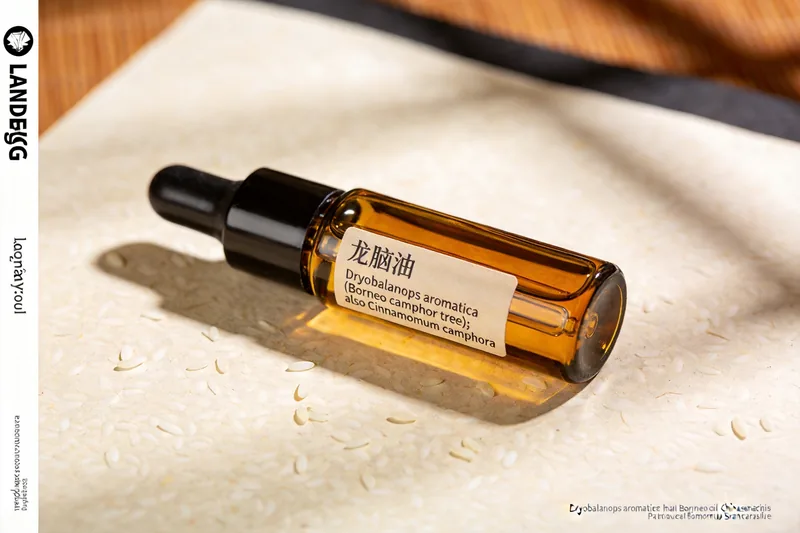
Technical answer: Borneol oil — lóngnǎo yóu (龙脑油, “dragon-brain oil”) in Chinese, classically 婆律膏 (pólǜ gāo) — is the liquid aromatic extract of the borneol camphor tree, Dryobalanops aromatica. It is the oil companion to crystalline borneol (龙脑 / 冰片): the same tree yields both, but the crystal and the oil are distinct materials with distinct histories.
Key facts
| Chinese | 龙脑油 (lóngnǎo yóu); classical name 婆律膏 (pólǜ gāo) |
| Botanical source | Dryobalanops aromatica (Borneo camphor tree); also camphor-tree (Cinnamomum camphora) sources |
| What it is | A liquid aromatic extract, distinct from crystalline borneol |
| Aroma | Camphoraceous, cooling, balsamic, woody |
| Traditional role | Perfumery, incense, materia medica |
Aroma profile
Borneol oil carries the same camphoraceous, cooling family as crystalline borneol, but as a liquid balsam it is softer, more woody-balsamic, and less piercing. Where the crystal 冰片 is a sharp, cooling top note, the oil reads as a rounder camphor-balsam — historically valued as a fine aromatic in its own right.
The crystal / oil distinction
The key point for this material is that it is not the same as crystalline borneol (龙脑 / 冰片), though both come from the same tree. The Ming-dynasty Xiangcheng (香乘), quoting the Bencao Gangmu (本草纲目), records the classical distinction:
- 龙脑香 (the crystal) — 龙脑是西海婆律国婆律树中脂也, the resinous “fat” of the 婆律 tree (Dryobalanops aromatica).
- 婆律膏 (the oil) — the oil of the same tree; classical sources note that thin trees yield the crystal (龙脑香) while fat trees yield the oil (婆律膏) — 瘦者出龙脑香肥者出婆律膏.
The Xiangcheng also records that 龙脑油 was imported — “borneol oil comes from 佛誓国, taken from the tree” (龙脑油本出佛誓国从树取之), and that 大食国 (the Abbasid caliphate) sent 龙脑油 as tribute.
In Chinese tradition
- Perfumery and incense: borneol oil was a prized imported aromatic, distinct from the crystal in use and value.
- Materia medica: 龙脑 / 冰片 appear in traditional Chinese medicine; the oil form is mentioned in the same literature. We treat any such use as traditional, not established clinical fact.
- Historical prestige: the tribute records (大食国进龙脑油) and the Xiangcheng’s careful crystal/oil distinction mark 龙脑油 as a high-status, imported material.
Traditional use vs modern evidence
The classical record documents the crystal/oil distinction, the tree’s origin (婆律国), and the oil’s import and prestige — all historical and observational. The medicinal uses are traditional, not established clinical fact, and we make no medical claims. The documented, non-medical facts are the botanical source and the crystal/oil distinction.
Quality and sourcing notes
Practical points for buyers:
- 龙脑油 (the oil) and 龙脑 / 冰片 (the crystal) are different materials from the same tree — do not confuse them.
- “Borneol” on a modern label can also be synthetic (机制冰片) or leaf-distilled (艾片, l-borneol from Blumea balsamifera) — see our borneol page for the full source problem.
- Natural borneol oil from Dryobalanops aromatica is historically documented but uncommon in modern trade; most commercial “borneol” today is the crystal or synthetic forms.
Safety
Incense combustion produces smoke and particulate matter; burn in a well-ventilated space and avoid inhaling concentrated smoke. Borneol oil is potent and is not for consumption. Keep away from children and pets. This is editorial knowledge content, not medical advice.
FAQ
What is the difference between borneol oil and borneol crystal? They come from the same tree but are different materials. Borneol crystal (龙脑 / 冰片) is the solid “fat” of the Borneo camphor tree (Dryobalanops aromatica); borneol oil (龙脑油 / 婆律膏) is the liquid extract. The Ming-dynasty Xiangcheng (香乘) records that thin trees yield the crystal and fat trees yield the oil — 瘦者出龙脑香肥者出婆律膏. The oil is softer and more balsamic; the crystal is sharper and more cooling.
What is 婆律膏? 婆律膏 (pólǜ gāo) is the classical Chinese name for borneol oil, taken from 婆律国 (Borneo), the source region of the borneol camphor tree. The name appears in the Xiangcheng (香乘) and the Bencao Gangmu (本草纲目) for the oil of the tree, distinguished from the crystal 龙脑香. So 婆律膏 and 龙脑油 refer to the same liquid aromatic material.
Where does borneol oil come from? Classically, from the Borneo camphor tree, Dryobalanops aromatica — called the 婆律 tree in Chinese sources, growing in 婆律国 (Borneo). The Xiangcheng (香乘) records that borneol oil was imported from 佛誓国 and sent as tribute by 大食国 (the Abbasid caliphate). Related camphor-tree (Cinnamomum camphora) sources also yield borneol-family oils.
Is borneol oil natural? Historically, yes — borneol oil was the natural liquid extract of Dryobalanops aromatica. In modern trade, however, “borneol” is usually the crystal or synthetic forms (机制冰片), and genuine natural borneol oil is uncommon. The same “borneol” label can hide synthetic material or a mixture of isomers, so the source — not just the name — determines what you are getting. See our borneol page.
What does borneol oil smell like? Borneol oil carries the same camphoraceous, cooling family as crystalline borneol, but as a liquid balsam it is softer, more woody-balsamic, and less piercing. Where the crystal 冰片 is a sharp, cooling top note, the oil reads as a rounder camphor-balsam — historically valued as a fine aromatic in its own right.
See also: borneol, pine resin, and the full scent guide.
Evidence & Sources
Botanical identity
Source: Dryobalanops aromatica on GBIF · Cinnamomum camphora in Flora of China. Evidence type: Established.
Traditional Chinese use
Source: the Ming-dynasty Xiangcheng (香乘), quoting the Bencao Gangmu (本草纲目), records the crystal/oil distinction (瘦者出龙脑香肥者出婆律膏) and the oil’s import from 佛誓国 and tribute from 大食国. Evidence type: Historically documented — traditional, not modern clinical evidence.
Authenticity / disambiguation
Source: the 龙脑油 (oil) vs 龙脑 / 冰片 (crystal) vs synthetic borneol distinction. Evidence type: Practical screening.
Safety
Source: incense combustion produces smoke and particulate matter; borneol oil is potent and not for consumption. Evidence type: Established.
Evidence status
| Layer | Status |
|---|---|
| Botanical identity | Established |
| Traditional use | Historically documented |
| Authenticity test | Practical screening |
| Health claims | Not established |
Sources
Sources: botanical references on Dryobalanops aromatica (Borneo camphor tree) and Cinnamomum camphora, plus the Ming-dynasty Xiangcheng (香乘) / Bencao Gangmu (本草纲目) records of 龙脑油 / 婆律膏. The oil / crystal / synthetic distinction is recorded as practical screening. Medicinal uses are treated as traditional, not established clinical fact. This is editorial knowledge content, not medical advice.