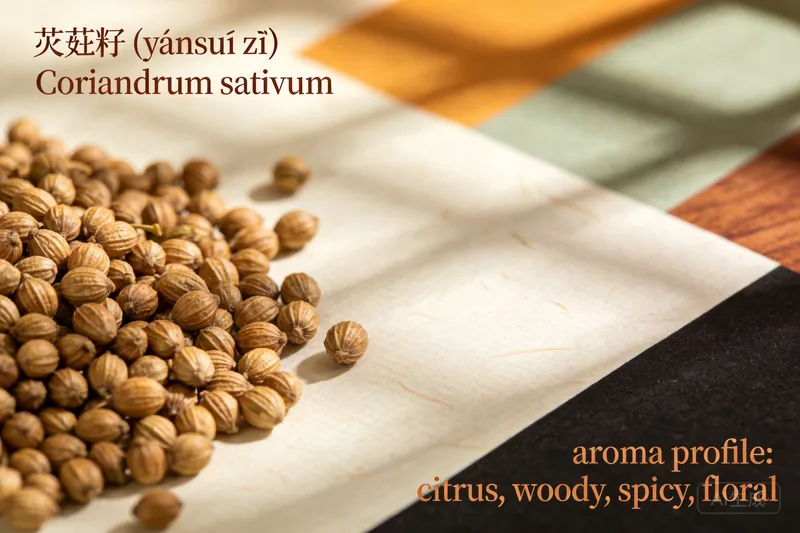
Technical answer: Coriander seed — yánsuī zǐ (芫荽籽) in Chinese — is the dried fruit of Coriandrum sativum, an annual herb of the carrot family (Apiaceae) native to the Mediterranean and western Asia. It is a warm, citrusy spice with a woody, faintly floral undertone, used in Chinese incense as a fresh spice accent. It is the seed of the same plant as the leaf herb cilantro (芫荽, also 香菜), but the seed and the leaf are very different aromatics.
Key facts
| Chinese | 芫荽籽 (yánsuī zǐ); the leaf herb = 芫荽 / 香菜 |
| Botanical source | Coriandrum sativum (family Apiaceae) — the dried fruit (“seed”) |
| What it is | A dried spice fruit, not a wood or resin |
| Aroma | Citrus, woody, spicy, faintly floral |
| Traditional role | Culinary spice, materia medica, fresh incense accent |
Aroma profile
Coriander seed is warm and citrusy, with a woody, slightly spicy, faintly floral character that is completely different from the fresh, soapy-tasting leaf. The seed’s aroma comes largely from the essential oil linalool, which gives it a clean, sweet-woody, citrusy lift. It is a fresh spice accent rather than a base note — it brightens heavier blends in the way that citrus and fennel do.
Botanical source and origin
Coriandrum sativum is an annual herb of the carrot family (Apiaceae), native to the Mediterranean and western Asia, now grown worldwide. The same plant yields two distinct aromatics: the fresh leaf — cilantro in English, 芫荽 or 香菜 in Chinese — and the dried fruit, coriander seed. The seed is the part used in incense and most spice blends; its warm, citrusy character is entirely unlike the leaf.
A naming caution: coriander seed (芫荽籽) and the leaf herb cilantro (芫荽 / 香菜) come from the same plant, Coriandrum sativum, but are different aromatics. The seed is warm, citrusy, and woody; the leaf is fresh, green, and polarizing. In incense it is the seed that is used.
In Chinese tradition
- Culinary spice: coriander seed is a warm, citrusy spice used in cooking and spice blends.
- Materia medica: 芫荽 and 胡荽 (older name) are recorded in traditional Chinese medicine (本草綱目, 菜部) as aromatics. This is traditional materia-medica language, not modern clinical evidence.
- Incense context: coriander seed appears as a fresh spice accent in some 合香 blends, alongside fennel and citrus peels, rather than as a classical defining material.
Traditional use vs modern evidence
The culinary role is well documented. Medicinal uses are traditional, not established clinical fact, and we make no medical claims. The documented, non-medical facts are botanical identity, the seed-vs-leaf distinction, and the fresh, citrusy aromatic use.
Quality and sourcing notes
Practical points for buyers:
- Whole coriander seed should be round, dry, and fragrant with a warm, citrusy, slightly floral aroma; ground seed loses scent faster.
- Distinguish the seed (芫荽籽, warm and citrusy) from the leaf herb (芫荽 / 香菜, fresh and green) — different aromatics from the same plant.
- In incense, coriander seed is a fresh spice accent, usually blended, not burned alone.
Safety
Incense combustion produces smoke and particulate matter. Burn in a well-ventilated space, avoid inhaling concentrated smoke, and keep away from children and pets. This is editorial knowledge content, not medical advice.
FAQ
What is coriander seed? The dried fruit of Coriandrum sativum, an annual herb of the carrot family (Apiaceae) native to the Mediterranean and western Asia. It is a warm, citrusy spice with a woody, faintly floral undertone, used in cooking, spice blends, and as a fresh accent in some incense. It is the seed of the same plant as the leaf herb cilantro.
Are coriander seed and cilantro the same thing? They come from the same plant, Coriandrum sativum, but are different aromatics. The seed (芫荽籽) is warm, citrusy, woody, and faintly floral; the leaf (cilantro, 芫荽 / 香菜) is fresh, green, and strongly flavored. In incense and most spice blends, it is the seed that is used. They are not interchangeable in aroma.
What does coriander seed smell like? Warm and citrusy, with a woody, slightly spicy, faintly floral character that comes largely from the essential oil linalool. It is a fresh spice accent — it brightens heavier blends in the way that citrus and fennel do — rather than a base note. The seed’s aroma is entirely unlike the fresh, green scent of the coriander leaf.
What is 芫荽 in Chinese tradition? 芫荽 (also 胡荽 in older texts) is the coriander plant, recorded as a culinary herb and a materia-medica aromatic in the 本草綱目 菜部. The seed (芫荽籽) is the part used as a spice, and it appears as a fresh accent in some 合香 (blended incense) formulas alongside fennel and citrus peels.
How should coriander seed be stored for quality? Whole, rather than ground. Whole coriander seed is round, dry, and fragrant with a warm, citrusy, slightly floral aroma, and it retains its scent far longer than pre-ground powder. The strength of the aroma when the seed is freshly crushed is the main quality indicator, and in incense it is a fresh spice accent used in blends.
See also: fennel, orange-peel, and the full scent guide.
Evidence & Sources
Botanical identity
Source: Coriandrum sativum in Flora of China · Coriandrum sativum on GBIF. Evidence type: Established.
Traditional Chinese use
Source: 芫荽 / 胡荽 as a culinary herb and materia-medica aromatic, recorded in the 本草綱目 菜部. Evidence type: Historically documented — culinary use; medicinal uses are traditional, not modern clinical evidence.
Authenticity / disambiguation
Source: coriander seed vs cilantro leaf — different aromatics from the same plant, Coriandrum sativum. Evidence type: Practical screening.
Safety
Source: incense combustion produces smoke and particulate matter; burn in a well-ventilated space. Evidence type: Established.
Evidence status
| Layer | Status |
|---|---|
| Botanical identity | Established |
| Traditional use | Historically documented (culinary) |
| Authenticity test | Practical screening |
| Health claims | Not established |
Sources
Sources: botanical references on Coriandrum sativum and the coriander-seed-vs-leaf distinction. Coriander is recorded as a culinary spice; medicinal uses are treated as traditional, not established clinical fact. This is editorial knowledge content, not medical advice.