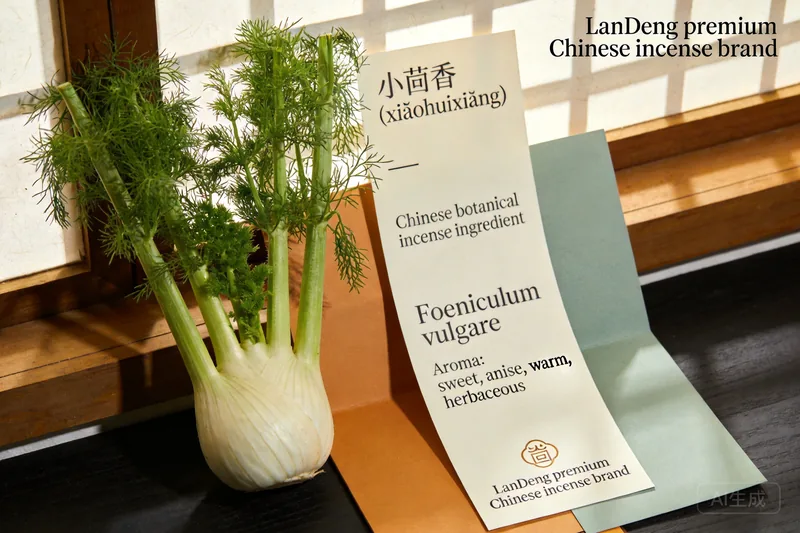
Technical answer: Fennel — xiǎohuíxiāng (小茴香) in Chinese — is the dried seed-like fruit of Foeniculum vulgare, a herbaceous plant of the carrot family (Apiaceae). It is best known as a sweet, anise-like culinary spice, and it appears in Chinese incense as a warm, sweet supporting note in classical 合香 (blended incense) formulas — including the famous 寿阳公主梅花香 (Shouyang princess’s plum incense), where it is listed as 茴香. It is distinct from the larger, star-shaped 八角 (star anise, Illicium verum), which Chinese usage sometimes also calls 大茴香.
Key facts
| Chinese | 小茴香 (xiǎohuíxiāng), also 茴香; cf. 大茴香/八角 (star anise) |
| Botanical source | Foeniculum vulgare (family Apiaceae) — the dried fruit |
| What it is | A dried aromatic seed-fruit, a spice |
| Aroma | Sweet, anise-like, warm, slightly herbaceous |
| Traditional role | Culinary spice, materia medica, 合香 supporting note |
Aroma profile
Fennel is sweet and anise-like — warm, herbaceous, and softly licorice-scented, driven largely by the aromatic anethole that it shares with anise and star anise. It is a gentler, greener “sweet-spice” note than star anise. In incense it adds a warm, food-adjacent sweetness that supports and rounds a blend rather than leading it.
Botanical source and origin
Foeniculum vulgare is a hardy herbaceous plant of the carrot family, native to the Mediterranean but long cultivated across temperate Eurasia, including China. The part used is the small, ridged, seed-like fruit, often simply called “fennel seed.” Its anethole content gives the characteristic anise sweetness.
A naming caution: Chinese 茴香 is ambiguous. 小茴香 (xiǎohuíxiāng) is fennel, Foeniculum vulgare; 大茴香 or 八角 (bājiǎo) is star anise, Illicium verum, a different plant. Classical incense recipes that list 茴香 are usually read as fennel, but the two share the 茴香 name and both carry an anethole sweetness.
In Chinese tradition
- Culinary spice: 小茴香 is a staple of Chinese braising and spice blends, valued for its warm, sweet, anise-like character.
- Materia medica: 小茴香 appears in traditional Chinese medicine as a warming aromatic. This is traditional materia-medica language, not modern clinical evidence.
- Incense context: 茴香 is listed as an ingredient in classical 合香 formulas — most notably the 寿阳公主梅花香 (Shouyang princess’s plum incense), where it acts as a warm spice-and-sweetness note alongside clove bark and rosewood.
Traditional use vs modern evidence
The culinary role is unambiguous and well documented. Medicinal uses are traditional, not established clinical fact, and we make no medical claims. In incense, fennel’s documented role is a warm sweet-spice supporting note in classical blended formulas.
Quality and sourcing notes
Practical points for buyers:
- Fennel fruit should be whole, greenish-brown, and strongly sweet-anise in scent; the aroma is the main quality indicator.
- Distinguish 小茴香 (fennel) from 大茴香/八角 (star anise) when a recipe or label says 茴香 — they are different plants with a shared name and a shared anethole sweetness.
- In incense, fennel is a supporting spice note, not a base or a self-sufficient fragrance.
Safety
Incense combustion produces smoke and particulate matter. Burn in a well-ventilated space, avoid inhaling concentrated smoke, and keep away from children and pets. This is editorial knowledge content, not medical advice.
FAQ
Is fennel the same as star anise? No. Fennel (小茴香, Foeniculum vulgare) is the small seed-like fruit of a carrot-family herb; star anise (八角 / 大茴香, Illicium verum) is the star-shaped fruit of an unrelated evergreen tree. Both carry the sweet anethole note and both share the Chinese name element 茴香, which is why they are confused. Classical recipes listing 茴香 are usually read as fennel, but the ambiguity is real and worth checking.
What does fennel smell like? Sweet and anise-like — warm, herbaceous, and softly licorice-scented. The anethole molecule it shares with anise and star anise drives the sweetness. Fennel is a gentler, greener note than star anise, and in incense it adds a warm, food-adjacent sweetness that supports a blend rather than dominating it.
Is fennel a Chinese incense ingredient? Yes, as a supporting note. 茴香 is listed in classical 合香 (blended incense) formulas, most famously the 寿阳公主梅花香 (Shouyang princess’s plum incense), where it contributes warm spice-and-sweetness alongside clove bark and rosewood. It is a blended-formula ingredient, not a material burned alone, and its role is aromatic rather than anything this page would describe as medical.
What part of the fennel plant is used? The small, ridged, seed-like fruit — commonly called “fennel seed.” It is used whole or ground, both as a culinary spice and as an incense ingredient. The plant’s foliage is also aromatic, but the fruit is the material of trade and the part named 小茴香.
Why does fennel taste and smell like licorice? Because of anethole, the aromatic compound fennel shares with anise and star anise. Anethole is what gives all three their characteristic sweet, licorice-like scent and flavor. The three are unrelated plants, but they converge on the same aromatic chemistry — which is also why their Chinese names overlap around 茴香.
See also: star-anise, clove, the Shouyang princess plum recipe, and the full scent guide.
Evidence & Sources
Botanical identity
Source: Foeniculum vulgare in Flora of China · Foeniculum vulgare on GBIF. Evidence type: Established.
Traditional Chinese use
Source: 小茴香 as a culinary spice and materia-medica aromatic; 茴香 listed in the 寿阳公主梅花香 formula (香乘). Evidence type: Historically documented — culinary use; medicinal uses are traditional, not modern clinical evidence.
Authenticity / disambiguation
Source: 小茴香 (fennel, Foeniculum vulgare) vs 大茴香/八角 (star anise, Illicium verum) — the shared 茴香 name. Evidence type: Practical screening.
Safety
Source: incense combustion produces smoke and particulate matter; burn in a well-ventilated space. Evidence type: Established.
Evidence status
| Layer | Status |
|---|---|
| Botanical identity | Established |
| Traditional use | Historically documented (culinary) |
| Authenticity test | Practical screening |
| Health claims | Not established |
Sources
Sources: botanical references on Foeniculum vulgare and the 小茴香/大茴香 (fennel vs star anise) distinction. Fennel is recorded as a culinary spice and a 合香 supporting note; medicinal uses are treated as traditional, not established clinical fact. This is editorial knowledge content, not medical advice.