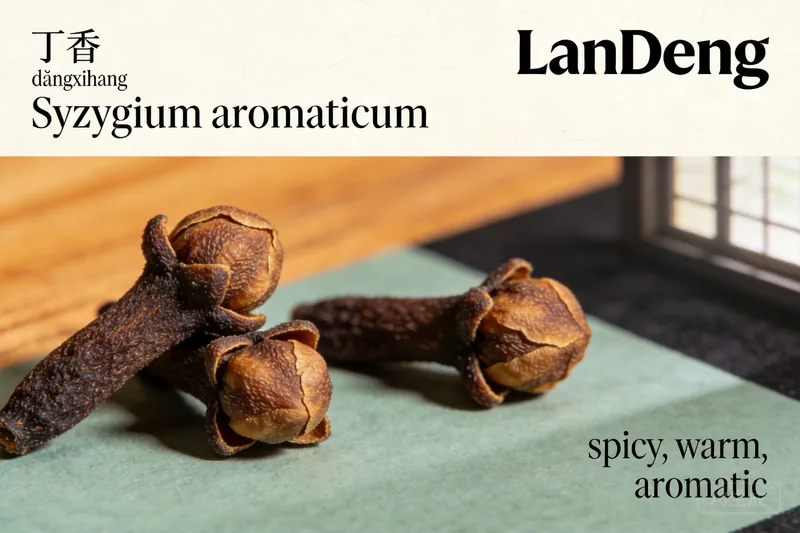
Data summary: Clove — dīngxiāng (丁香) in Chinese — is the dried flower bud of Syzygium aromaticum, prized for a warm, spicy, penetrating aroma. It is used as a spice, in incense, and in traditional materia medica.
Key facts
| Chinese | 丁香 (dīngxiāng) |
| Botanical source | Syzygium aromaticum (dried flower buds) |
| What it is | A dried flower bud (not a wood) |
| Aroma | Spicy, warm, aromatic |
| Traditional role | Spice, incense, perfume |
Aroma profile
Clove has a sharp, warm, spicy, slightly sweet aroma — one of the most penetrating spice notes. A little goes a long way; it is usually a supporting note in blends rather than a base.
The scent is driven by eugenol, which gives clove its characteristic “clove oil” pungency. In an incense blend, clove adds a bright, almost medicinal sharpness that cuts through sweeter woods and resins — useful in small doses, overwhelming in large ones. It is the “hot spice” that balances a soft base like sandalwood or benzoin.
What clove is (botany)
Clove is the unopened flower bud of the clove tree (Syzygium aromaticum), a member of the myrtle family (Myrtaceae). The buds are harvested before they open and dried, turning from red to the familiar brown “nail” shape (the English word “clove” itself comes from the Latin clavus, “nail”). Major producing regions include Indonesia (historically the Moluccas), Madagascar, Zanzibar, and Sri Lanka.
A naming trap (disambiguation)
In Chinese, 丁香 (dīngxiāng) means two different plants:
- Clove — Syzygium aromaticum, the spice/incense material.
- Lilac — Syringa species, the ornamental flowering shrub (sometimes called 欧丁香, “European clove”).
The spice clove and the ornamental lilac are botanically unrelated. Context distinguishes them; in an incense/spice context, 丁香 means clove. This is one of the classic traps in translating Chinese incense and spice ingredient lists.
In incense & Chinese tradition
- 合香 (blended incense): clove is a classic warm-spice ingredient, adding a pungent, aromatic lift.
- Five-spice (五香粉): clove is one of the traditional five-spice components (with star anise, cassia/cinnamon, Sichuan pepper, and fennel), which is why its aroma reads as familiar and food-adjacent.
- Materia medica: clove is described as a warming herb in traditional Chinese medicine.
Clove vs cinnamon
Both are warm spices used in 合香, but clove is sharper and more pungent (eugenol), while cassia is sweeter and rounder (cinnamaldehyde). Clove “cuts” a blend; cinnamon “warms” it. They are frequent partners, with clove adding the bright spice and cinnamon the sweet depth.
Traditional use vs modern evidence
Clove’s principal compound, eugenol, is the subject of laboratory research on anti-inflammatory, analgesic, and antimicrobial activity. In traditional materia medica, clove is described as a warming herb.
Important: we treat medicinal claims about clove as traditional and/or preliminary research, not established clinical fact. We describe clove’s aromatic and culinary use; we do not make medical claims.
Safety
Clove oil/eugenol is potent and can be irritating; it should not be applied undiluted. Incense combustion produces smoke and particulate matter — burn in a well-ventilated space.
FAQ
Is 丁香 clove or lilac? Both — the Chinese word 丁香 (dīngxiāng) names two different plants. In a spice or incense context, it means clove, Syzygium aromaticum, the dried flower bud prized for its warm, spicy aroma. In a gardening context, it means lilac, Syringa species, an ornamental flowering shrub sometimes called 欧丁香 (“European clove”). The two are botanically unrelated, and context distinguishes them. This is one of the classic traps in translating Chinese ingredient lists, so in an incense or spice setting 丁香 always means clove.
Is clove a wood or a flower? A flower bud. Clove is the unopened, dried flower bud of Syzygium aromaticum, a member of the myrtle family (Myrtaceae), not a wood or bark. The buds are harvested before they open and dried, turning from red to the familiar brown “nail” shape — the English word “clove” itself derives from the Latin clavus, meaning “nail.” Because the aromatic part is the bud rather than wood or resin, clove has a distinctive sharp, spicy character unlike woody or resinous ingredients.
What does clove smell like? Clove has a sharp, warm, spicy, slightly sweet aroma — one of the most penetrating spice notes. Its scent is driven by eugenol, which gives clove oil its characteristic pungency. In an incense blend, clove adds a bright, almost medicinal sharpness that cuts through sweeter woods and resins. It is useful in small doses and overwhelming in large ones, which is why it usually acts as a supporting “hot spice” note that balances a soft base like sandalwood or benzoin rather than leading the blend.
Is clove used in Chinese incense? Yes. Clove (丁香) is a classic warm-spice ingredient in Chinese 合香 (blended incense), adding a pungent, aromatic lift. Its bright, penetrating character cuts through sweeter woods and resins, so it is used in small amounts as an accent rather than a base. Clove also appears in Chinese five-spice (五香粉), alongside star anise, cassia, Sichuan pepper, and fennel, which is why its aroma reads as familiar and food-adjacent. It is one of the traditional spice notes of classical incense formulas.
Where does clove come from? Clove comes from the dried flower buds of Syzygium aromaticum, harvested before the buds open and then dried until they turn brown. Major producing regions include Indonesia — historically the Moluccas, the spice’s original home — as well as Madagascar, Zanzibar, and Sri Lanka. The buds are picked by hand before flowering, which is labor-intensive and contributes to clove’s value. After drying, the buds are sold whole or ground for use as a spice, in incense, and in traditional materia medica.
See also: cinnamon, its frequent spice partner, and the full scent guide.
Evidence & Sources
Botanical identity
Source: Syzygium in Flora of China · Syzygium aromaticum on GBIF. Evidence type: Established.
Traditional Chinese use
Source: this page records clove (丁香) as a warming herb in traditional Chinese medicine and a classic warm-spice ingredient in 合香. Evidence type: Historically documented — traditional materia-medica language, not modern clinical evidence.
Authenticity / adulteration
Source: the 丁香 clove (Syzygium aromaticum) vs lilac (Syringa) naming trap. Evidence type: Practical screening.
Safety
Source: clove oil/eugenol is potent and can be irritating; incense combustion produces smoke and particulate matter. Evidence type: Established.
Evidence status
| Layer | Status |
|---|---|
| Botanical identity | Established |
| Traditional use | Historically documented |
| Authenticity test | Practical screening |
| Laboratory confirmation | Requires analytical testing |
| Health claims | Not established |
Sources
Sources: botanical references on Syzygium aromaticum (eugenol, harvest regions) and the clove/lilac naming note. Medicinal claims are treated as traditional/preliminary. This is editorial knowledge content, not medical advice.