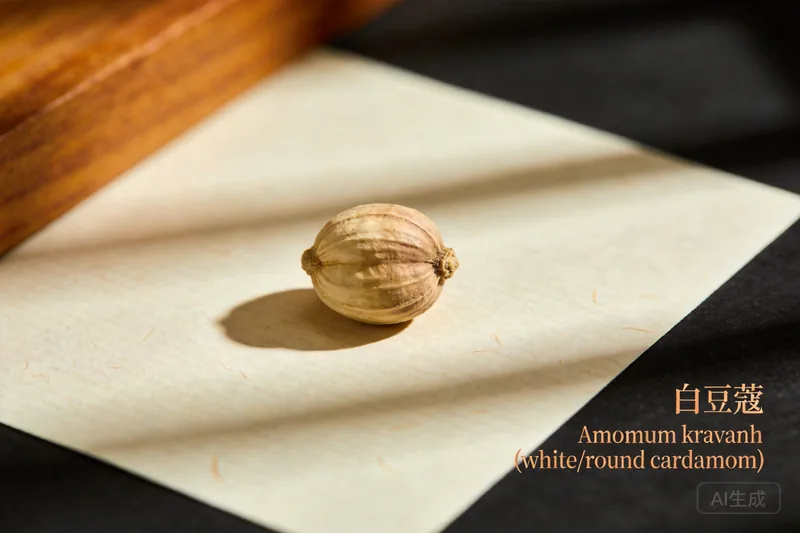
Technical answer: White cardamom — báidòukòu (白豆蔻) in Chinese — is the dried fruit of Amomum kravanh, a ginger-family (Zingiberaceae) plant of Southeast Asia. It is a warm, camphoraceous spice used in Chinese cooking, traditional medicine, and — as the classical texts specify — as a blending ingredient in incense (和香), not a burning material in its own right.
Key facts
| Chinese | 白豆蔻 (báidòukòu); “cardamom” also 豆蔻 |
| Botanical source | Amomum kravanh (family Zingiberaceae) — the dried fruit/seed |
| What it is | A dried spice fruit, not a wood or resin |
| Aroma | Camphoraceous, spicy, eucalyptus-like, warm |
| Traditional role | 合香 blending, cooking, materia medica |
Aroma profile
White cardamom has a warm, camphoraceous, slightly eucalyptus-like aroma — more “medicinal-spicy” than sweet. It is one of a cluster of ginger-family spice aromas, and in Chinese incense it is used to add a warm, pungent lift. The classical manuals specify that its role is blending: the Ming-dynasty Xiangcheng (香乘) notes that cardamom “is not a burning incense material — its seed and root are pungent and can only be used for blending” (豆蔻非焚爇香具…止可用以和香).
A family of look-alike “cardamoms”
The word “豆蔻” (cardamom) covers several different spice plants, which is a standing source of confusion:
- 白豆蔻 (this page) — Amomum kravanh, white/round cardamom, the Southeast Asian ginger-family spice.
- 草豆蔻 — Alpinia katsumadai (and relatives), a different ginger-family seed used in materia medica.
- 肉豆蔻 — Myristica fragrans, nutmeg — a completely different plant and family, not a cardamom at all despite the shared 豆蔻 name.
- Green cardamom — Elettaria cardamomum, the familiar “cardamom” of Indian and Middle Eastern cooking, called 小豆蔻 in Chinese.
A label that says only “cardamom” or “豆蔻” is underspecified — these are different plants with different scents and uses.
In Chinese tradition
- 合香 (blended incense): 白豆蔻 is a classical blending spice in incense formulas, contributing a warm, pungent lift — but specifically as a 和香 ingredient, not a solo burn.
- Culinary: 白豆蔻 is a warming spice in Chinese cooking and spiced-broth traditions.
- Materia medica: 白豆蔻 is a traditional-medicine herb, classically described for “transforming dampness and moving qi” (化湿行气) and related uses. This is traditional materia-medica language, not modern clinical evidence.
Traditional use vs modern evidence
The classical records are specific about cardamom’s blending role in incense, which is a useful and well-documented point. The medicinal uses are traditional, not established clinical fact, and we make no medical claims. The documented, non-medical facts are botanical identity and the blending-only role in classical incense.
Quality and sourcing notes
Practical points for buyers:
- Confirm which “cardamom” is meant: 白豆蔻 (Amomum kravanh), 草豆蔻 (Alpinia), or nutmeg (肉豆蔻, Myristica fragrans) — the 豆蔻 name covers all three.
- The dried fruit should be whole and camphoraceous-aromatic; the seed inside carries the scent.
- In incense, 白豆蔻 is a blender — its pungent warmth supports a formula rather than carrying one alone.
Safety
Incense combustion produces smoke and particulate matter. Burn in a well-ventilated space, avoid inhaling concentrated smoke, and keep away from children and pets. This is editorial knowledge content, not medical advice.
FAQ
Is cardamom the same as nutmeg? No. The Chinese name 豆蔻 covers both, which is the source of the confusion, but they are different plants and families. 白豆蔻 (white cardamom) is Amomum kravanh, a ginger-family spice; 肉豆蔻 (“meat 豆蔻”) is Myristica fragrans, nutmeg, a completely different plant. The shared 豆蔻 name hides the difference, so a label should specify which is meant.
What does white cardamom smell like? White cardamom has a warm, camphoraceous, slightly eucalyptus-like aroma — more “medicinal-spicy” than sweet. It belongs to a cluster of ginger-family spice scents. In Chinese incense it adds a warm, pungent lift, and the classical manuals specify that this is a blending role rather than a solo fragrance.
Is cardamom used in Chinese incense? Yes, but as a blender. The Ming-dynasty Xiangcheng (香乘) is explicit that cardamom “is not a burning incense material — its seed and root are pungent and can only be used for blending” (豆蔻非焚爇香具…止可用以和香). So it appears in huxiang (合香) formulas as a warm, pungent supporting note, not as a material burned alone.
What is the difference between 白豆蔻 and 草豆蔻? They are different ginger-family (Zingiberaceae) seeds. 白豆蔻 is Amomum kravanh (white/round cardamom), the Southeast Asian spice; 草豆蔻 is Alpinia katsumadai (and relatives), used in materia medica. They share the 豆蔻 name and a general warm-spice character but are distinct plants with different aromas and uses.
What is green cardamom? Green cardamom is Elettaria cardamomum, the familiar “cardamom” of Indian and Middle Eastern cooking, called 小豆蔻 in Chinese. It is yet another distinct plant — not 白豆蔻 (Amomum kravanh), 草豆蔻 (Alpinia), or nutmeg (肉豆蔻). The English word “cardamom” usually means the green one, while 白豆蔻 is the white/round variety, which is a useful distinction to keep straight.
See also: clove, cinnamon, and the full scent guide.
Evidence & Sources
Botanical identity
Source: Amomum kravanh on GBIF · Amomum compactum (related white cardamom) in Flora of China. Evidence type: Established.
Traditional Chinese use
Source: the Ming-dynasty Xiangcheng (香乘) records 豆蔻香 and specifies cardamom’s blending-only role (豆蔻非焚爇香具…止可用以和香). Evidence type: Historically documented — traditional, not modern clinical evidence.
Authenticity / disambiguation
Source: the 白豆蔻 (Amomum kravanh) vs 草豆蔻 (Alpinia) vs 肉豆蔻 (Myristica fragrans, nutmeg) vs green cardamom (Elettaria) distinction. Evidence type: Practical screening.
Safety
Source: incense combustion produces smoke and particulate matter; burn in a well-ventilated space. Evidence type: Established.
Evidence status
| Layer | Status |
|---|---|
| Botanical identity | Established |
| Traditional use | Historically documented |
| Authenticity test | Practical screening |
| Health claims | Not established |
Sources
Sources: botanical references on Amomum kravanh (white cardamom) and the Ming-dynasty Xiangcheng (香乘) record of 豆蔻香. The 白豆蔻 / 草豆蔻 / 肉豆蔻 (nutmeg) / green-cardamom disambiguation is recorded as practical screening. Medicinal uses are treated as traditional, not established clinical fact. This is editorial knowledge content, not medical advice.