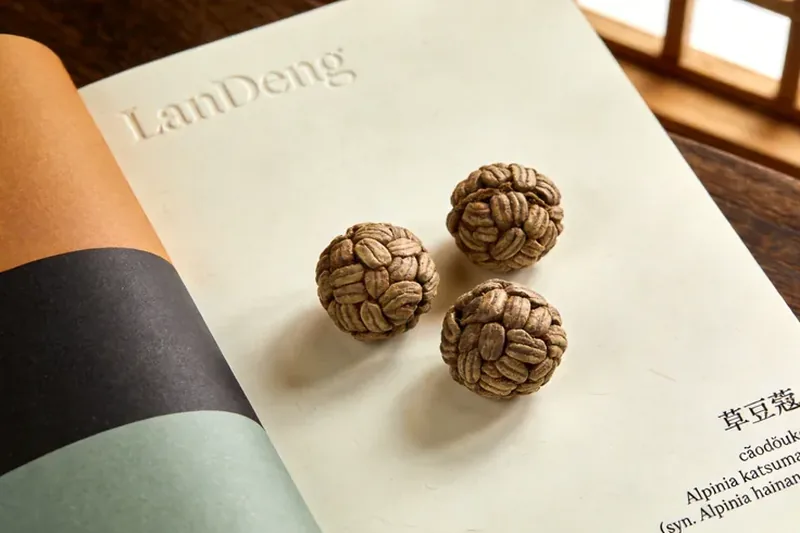
Direct answer: Katsumadai (草豆蔻, cǎodòukòu) is the dried seed of Alpinia katsumadae (often treated under Alpinia hainanensis), a ginger-family (Zingiberaceae) perennial native to southern China and Hainan. It is a warm, camphoraceous, slightly bitter spice seed used in traditional medicine and as a minor aromatic. Its name — 草豆蔻, “grass cardamom” — is one of several “cardamom” names in Chinese.
Key facts
| Chinese | 草豆蔻 (cǎodòukòu) — “grass cardamom” |
| Botanical source | Alpinia katsumadae (syn. Alpinia hainanensis; family Zingiberaceae) — the seed |
| What it is | A dried spice seed, not a wood or resin |
| Aroma | Camphoraceous, spicy, warm, slightly bitter |
| Traditional role | Materia medica; minor warm spice |
Aroma profile
草豆蔻 is warm and camphoraceous with a spicy, slightly bitter edge — in the ginger-family register alongside cardamom and galangal, but more medicinal and less sweet than white cardamom. It reads as a warm spice accent when used at all in fragrance, though its primary place is traditional medicine rather than incense. In a blend it adds a dry, warm pungency rather than a bright or sweet note.
A family of look-alike “cardamoms” (read this)
The word “豆蔻” (cardamom) covers several different spice plants, which is a standing source of confusion:
- 白豆蔻 (white cardamom) — Amomum kravanh, the Southeast Asian ginger-family spice. Its own entry.
- 草豆蔻 (this page) — Alpinia katsumadae (syn. Alpinia hainanensis), a different ginger-family seed used in materia medica.
- 肉豆蔻 (nutmeg) — Myristica fragrans, a completely different plant and family, not a cardamom at all despite the shared 豆蔻 name.
- Green cardamom — Elettaria cardamomum, the familiar “cardamom” of Indian cooking, called 小豆蔻 in Chinese.
This page describes 草豆蔻 = Alpinia katsumadae. When a source says 白豆蔻, 肉豆蔻, or green cardamom, it is describing a different material.
Botanical source and origin
Alpinia katsumadae is a ginger-family (Zingiberaceae) perennial native to southern China and Hainan; the name is often treated under Alpinia hainanensis, with Flora of China recording 草豆蔻 as the Chinese name for that species. The part used is the dried seed. The genus Alpinia also includes 高良姜 (galangal, Alpinia officinarum) and 益智仁 (Alpinia oxyphylla), and the wider ginger family includes the 白豆蔻 group (Amomum).
In Chinese tradition
- Materia medica: 草豆蔻 is recorded in traditional Chinese medicine, classically described as a warming aromatic for “transforming dampness.” This is traditional materia-medica language, not modern clinical evidence.
- Minor spice: 草豆蔻 is a lesser-used warm spice in Chinese cooking and spice blends.
- Not the white cardamom: 草豆蔻 is a distinct seed from 白豆蔻 (Amomum kravanh), despite the shared 豆蔻 name.
Traditional use vs modern evidence
The traditional-medicine and minor spice use is documented. Medicinal uses are traditional, not established clinical fact, and we make no medical claims. The documented, non-medical facts are botanical identity, the Zingiberaceae placement, and the warm-spice character.
Quality and sourcing notes
Practical points for buyers:
- Distinguish 草豆蔻 (Alpinia katsumadae) from 白豆蔻 (Amomum kravanh) and nutmeg (肉豆蔻, Myristica fragrans) — the 豆蔻 name covers all three.
- Expect a warm, camphoraceous, slightly bitter character, more medicinal than the white cardamom’s sweet pungency.
- Its primary place is materia medica and as a minor warm spice, not a leading incense material.
Safety
Incense combustion produces smoke and particulate matter. Burn in a well-ventilated space, avoid inhaling concentrated smoke, and keep away from children and pets. This is editorial knowledge content, not medical advice.
FAQ
What is 草豆蔻 (katsumadai)? The dried seed of Alpinia katsumadae (often treated under Alpinia hainanensis), a ginger-family (Zingiberaceae) perennial native to southern China and Hainan. It is a warm, camphoraceous, slightly bitter spice seed used in traditional medicine and as a minor aromatic.
Is 草豆蔻 the same as 白豆蔻 (white cardamom)? No. 草豆蔻 is Alpinia katsumadae — a ginger-family seed used in materia medica — while 白豆蔻 is Amomum kravanh, a different ginger-family spice. They share the 豆蔻 name and a general warm-spice character but are distinct plants with different aromas and uses, and each has its own entry here.
What does 草豆蔻 smell like? Warm and camphoraceous with a spicy, slightly bitter edge — in the ginger-family register alongside cardamom and galangal, but more medicinal and less sweet than white cardamom. In a blend it adds a dry, warm pungency rather than a bright or sweet note.
Is 草豆蔻 a cardamom? By Chinese name it is one of the “豆蔻” (cardamom) group, but it is not the white cardamom (Amomum kravanh) nor the green cardamom (Elettaria cardamomum). It is Alpinia katsumadae, a distinct ginger-family seed used in materia medica. The shared 豆蔻 name hides the botanical differences.
Where does 草豆蔻 come from? From Alpinia katsumadae, a ginger-family perennial native to southern China and Hainan. The name is often treated under Alpinia hainanensis, and Flora of China records 草豆蔻 as the Chinese name for that species. The genus Alpinia also includes galangal (Alpinia officinarum) and 益智仁 (Alpinia oxyphylla).
See also: cardamom, amomum-villosum, sharp-leaf galangal and the full scent guide.
Evidence & Sources
Botanical identity
Source: Alpinia hainanensis (草豆蔻) in Flora of China · Alpinia hainanensis on GBIF. Evidence type: Established.
Traditional Chinese use
Source: 草豆蔻 as a materia-medica warming aromatic; the 草豆蔻 (Alpinia katsumadae) vs 白豆蔻 (Amomum kravanh) distinction. Evidence type: Historically documented — traditional, not modern clinical evidence.
Authenticity / disambiguation
Source: 草豆蔻 (Alpinia katsumadae / A. hainanensis) vs 白豆蔻 (Amomum kravanh) vs 肉豆蔻 (Myristica fragrans, nutmeg) vs green cardamom (Elettaria cardamomum). Evidence type: Practical screening.
Safety
Source: incense combustion produces smoke and particulate matter; burn in a well-ventilated space. Evidence type: Established.
Evidence status
| Layer | Status |
|---|---|
| Botanical identity | Established |
| Traditional use | Historically documented |
| Authenticity test | Practical screening |
| Health claims | Not established |
Sources
Sources: botanical references on Alpinia katsumadae (treated under Alpinia hainanensis) and the 草豆蔻/白豆蔻/nutmeg distinction. 草豆蔻’s traditional-medicine and minor spice use is documented; medicinal uses are treated as traditional, not established clinical fact. This is editorial knowledge content, not medical advice.