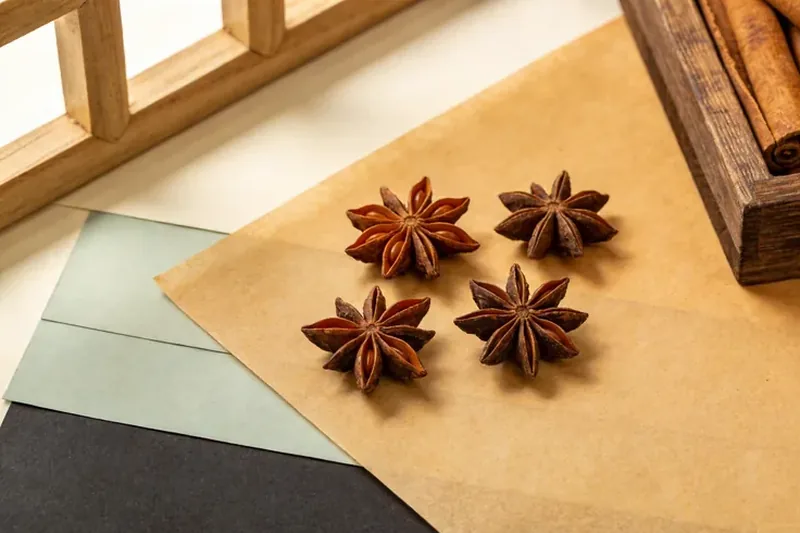
Direct answer: Tsaoko (草果, cǎoguǒ) is the dried fruit of Amomum tsao-ko (recently reclassified as Lanxangia tsao-ko in some databases), a ginger-family herb (Zingiberaceae) native to the mountains of Yunnan and Guangxi. It is a smoky, spicy, camphoraceous aromatic best known as the “black cardamom” of southwestern Chinese cooking, used in incense as a 香药 (aromatic-medicine) spice accent.
Key facts
| Chinese | 草果 (cǎoguǒ) |
| Botanical source | Amomum tsao-ko (family Zingiberaceae; syn. Lanxangia tsao-ko) — the fruit |
| What it is | A dried aromatic fruit, not a wood or resin |
| Aroma | Smoky, spicy, camphoraceous, warm |
| Traditional role | 香药 spice accent; culinary “black cardamom” |
Aroma profile
Direct answer: 草果 is smoky and spicy, with a camphoraceous, resinous warmth and a distinctly earthy-smoky depth that sets it apart from the brighter, sweeter white cardamom. Its smokiness comes through especially in the dried whole fruit, which is usually cracked or bruised before use. In a blend it reads as a dark, warming spice that adds body rather than sweet lift.
草果 is smoky and spicy, with a camphoraceous, resinous warmth and a distinctly earthy-smoky depth that sets it apart from the brighter, sweeter white cardamom. Its smokiness comes through especially in the dried whole fruit, which is usually cracked or bruised before use. In a blend it reads as a dark, warming spice, adding body and a smouldering undertone rather than sweet lift.
Botanical identity
Direct answer: Amomum tsao-ko is a ginger-family (Zingiberaceae) herb native to the mountains of southern China (Yunnan, Guangxi) and adjacent northern Southeast Asia. The part used is the dried, ribbed, red-brown fruit, whose dark seeds carry the aroma. Flora of China records it as Amomum tsaoko; GBIF has recently transferred the name to Lanxangia tsao-ko.
Amomum tsao-ko is a ginger-family (Zingiberaceae) herb native to the mountains of southern China (Yunnan, Guangxi) and adjacent northern Southeast Asia. The part used is the dried, ribbed, red-brown fruit, whose dark seeds carry the aroma. Flora of China records it as Amomum tsaoko; GBIF has recently transferred the name to Lanxangia tsao-ko. The same ginger family includes 白豆蔻 (Amomum kravanh), 砂仁 (Amomum villosum), and 高良姜 (galangal). See Amomum tsaoko in Flora of China.
Chinese name and terminology
Direct answer: The name 草果 (cǎoguǒ) means “grass fruit” — 草 (grass/herb) + 果 (fruit) — a plain name that sits confusingly near 草豆蔻 (“grass cardamom,” katsumadai). The near-homophone is a real trap: 草果 and 草豆蔻 are different ginger-family fruits with different species, yet the shared 草 and the shared “cardamom” register blur them.
The name 草果 (cǎoguǒ) is plain — “grass fruit” — and that plainness is itself a hazard, because it sits beside 草豆蔻 (cǎodòukòu), “grass cardamom” (katsumadai). The two names share the 草 character and a ginger-family register, but name different plants:
- 草果 (tsaoko) — Amomum tsao-ko, the smoky “black cardamom.” This entry.
- 草豆蔻 (katsumadai) — Alpinia katsumadae, a seed of the ginger family. Its own entry.
A buyer who conflates 草果 and 草豆蔻 — two “grass”-named ginger-family fruits — has made a genuine sourcing error, because they are different species with different characters.
The “black cardamom” false friend (read this)
Direct answer: In English, 草果 is often called “black cardamom,” but that name is a false friend: 草果 (Amomum tsao-ko) is not the Indian black cardamom (Amomum subulatum), and it is not white/round cardamom (Amomum kravanh) either. The English name collapses three different ginger-family fruits into one “cardamom” label, and the near-homophone 草豆蔻 adds a fourth layer of confusion.
The English name “black cardamom” does more harm than help with 草果, because it merges several distinct ginger-family fruits:
- 草果 (Amomum tsao-ko) — the smoky, camphoraceous fruit of Yunnan/Guangxi. This entry.
- Indian black cardamom (Amomum subulatum) — a different species from the Himalayan region, also smoky but botanically distinct.
- 白豆蔻 (Amomum kravanh) — white/round cardamom, the bright, eucalyptus-sweet fruit. Its own entry.
- 草豆蔻 (Alpinia katsumadae) — katsumadai, the “grass cardamom” seed, a fourth, distinct material.
So “black cardamom” is not a species name; it is a loose English category that 草果 happens to fall into. This page describes 草果 = Amomum tsao-ko (Lanxangia tsao-ko). When a source means Amomum subulatum, 白豆蔻, or 草豆蔻, it is describing a different material. See cardamom and katsumadai.
Where does tsaoko come from?
Direct answer: Tsaoko comes from the mountains of southern China — chiefly Yunnan and Guangxi — and adjacent northern Southeast Asia, where Amomum tsao-ko grows. The dried, ribbed fruit is the material of trade, its dark seeds carrying the smoky aroma.
Amomum tsao-ko is native to the mountains of Yunnan and Guangxi in southern China, with a range extending into adjacent northern Southeast Asia. The fruit is harvested and dried whole, becoming the ribbed, red-brown pod whose dark seeds hold the aroma. Its southwestern-China origin is the root of its role as a signature spice of Yunnan and Sichuan cooking.
Why is it used in incense?
Direct answer: 草果 is used in incense as a 香药 (aromatic-medicine) spice accent — a dark, smoky, camphoraceous warming note that adds body and a smouldering undertone to a blend. It is a modern application of its culinary character, not a classical 香乘 incense ingredient.
草果’s role in incense is as a 香药 spice accent — a dark, smoky, camphoraceous note that adds body and warmth. Its use in incense is a modern application of the character that made it a culinary spice: the same smoky depth that anchors a Sichuan braise can anchor a blend, lending a smouldering, resinous undertone. It is not a classical 香乘 ingredient, and its documented fame is culinary and medicinal (香药) rather than incense-specific.
How is it processed?
Direct answer: 草果 is used as the dried whole fruit, which is usually cracked or bruised before use to release its dark, aromatic seeds. The fruit is dried whole for storage; the seeds carry the aroma and are what release the smoky, camphoraceous character.
The fruit is harvested and dried whole, becoming the ribbed red-brown pod. Before use — in cooking or as an aromatic — the whole fruit is cracked or bruised to expose the dark seeds, which carry the aroma. This cracking step is the practical constant: the seeds, not the pod, are the aromatic part, and a whole, uncracked fruit releases little scent.
What determines tsaoko quality?
Direct answer: Quality turns on species identity and fruit condition. The buyer’s first job is to distinguish 草果 (Amomum tsao-ko) from white cardamom, Indian black cardamom, and 草豆蔻; then to judge well-filled, intact fruits with dark, aromatic seeds. Expect a dark, smoky, camphoraceous character.
The quality factors:
- Species identity — the decisive check: 草果 (Amomum tsao-ko) versus 白豆蔻 (Amomum kravanh), Indian black cardamom (Amomum subulatum), and 草豆蔻 (Alpinia katsumadae).
- Fruit condition — well-filled, intact fruits with dark, aromatic seeds; the aroma is in the seeds.
- Aroma — a dark, smoky, camphoraceous character, distinct from the sweeter white cardamom.
- Freshness — the smoky aroma fades with age and poor storage.
Common forms
Direct answer: 草果 is sold as the dried whole fruit and, less often, as the separated seeds or a ground powder. The whole fruit is the standard form, cracked or bruised at the point of use; the seeds and powder release the aroma more directly.
| Form | Typical use |
|---|---|
| Dried whole fruit | Cooking and incense, cracked/bruised before use |
| Seeds | Direct aromatic release |
| Ground powder | Blending convenience (fades faster) |
In Chinese tradition
- Culinary spice (Historical Record): 草果 is a signature spice of southwestern Chinese cooking — the dark, smoky “black cardamom” of braised and stewed dishes.
- 香药 aromatic medicine (Traditional Use): as a 香药 it bridges spice and traditional medicine.
- Not a 香乘 ingredient (Historical Record): 草果 does not appear in the classical incense compendium 香乘; its documented role is culinary and medicinal rather than as a canonical incense ingredient.
Traditional use vs modern evidence
Direct answer: The culinary and 香药 use is well documented. Medicinal uses are traditional, not established clinical fact, and this page makes no medical claims. The documented, non-medical facts are botanical identity, the Zingiberaceae placement, and the smoky camphoraceous aromatic use.
- Traditional Use — 草果 as a 香药 (aromatic medicine), bridging spice and traditional medicine.
- Historical Record — its role as a signature culinary spice of southwestern Chinese cooking, and its absence from the classical 香乘 incense canon.
- Scientific Evidence — the botanical identity of Amomum tsao-ko (Lanxangia tsao-ko, Zingiberaceae) is documented. We present no clinical or medical efficacy claims.
What buyers should look for
Direct answer: Buyers should distinguish 草果 (Amomum tsao-ko) from white cardamom, Indian black cardamom, and 草豆蔻, then judge well-filled, intact fruits with dark, aromatic seeds. Expect a dark, smoky, camphoraceous spice — distinct from sweeter cardamoms — and note it is a modern incense accent, not a classical 香乘 ingredient.
For a buyer or formulator:
- Species — 草果 (Amomum tsao-ko / Lanxangia tsao-ko), not 白豆蔻, Indian black cardamom, or 草豆蔻.
- Fruit condition — well-filled, intact fruits; the aroma is in the dark seeds.
- Aroma — a dark, smoky, camphoraceous character, distinct from sweeter cardamoms.
- Role — a dark warming accent, usually blended, not burned alone.
Safety
Incense combustion produces smoke and particulate matter. Burn in a well-ventilated space, avoid inhaling concentrated smoke, and keep away from children and pets. This is editorial knowledge content, not medical advice.
Tsaoko vs cardamom vs katsumadai
Direct answer: These are three ginger-family fruits that the loose English word “cardamom” runs together. 草果 (Amomum tsao-ko) is the smoky “black cardamom”; 白豆蔻 (Amomum kravanh) is bright, sweet white cardamom; 草豆蔻 (Alpinia katsumadae) is the “grass cardamom” seed. They are distinct species with distinct characters.
| Tsaoko (草果) | Cardamom (白豆蔻) | Katsumadai (草豆蔻) | |
|---|---|---|---|
| Botanical source | Amomum tsao-ko (Lanxangia tsao-ko) | Amomum kravanh | Alpinia katsumadae |
| Character | Smoky, spicy, camphoraceous | Camphoraceous, spicy, eucalyptus, warm | Camphoraceous, spicy, warm, slightly bitter |
| English gloss | “Black cardamom” (false friend) | White/round cardamom | “Grass cardamom” |
See cardamom, katsumadai, amomum-villosum, and the material comparison matrix.
Our Industry View
Direct answer: 草果’s commercial lesson is that the English “black cardamom” label is a false friend that merges several distinct ginger-family fruits. A buyer should fix the species — 草果 (Amomum tsao-ko), not Amomum subulatum or a sweet cardamom — and value the smoky, dark, warming character that is its actual specification.
From a manufacturing perspective, 草果 is a case where the English name is the hazard:
- “Black cardamom” is a category, not a species. In English the name collapses 草果, Indian black cardamom, and — by association — the sweet cardamoms into one label. A buyer who orders “black cardamom” without pinning the species may receive a different fruit with a different character. The disciplined move is to name Amomum tsao-ko (Lanxangia tsao-ko).
- The smoky note is the specification. 草果’s value is its dark, smoky, camphoraceous warmth — the character that makes it the “black cardamom” of braises. A buyer wanting that smouldering depth should confirm it is present, not assume the name guarantees it.
- It is a modern incense accent, not a classical material. 草果 has no 香乘 canon role; its incense use is a modern borrowing of its culinary character. That is fine — but it should be framed honestly, not dressed up as a classical 香材.
In our view, 草果 is a dark, smoky, warming spice whose real procurement question is which “black cardamom” — fix the species, check for the smoky depth, and treat it as a modern culinary-crossover accent, not a classical incense ingredient.
Summary
草果 (Amomum tsao-ko, syn. Lanxangia tsao-ko) is the dried fruit of a ginger-family herb of the Yunnan/Guangxi mountains — a smoky, spicy, camphoraceous aromatic best known as the “black cardamom” of southwestern Chinese cooking. That English name is a false friend: 草果 is not the Indian black cardamom (Amomum subulatum), not white cardamom (白豆蔻), and — in a near-homophone trap — not 草豆蔻 (katsumadai). Its incense use is a modern 香药 accent borrowed from its culinary character, not a classical 香乘 ingredient, and its medicinal uses are traditional language, not clinical evidence.
FAQ
What is 草果 (tsaoko)? The dried fruit of Amomum tsao-ko (Flora of China: Amomum tsaoko; recently reclassified as Lanxangia tsao-ko), a ginger-family herb (Zingiberaceae) native to the mountains of Yunnan and Guangxi. It is a smoky, spicy, camphoraceous aromatic best known as the “black cardamom” of southwestern Chinese cooking, and used in incense as a 香药 spice accent.
Is 草果 the same as black cardamom? In the Chinese context, yes — 草果 is often called “black cardamom” in English, but it is not the same as the Indian black cardamom (Amomum subulatum). 草果 is Amomum tsao-ko, a distinct species with a smoky, camphoraceous character. It is also distinct from white/round cardamom (白豆蔻, Amomum kravanh).
What does 草果 smell like? Smoky and spicy, with a camphoraceous, resinous warmth and an earthy-smoky depth that sets it apart from brighter, sweeter cardamom. The smokiness comes through especially in the dried whole fruit, usually cracked or bruised before use. In a blend it reads as a dark, warming spice that adds body rather than sweet lift.
How is 草果 used in Chinese cooking? It is a signature spice of southwestern Chinese cuisine — the dark, smoky “black cardamom” of braised and stewed dishes, where whole fruits are cracked or bruised to release their aromatic seeds. Its smoky warmth is central to many Sichuan and Yunnan braises and stews, and it also serves as a 香药 (aromatic medicine).
Is 草果 a classical incense ingredient? Not in the 香乘 canon — 草果 does not appear in the classical incense compendium 香乘. Its documented role is culinary and medicinal (香药) rather than as a canonical incense ingredient. Its use in incense is a modern application of its smoky aromatic character.
What is the difference between 草果 and 草豆蔻? They are different ginger-family fruits with near-homophone names. 草果 (tsaoko) is Amomum tsao-ko, the smoky “black cardamom” fruit; 草豆蔻 (katsumadai) is Alpinia katsumadae, a distinct “grass cardamom” seed. The shared 草 character and the shared “cardamom” register blur them, but they are different species with different characters.
See also: cardamom, amomum-villosum, katsumadai, galangal, and the full scent guide.
Evidence & Sources
Botanical identity
Source: Amomum tsaoko in Flora of China · Lanxangia tsao-ko on GBIF. Evidence type: Established.
Traditional Chinese use
Source: 草果 as a culinary spice and 香药; no entry in the classical compendium 香乘. Evidence type: Historically documented (culinary); traditional materia-medica language, not modern clinical evidence.
Authenticity / disambiguation
Source: 草果 (Amomum tsao-ko) vs 白豆蔻 (Amomum kravanh) vs 砂仁 (Amomum villosum). Evidence type: Practical screening.
Safety
Source: incense combustion produces smoke and particulate matter; burn in a well-ventilated space. Evidence type: Established.
Evidence status
| Layer | Status |
|---|---|
| Botanical identity | Established |
| Traditional use | Historically documented (culinary) |
| Authenticity test | Practical screening |
| Health claims | Not established |
Sources
Sources: botanical references on Amomum tsao-ko (Lanxangia tsao-ko) and the tsaoko-vs-cardamom-vs-sharen distinction. 草果 is documented as a culinary spice and 香药; medicinal uses are treated as traditional, not established clinical fact. This is editorial knowledge content, not medical advice.