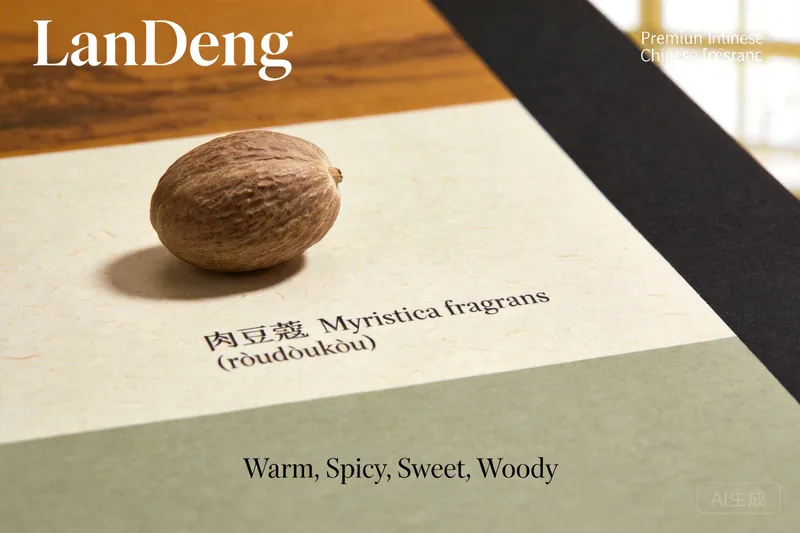
Technical answer: Nutmeg — ròudòukòu (肉豆蔻) in Chinese — is the dried seed of Myristica fragrans, an evergreen tree of the nutmeg family (Myristicaceae) native to the Moluccas (Spice Islands) of Indonesia. It is a warm, spicy, sweet spice, familiar from cooking and baking, and it appears in Chinese incense as a warm spice note in some 合香 (blended incense) contexts. Its lacy red covering — mace — is a separate, closely related spice.
Key facts
| Chinese | 肉豆蔻 (ròudòukòu); mace = 肉豆蔻衣 |
| Botanical source | Myristica fragrans (family Myristicaceae) — the seed |
| What it is | A dried spice seed, not a wood or resin |
| Aroma | Warm, spicy, sweet, slightly woody |
| Traditional role | Culinary spice, materia medica, warm incense accent |
Aroma profile
Nutmeg is warm, spicy, and sweet, with a woody, slightly penetrating edge from its essential oil. It is a “sweet-spice” note in the family of clove and cardamom. In incense it adds a warm, food-adjacent spiciness — an accent rather than a base. The closely related mace (the red aril around the seed) has a similar but more delicate character.
Botanical source and origin
Myristica fragrans is an evergreen tree native to the Moluccas of Indonesia, the historical “Spice Islands,” now cultivated across the tropics. The tree yields two spices from one fruit: the seed is nutmeg (肉豆蔻), and the lacy red aril around it is mace (肉豆蔻衣). Nutmeg has been traded globally for centuries and entered Chinese materia medica and cooking as an imported aromatic.
A naming caution: 肉豆蔻 (nutmeg, Myristica fragrans) is distinct from 豆蔻/白豆蔻 (cardamom, Amomum kravanh) — a different spice that already has its own entry. The shared 豆蔻 (“cardamom”) in their names reflects historical grouping, not the same plant.
In Chinese tradition
- Culinary spice: 肉豆蔻 is a warm, sweet spice used in braising and spice blends, valued for its aromatic depth.
- Materia medica: 肉豆蔻 is recorded in traditional Chinese medicine as a warming aromatic. This is traditional materia-medica language, not modern clinical evidence.
- Incense context: nutmeg appears as a warm spice accent in some 合香 blends, alongside clove and cardamom, rather than as a classical defining material.
Traditional use vs modern evidence
The culinary role is unambiguous and well documented. Medicinal uses are traditional, not established clinical fact, and we make no medical claims. The documented, non-medical facts are botanical identity, the spice trade history, and its warm aromatic use.
Quality and sourcing notes
Practical points for buyers:
- Whole nutmeg should be dense, oily, and strongly aromatic; the seed loses scent once ground, so whole is preferred.
- Distinguish 肉豆蔻 (nutmeg) from 白豆蔻 (cardamom) — different spices with a shared 豆蔻 name.
- In incense, nutmeg is a warm spice accent, usually blended, not burned alone.
Safety
Incense combustion produces smoke and particulate matter. Burn in a well-ventilated space, avoid inhaling concentrated smoke, and keep away from children and pets. This is editorial knowledge content, not medical advice.
FAQ
What is the difference between nutmeg and mace? They come from the same fruit of Myristica fragrans. Nutmeg (肉豆蔻) is the seed, and mace (肉豆蔻衣) is the lacy red aril that wraps around it. Both are warm, sweet spices, but mace is more delicate and slightly brighter. One tree yields two distinct spices from a single fruit.
Is 肉豆蔻 the same as cardamom? No. 肉豆蔻 (nutmeg) is Myristica fragrans; cardamom (白豆蔻) is Amomum kravanh, a different spice from the ginger family. They share the 豆蔻 name element in Chinese, which reflects historical grouping rather than the same plant. They have different aromas, sources, and uses, and cardamom has its own entry in this encyclopedia.
What does nutmeg smell like? Warm, spicy, and sweet, with a woody, slightly penetrating edge from its essential oil. It is a “sweet-spice” note in the family of clove and cardamom, familiar from baking and braising. In incense it adds a warm, food-adjacent spiciness as an accent rather than a base note.
Where does nutmeg come from? From Myristica fragrans, an evergreen tree native to the Moluccas — the historical “Spice Islands” of Indonesia — now cultivated across the tropics. Nutmeg has been a globally traded spice for centuries, entering Chinese cooking and materia medica as an imported aromatic. The seed is nutmeg; the red aril around it is mace.
How should nutmeg be stored for quality? Whole, rather than ground. Whole nutmeg is dense, oily, and strongly aromatic, and it retains its scent far longer than pre-ground powder, which loses aroma quickly. The strength of the aroma when freshly broken or grated is the main quality indicator, and in incense the material is a warm spice accent used in blends.
See also: clove, cardamom, and the full scent guide.
Evidence & Sources
Botanical identity
Source: Myristica fragrans on GBIF. Evidence type: Established.
Traditional Chinese use
Source: 肉豆蔻 as a culinary spice and materia-medica aromatic. Evidence type: Historically documented — culinary use; medicinal uses are traditional, not modern clinical evidence.
Authenticity / disambiguation
Source: 肉豆蔻 (nutmeg) vs 白豆蔻 (cardamom) — different spices with a shared 豆蔻 name. Evidence type: Practical screening.
Safety
Source: incense combustion produces smoke and particulate matter; burn in a well-ventilated space. Evidence type: Established.
Evidence status
| Layer | Status |
|---|---|
| Botanical identity | Established |
| Traditional use | Historically documented (culinary) |
| Authenticity test | Practical screening |
| Health claims | Not established |
Sources
Sources: botanical references on Myristica fragrans and the nutmeg-vs-mace and nutmeg-vs-cardamom distinctions. Nutmeg is recorded as a culinary spice; medicinal uses are treated as traditional, not established clinical fact. This is editorial knowledge content, not medical advice.