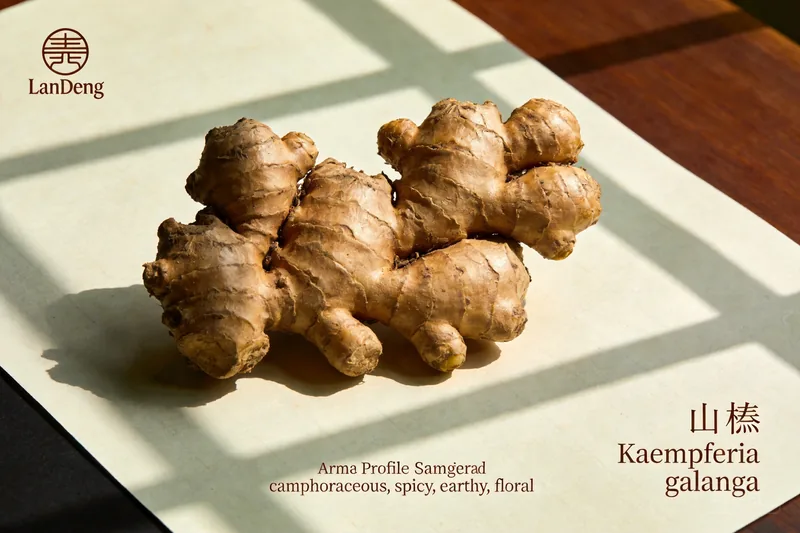
Technical answer: Sand ginger — shānnài (山柰) in Chinese — is the dried, aromatic rhizome of Kaempferia galanga, a ginger-family herb (Zingiberaceae) of tropical Asia. It is a pungent, camphoraceous spice, best known in English as kencur or aromatic ginger, used across Southeast Asian cooking and in Chinese incense and materia medica as a warm, spicy aromatic. Despite the name, it is a distinct plant from the common ginger (生姜, Zingiber officinale).
Key facts
| Chinese | 山柰 (shānnài), also 沙姜 (shājiāng) |
| Botanical source | Kaempferia galanga (family Zingiberaceae) — the rhizome |
| What it is | A dried aromatic rhizome, a spice |
| Aroma | Camphoraceous, spicy, earthy, faintly floral |
| Traditional role | Culinary spice, materia medica, warm incense aromatic |
Aroma profile
Sand ginger is pungent and camphoraceous — a warm, spicy, earthy scent with a faint floral undertone, distinct from the fresher heat of common ginger. It is a strong, characterful spice note. In incense it adds a warm, penetrating spice character, usually as an accent in blended formulas rather than a material burned alone.
Botanical source and origin
Kaempferia galanga is a low herb of the ginger family (Zingiberaceae), native to tropical Asia and widely cultivated from India through Southeast Asia to southern China. The part used is the rhizome, which is harvested, cleaned, and dried. It is known in English as kencur, aromatic ginger, or sand ginger — the last name referring to its cultivation in sandy soils.
A naming caution: 山柰 (Kaempferia galanga, sand ginger / kencur) is not the same as common ginger 生姜 (Zingiber officinale). Both are Zingiberaceae rhizomes, but they are different species with different aromas and uses.
In Chinese tradition
- Culinary spice: 山柰 (also 沙姜) is a defining aromatic of southern-Chinese and Southeast Asian cooking, valued for its pungent, camphoraceous warmth.
- Materia medica: 山柰 is recorded in traditional Chinese medicine as a warming aromatic. This is traditional materia-medica language, not modern clinical evidence.
- Incense context: 山柰 appears in some traditional aromatic and incense contexts as a warm, spicy supporting note.
Traditional use vs modern evidence
The culinary role is well documented. Medicinal uses are traditional, not established clinical fact, and we make no medical claims. The documented, non-medical facts are botanical identity and the rhizome’s long use as a pungent culinary and aromatic spice.
Quality and sourcing notes
Practical points for buyers:
- Sand ginger should be clean, dry, and strongly camphoraceous-spicy when broken; the aroma is the main quality indicator.
- Distinguish 山柰 (Kaempferia galanga, sand ginger) from common ginger 生姜 (Zingiber officinale) — different rhizomes.
- In incense, sand ginger is a warm spice accent, usually blended, not burned alone.
Safety
Incense combustion produces smoke and particulate matter. Burn in a well-ventilated space, avoid inhaling concentrated smoke, and keep away from children and pets. This is editorial knowledge content, not medical advice.
FAQ
What is sand ginger? The dried aromatic rhizome of Kaempferia galanga, a ginger-family herb of tropical Asia. It is known in English as kencur or aromatic ginger, and in Chinese as 山柰 (shānnài) or 沙姜 (shājiāng). It is a pungent, camphoraceous spice used across Southeast Asian cooking and in Chinese incense and materia medica as a warm, spicy aromatic.
Is sand ginger the same as common ginger? No. Sand ginger (山柰, Kaempferia galanga) and common ginger (生姜, Zingiber officinale) are both ginger-family rhizomes, but they are different species. Sand ginger is camphoraceous and pungent with a faint floral undertone, while common ginger is fresher and hotter. They are not interchangeable.
What does sand ginger smell like? Pungent and camphoraceous — warm, spicy, and earthy, with a faint floral undertone. It is a strong, characterful spice note, distinct from the fresher heat of common ginger. In incense it adds a warm, penetrating spice character, usually as an accent in blends rather than a material burned alone.
How is 山柰 used in cooking? As a defining aromatic of southern-Chinese and Southeast Asian cooking, where it is called 沙姜 (shājiāng) in Cantonese contexts. Its pungent, camphoraceous warmth flavors braises, marinades, and dipping sauces. This culinary role is well documented and is separate from any medicinal claim.
What part of the plant is used? The rhizome — the underground stem — harvested, cleaned, and dried. The name “sand ginger” reflects its cultivation in sandy soils. The dried rhizome is used whole, sliced, or ground, and the strength of its camphoraceous-spicy aroma is the main quality indicator.
See also: cardamom, clove, and the full scent guide.
Evidence & Sources
Botanical identity
Source: Kaempferia galanga on GBIF. Evidence type: Established.
Traditional Chinese use
Source: 山柰 (沙姜) as a culinary spice and materia-medica aromatic. Evidence type: Historically documented — culinary use; medicinal uses are traditional, not modern clinical evidence.
Authenticity / disambiguation
Source: 山柰 (Kaempferia galanga, sand ginger) vs 生姜 (Zingiber officinale, common ginger). Evidence type: Practical screening.
Safety
Source: incense combustion produces smoke and particulate matter; burn in a well-ventilated space. Evidence type: Established.
Evidence status
| Layer | Status |
|---|---|
| Botanical identity | Established |
| Traditional use | Historically documented (culinary) |
| Authenticity test | Practical screening |
| Health claims | Not established |
Sources
Sources: botanical references on Kaempferia galanga and the sand-ginger-vs-common-ginger distinction. Sand ginger is recorded as a culinary spice; medicinal uses are treated as traditional, not established clinical fact. This is editorial knowledge content, not medical advice.