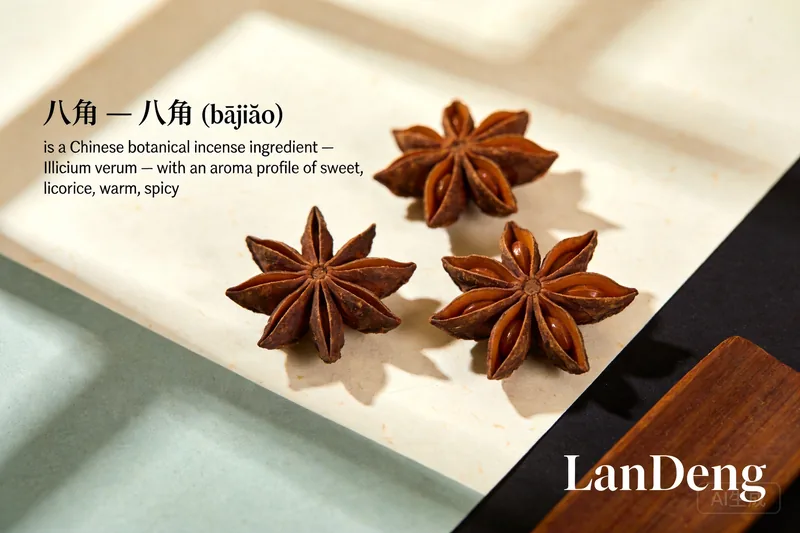
Technical answer: Star anise — bājiǎo (八角) in Chinese — is the star-shaped fruit of Illicium verum, an evergreen tree of southern China and Vietnam. It is one of the defining sweet-spice aromas of Chinese cooking, and a traditional-medicine item, but it is not a classical Chinese incense material: it does not appear in the Song- and Ming-dynasty fragrance manuals. Its presence in incense is a modern culinary crossover.
Key facts
| Chinese | 八角 (bājiǎo), also 八角茴香 / 大茴香 |
| Botanical source | Illicium verum (family Schisandraceae) — the dried fruit |
| What it is | A dried spice fruit, not a wood or resin |
| Aroma | Sweet, licorice-anise, warm, spicy |
| Traditional role | Culinary spice, materia medica; modern incense crossover |
Aroma profile
Star anise smells sweet and licorice-like — warm, spicy, and intensely aromatic — driven largely by anethole, the same molecule behind anise and fennel. It is a “sweet-spice” note in the same family as cinnamon and clove, and in modern incense it is used to add a warm, food-like sweetness rather than a classical incense character.
A safety note that matters (two “star anise”)
This is the one point about star anise that is genuinely safety-relevant, and it is a real distinction, not a pedantic one:
- Chinese star anise — Illicium verum, the safe culinary spice.
- Japanese star anise — Illicium anisatum (syn. I. religiosum), a look-alike whose fruits are toxic and must not be eaten or burned for fragrance.
The two are nearly identical in appearance and have been involved in adulteration incidents. For a material that is primarily a food spice, this substitution risk is the key thing to know.
In Chinese tradition
- Culinary: 八角 (八角茴香 / 大茴香) is a cornerstone of Chinese braising and the “five-spice” tradition, and one of the most recognizable sweet-spice aromas in the cuisine.
- Materia medica: 八角茴香 appears in traditional Chinese medicine, where it is described as a warming aromatic. This is traditional materia-medica language, not modern clinical evidence.
- Incense context: star anise does not appear in the classical fragrance manuals (香乘 / 香譜) as an incense material. Its use in incense is a modern crossover from its culinary and aromatic-spice identity.
Traditional use vs modern evidence
The culinary role is unambiguous and well documented. The medicinal uses are traditional, not established clinical fact, and we make no medical claims. The documented, non-medical facts are botanical identity, the culinary status, and the Illicium verum vs Illicium anisatum safety distinction.
Quality and sourcing notes
Practical points for buyers:
- Confirm the species: Illicium verum (Chinese star anise) is the edible, fragrant one; Illicium anisatum (Japanese star anise) is toxic and a known adulterant.
- The fruit should be whole, star-shaped, and intensely aromatic; the scent is the main quality indicator.
- In incense, star anise is a modern sweet-spice additive, not a classical 香材 — worth understanding if you are aiming for an authentically classical formula.
Safety
Incense combustion produces smoke and particulate matter; burn in a well-ventilated space and avoid inhaling concentrated smoke. Do not confuse star anise with the toxic Japanese star anise (Illicium anisatum). Keep away from children and pets. This is editorial knowledge content, not medical advice.
FAQ
Is star anise a Chinese incense ingredient? Not classically. Star anise does not appear in the Song- and Ming-dynasty incense manuals (香譜 / 香乘) as an incense material. Its presence in incense is a modern crossover from its identity as a defining Chinese culinary sweet spice. The two roles — cooking spice and incense additive — should not be conflated.
What does star anise smell like? Star anise smells sweet and licorice-like — warm, spicy, and intensely aromatic — driven largely by anethole, the same molecule behind anise and fennel. It is a “sweet-spice” note in the family of cinnamon and clove. In modern incense it adds a warm, food-like sweetness rather than a classical incense character.
What is the difference between Chinese and Japanese star anise? A safety-critical one. Chinese star anise (Illicium verum) is the safe, edible, fragrant spice. Japanese star anise (Illicium anisatum, syn. I. religiosum) is a near-identical look-alike whose fruits are toxic and must not be eaten or burned for fragrance. The two have been involved in adulteration incidents, so the species should be confirmed whenever star anise is sourced.
Why is star anise in “five-spice”? Star anise is a cornerstone of Chinese braising and the five-spice (五香) tradition, contributing its sweet, licorice-like warmth. It is one of the most recognizable sweet-spice aromas in Chinese cooking. That culinary prominence — not any classical incense role — is the reason it is familiar, and the reason it occasionally crosses over into modern incense blends.
What part of star anise is used? The dried, star-shaped fruit of Illicium verum is the part used — the eight-pointed “star” is the seed-bearing fruit, and the whole fruit carries the intense aroma. It is a spice fruit rather than a wood, resin, or root, which is one reason it reads as a culinary, food-like note rather than a classical incense material.
See also: cinnamon, clove, and the full scent guide.
Evidence & Sources
Botanical identity
Source: Illicium verum in Flora of China · Illicium verum on GBIF. Evidence type: Established.
Traditional Chinese use
Source: 八角 (八角茴香 / 大茴香) as a culinary spice and traditional-medicine aromatic. Evidence type: Historically documented — culinary use; medicinal uses are traditional, not modern clinical evidence. Note: absent from the classical fragrance manuals 香乘 / 香譜.
Authenticity / safety
Source: the Illicium verum (edible) vs Illicium anisatum (toxic Japanese star anise) distinction — a documented adulteration risk. Evidence type: Established safety concern.
Safety
Source: incense combustion produces smoke and particulate matter; do not confuse star anise with toxic Japanese star anise (Illicium anisatum). Evidence type: Established.
Evidence status
| Layer | Status |
|---|---|
| Botanical identity | Established |
| Traditional use | Historically documented (culinary) |
| Authenticity test | Established safety concern (species adulteration) |
| Health claims | Not established |
Sources
Sources: botanical references on Illicium verum and the Illicium verum vs Illicium anisatum safety distinction. Star anise is recorded as a culinary spice and traditional-medicine aromatic, not a classical incense material. Medicinal uses are treated as traditional, not established clinical fact. This is editorial knowledge content, not medical advice.