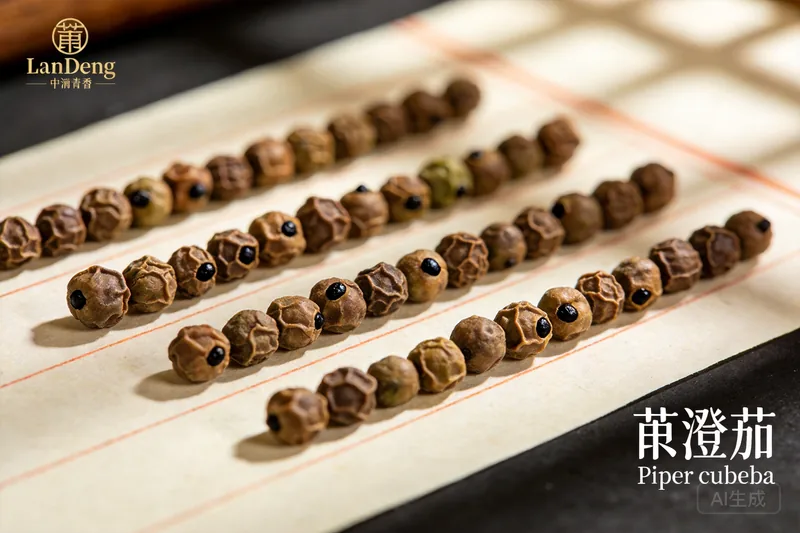
Technical answer: Cubeb — bìchéngqié (荜澄茄) in Chinese — is the dried, unripe fruit of Piper cubeba, a climbing vine of the pepper family (Piperaceae) native to Java and Sumatra in Indonesia. It is a peppery spice with a sharp, slightly woody, faintly camphoraceous bite, used in Chinese incense as a warm spice accent in some 合香 (blended incense) contexts. It belongs to the same genus as black pepper and long pepper, but is a distinct spice.
Key facts
| Chinese | 荜澄茄 (bìchéngqié) |
| Botanical source | Piper cubeba (family Piperaceae) — the dried fruit |
| What it is | A dried spice fruit, not a wood or resin |
| Aroma | Spicy, peppery, woody, faintly camphoraceous |
| Traditional role | Culinary spice, materia medica, warm incense accent |
Aroma profile
Cubeb is sharp and peppery, with a woody, slightly resinous, faintly camphoraceous edge — it is often described as a cross between black pepper and allspice, with a cooling, almost pine-like finish. It is a spice accent rather than a base note: it adds a warm, piquant bite that lifts heavier woods and resins. In the pepper family it is closely related to long pepper (Piper longum) and black pepper (Piper nigrum).
Botanical source and origin
Piper cubeba is a climbing vine native to Java and Sumatra in Indonesia, cultivated there and in parts of Southeast Asia and Africa. The part used is the dried, unripe fruit, which is gathered and dried whole — the stalk (“tail”) is usually still attached, giving it the name “tailed pepper.” It is a spice of the pepper family (Piperaceae), alongside black pepper and long pepper.
A naming caution: 荜澄茄 (cubeb, Piper cubeba) is a pepper-family spice, distinct from black pepper (Piper nigrum) and long pepper (荜茇, Piper longum). In Chinese materia medica the name 荜澄茄 has also been applied to Litsea cubeba (山鸡椒, “mountain pepper,” a laurel-family plant), which is a different species — confirm which material is meant when the name appears.
In Chinese tradition
- Culinary spice: cubeb is a warm, peppery spice used in cooking and spice blends.
- Materia medica: 荜澄茄 is recorded in traditional Chinese medicine as a warming aromatic. This is traditional materia-medica language, not modern clinical evidence.
- Incense context: cubeb appears as a warm spice accent in some 合香 blends, alongside other spices, rather than as a classical defining material.
Traditional use vs modern evidence
The culinary role is well documented. Medicinal uses are traditional, not established clinical fact, and we make no medical claims. The documented, non-medical facts are botanical identity, the pepper-family placement, and the warm, peppery aromatic use.
Quality and sourcing notes
Practical points for buyers:
- Whole cubeb should be dense, dark, and strongly peppery-aromatic; the tail (“stalk”) is a normal feature, not a defect.
- Distinguish 荜澄茄 (cubeb, Piper cubeba) from 山鸡椒 (Litsea cubeba, mountain pepper) — different plants that share a Chinese materia-medica name.
- In incense, cubeb is a spice accent, usually blended, not burned alone.
Safety
Incense combustion produces smoke and particulate matter. Burn in a well-ventilated space, avoid inhaling concentrated smoke, and keep away from children and pets. This is editorial knowledge content, not medical advice.
FAQ
What is cubeb pepper? The dried, unripe fruit of Piper cubeba, a climbing vine of the pepper family (Piperaceae) native to Java and Sumatra. It is a sharp, peppery spice with a woody, faintly camphoraceous bite, gathered and dried whole with its stalk attached — hence the name “tailed pepper.” It is related to black pepper and long pepper but is a distinct spice.
How does cubeb differ from black pepper and long pepper? They are all pepper-family (Piper) spices but different species. Cubeb is Piper cubeba — sharper and more camphoraceous, with a cooling finish; black pepper is Piper nigrum; long pepper (荜茇) is Piper longum. Cubeb is usually dried with its stalk attached, giving it the “tailed pepper” name, and it is less common in Western kitchens than black pepper.
What does cubeb smell like? Sharp and peppery, with a woody, slightly resinous, faintly camphoraceous edge — often described as a cross between black pepper and allspice, with a cooling, pine-like finish. In incense it acts as a warm, piquant spice accent that lifts heavier woods and resins rather than serving as a base note.
Is 荜澄茄 the same as 山鸡椒 (mountain pepper)? Not always. 荜澄茄 properly refers to cubeb (Piper cubeba), but in Chinese materia medica the name has also been applied to Litsea cubeba (山鸡椒, “mountain pepper”), a laurel-family plant. They are different species, so the material should be confirmed when the name appears. Cubeb is the pepper-family spice; mountain pepper is a different plant.
Where does cubeb come from? From Piper cubeba, a climbing vine native to Java and Sumatra in Indonesia, also cultivated in parts of Southeast Asia and Africa. The fruit is gathered unripe and dried whole. Cubeb has been traded as a spice for centuries and entered Chinese cooking and materia medica as an imported aromatic.
See also: long-pepper, clove, and the full scent guide.
Evidence & Sources
Botanical identity
Source: Piper cubeba on GBIF. Evidence type: Established.
Traditional Chinese use
Source: 荜澄茄 as a culinary spice and materia-medica warming aromatic. Evidence type: Historically documented — culinary use; medicinal uses are traditional, not modern clinical evidence.
Authenticity / disambiguation
Source: 荜澄茄 (Piper cubeba, cubeb) vs 山鸡椒 (Litsea cubeba, mountain pepper) — different species sharing a Chinese materia-medica name. Evidence type: Practical screening.
Safety
Source: incense combustion produces smoke and particulate matter; burn in a well-ventilated space. Evidence type: Established.
Evidence status
| Layer | Status |
|---|---|
| Botanical identity | Established |
| Traditional use | Historically documented (culinary) |
| Authenticity test | Practical screening |
| Health claims | Not established |
Sources
Sources: botanical references on Piper cubeba and the cubeb-vs-mountain-pepper distinction. Cubeb is recorded as a culinary spice; medicinal uses are treated as traditional, not established clinical fact. This is editorial knowledge content, not medical advice.