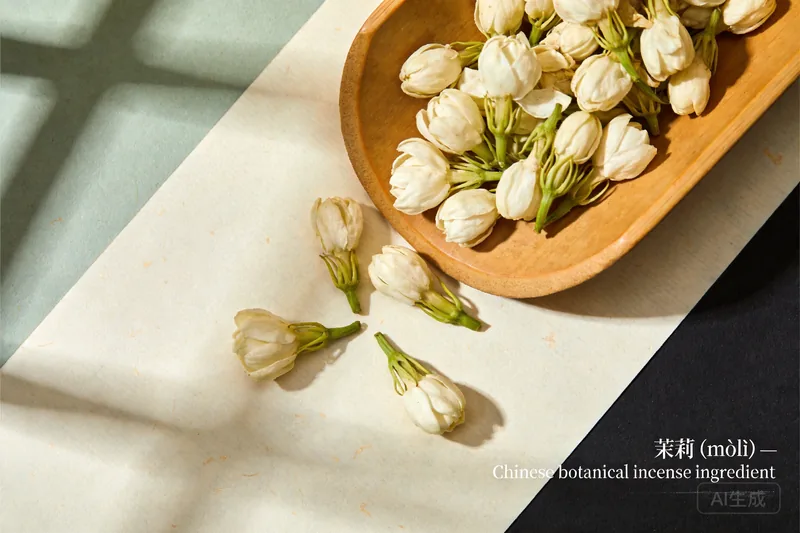
Data summary: Jasmine — mòlì (茉莉, also 茉莉花 mòlìhuā) in Chinese — is a sweet-scented white flower, most classically Jasminum sambac, used in Chinese tea, perfume, and incense. Jasmine tea is considered one of China’s oldest scented-flower teas.
Key facts
| Chinese | 茉莉 (mòlì), 茉莉花 (mòlìhuā) |
| Botanical source | Jasminum species — notably J. sambac |
| What it is | A dried flower (not a wood or resin) |
| Aroma | Sweet, floral, heady |
| Traditional role | Scented tea, perfume, fragrance |
Aroma profile
Jasmine has an intensely sweet, floral, slightly heady scent — one of the most recognizable floral notes in Chinese fragrance. In incense it is used to add a sweet, romantic floral lift.
It is richer and “heavier” than a light floral: where chrysanthemum is dry and cool and osmanthus is fruity-apricot, jasmine is opulent and white-floral, with a warm, almost indolic sweetness in its natural absolute form (though commercial jasmine notes are usually rendered as a cleaner, brighter accord). In a blend it pushes the scent toward “romantic” and “lush.”
In Chinese tradition
- Jasmine tea (茉莉花茶): traditionally said to be China’s oldest scented-flower tea, developed around the Song dynasty (960–1279). The classic method layers fresh jasmine flowers with tea leaves so the leaves absorb the scent (traditionally the flowers are then removed). The technique is called 窨制 (scenting/aromatizing), and fine jasmine tea may be scented in multiple passes.
- Symbolism: jasmine carries associations of purity, elegance, beauty, and love; it appears in weddings and festivals.
- Fragrance: used in perfume and incense.
Botanical note
“Jasmine” spans many Jasminum species; the classic Chinese fragrance/tea jasmine is Jasminum sambac (a different species from common European jasmine). The scent differs accordingly: J. sambac is the sweet, tea-scented jasmine; J. grandiflorum (Spanish/Poet’s jasmine) is the more common Western perfume jasmine. A label saying “jasmine” without a species is underspecified.
In incense
Jasmine appears in incense as a floral note, almost always as an accord or blended with a wood/resin base, because true jasmine absolute is expensive and delicate. It is more common in modern and floral-forward blends than in the classical wood-and-resin canon. Jasmine is also used to make jasmine absolute and concrete for perfumery.
Traditional use vs modern evidence
Jasmine is used as a tea, fragrance, and traditional materia medica ingredient. We describe its aromatic and cultural use; we do not make medical claims.
Safety
Incense combustion produces smoke and particulate matter. Burn in a well-ventilated space; avoid inhaling concentrated smoke.
FAQ
Is jasmine the same as jasmine tea? Jasmine is the flower; jasmine tea is tea scented with that flower. The classic method layers freshly picked jasmine blossoms with tea leaves, most often green tea, so the leaves absorb the fragrance. After each scenting pass the spent flowers are traditionally removed, so the finished tea carries the jasmine character while containing little or no flower matter. The technique is called 窨制, and premium jasmine tea is scented through several passes to deepen the aroma. In short, jasmine is the raw botanical material and jasmine tea is the finished, scented product — closely related but not interchangeable terms.
Is jasmine a wood or a flower? Jasmine is a flower, not a wood or resin. The classic Chinese tea and fragrance jasmine is Jasminum sambac, a small white flower in the olive family (Oleaceae); a different species, Jasminum grandiflorum, is the more common Western perfume jasmine. The blossoms are picked just before they fully open, when the scent is strongest, then used fresh for tea scenting or processed into absolute and concrete for fragrance. In incense, jasmine is almost always a floral accord layered over a wood or resin base, because true jasmine absolute is costly and delicate. There is no jasmine wood.
What does jasmine incense smell like? Jasmine incense carries an intensely sweet, floral, and slightly heady scent — one of the most recognizable floral notes in Chinese fragrance. It reads as opulent and white-floral, with a warm, almost indolic sweetness in its natural absolute form, though most commercial jasmine notes are rendered as a cleaner, brighter accord. In a blend it pushes the scent toward romantic and lush rather than dry or green. Because true jasmine absolute is expensive, jasmine incense usually layers a reconstructed jasmine accord over a wood or resin base, so the exact character varies by maker — some lean clean and bright, others richer and more full-bodied.
Is jasmine used in Chinese incense? Yes, jasmine appears in Chinese incense as a sweet, romantic floral lift, and it is usually blended rather than burned alone. True jasmine absolute is expensive and delicate, so the flower’s scent is more often carried as an accord over a wood or resin base. Jasmine is more common in modern and floral-forward blends than in the classical wood-and-resin canon, which favors agarwood, sandalwood, and resins. The same flower also scents jasmine tea and supplies jasmine absolute and concrete for perfumery. A label that says only “jasmine” without a species, and without noting whether it is natural or an accord, is underspecified.
What is the difference between jasmine and osmanthus? Both are sweet Chinese florals, but they sit at different points on the spectrum. Jasmine is heady, opulent, and white-floral, with a warm, almost indolic sweetness; osmanthus is brighter and more delicate, with a fruity apricot-and-honey character. In a blend, jasmine romanticizes and adds richness, while osmanthus lifts and sweetens without the heaviness. They also come from different plants: jasmine is a Jasminum species, and osmanthus is Osmanthus fragrans — both in the olive family, but different genera. The two are often paired with rose as the classic trio of Chinese floral notes.
How is jasmine tea made? Jasmine tea is made by scenting tea leaves with fresh jasmine flowers through a process called 窨制. Freshly picked blossoms, chosen when the buds are about to open, are layered with tea leaves — most often green tea — so the leaves absorb the flower’s volatile aroma. After a scenting pass, the spent flowers are traditionally removed, leaving the tea fragranced but largely flower-free. Premium jasmine tea goes through this cycle several times, each pass deepening the scent, which is why higher grades cost more. The result is a tea whose jasmine character comes from repeated contact with the living flower, not from added flavoring.
See also: rose and osmanthus, its fellow florals, plus the full scent guide.
Evidence & Sources
Botanical identity
Source: Jasminum in Flora of China · Jasminum on GBIF. Evidence type: Established.
Traditional Chinese use
Source: this page records jasmine tea (茉莉花茶) as traditionally China’s oldest scented-flower tea, developed around the Song dynasty (960–1279) via 窨制 scenting. Evidence type: Historically documented — traditional use, not modern clinical evidence.
Commercial grading
Source: the J. sambac vs J. grandiflorum species note and the “true absolute vs accord” distinction. Evidence type: Trade terminology.
Safety
Source: incense combustion produces smoke and particulate matter; burn in a well-ventilated space. Evidence type: Established.
Evidence status
| Layer | Status |
|---|---|
| Botanical identity | Established |
| Traditional use | Historically documented |
| Commercial grading | Trade terminology |
| Health claims | Not established |
Sources
Sources: botanical references on Jasminum and cultural accounts of jasmine tea (窨制 method). This is editorial knowledge content, not medical advice.