Direct answer: Lemon balm (香蜂草, xiāngfēngcǎo) is the herb Melissa officinalis, a perennial of the mint family (Lamiaceae) native to southern Europe and the Mediterranean. Its leaves carry a soft, lemony, fresh, green scent. It is a modern crossover, not a classical Chinese incense ingredient.
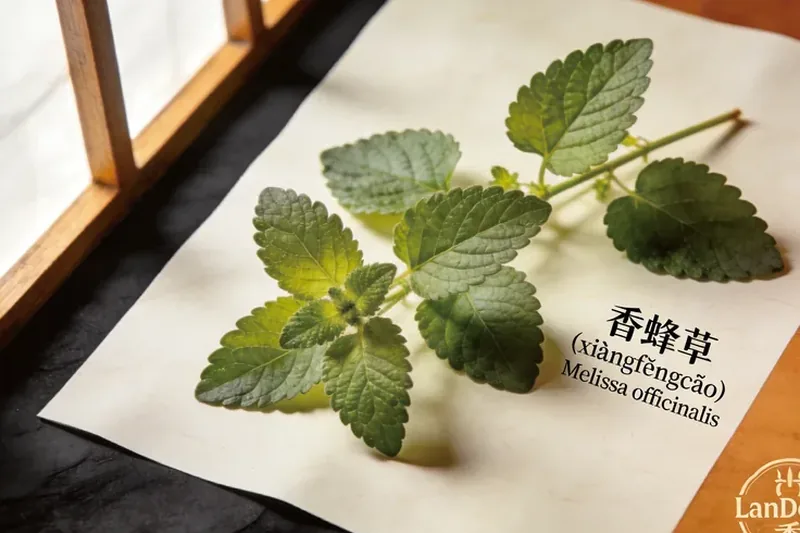
Key facts
| Chinese | 香蜂草 (xiāngfēngcǎo); also 香蜂花 (xiāngfēnghuā) |
| Botanical source | Melissa officinalis (family Lamiaceae) — the leaves |
| What it is | A Mediterranean mint-family herb |
| Aroma | Lemony, herbal, fresh, slightly sweet, green |
| Traditional role | None in classical Chinese incense; modern herbal/home fragrance |
Aroma profile
Direct answer: 香蜂草 (lemon balm) is soft and lemony, with a fresh, green, herbaceous character and a gentle sweetness — the delicate lemon scent of the crushed leaf, quieter and more herbal than the bright zest of actual lemon. Its lemony character comes from the compounds citral and citronellal, shared with other lemon-scented herbs.
香蜂草 (lemon balm) is soft and lemony, with a fresh, green, herbaceous character and a gentle sweetness — the delicate lemon scent of the crushed leaf, quieter and more herbal than the bright zest of actual lemon. Its lemony character comes from the compounds citral and citronellal, shared with other lemon-scented herbs. The key point is that this lemon note is a molecular convergence, not a citrus relationship: lemon balm is a mint-family herb that smells lemony through the same citral/citronellal chemistry found in lemongrass and other unrelated plants — it is not a citrus, and its “lemon” is a soft, green-leaf lemon rather than a bright, rind-zest lemon.
A provenance note (read this)
Direct answer: 香蜂草 (lemon balm) is a modern crossover, not a classical Chinese 香材. Melissa officinalis is a southern European and Mediterranean species, not native to China; Flora of China records it as a cultivated/introduced plant. The Chinese name 香蜂草 (or 香蜂花, the Flora of China name) is modern, and its use is a modern Western tradition.
香蜂草 (lemon balm) is a modern crossover, not a classical Chinese 香材:
- Melissa officinalis is a southern European and Mediterranean species, not native to China; Flora of China records it as a cultivated/introduced plant.
- The Chinese name 香蜂草 (or 香蜂花, the Flora of China name) is modern; lemon balm as a fragrance and herbal material is a modern Western tradition, absent from the classical 香材 canon.
- Its use is modern herbalism and home fragrance, not a classical Chinese incense ingredient.
This page records it honestly as a modern lemony herb — no classical Chinese origin is claimed, and none is fabricated.
Botanical source and origin
Direct answer: Melissa officinalis, lemon balm, is a perennial herb of the mint family (Lamiaceae), with erect, pyramidally branched stems, ovate leaves, and creamy-white flowers, flowering June–August. Flora of China records it (under 香蜂花) as cultivated in China, native to the Mediterranean and southwestern Asia.
Melissa officinalis, lemon balm, is a perennial herb of the mint family (Lamiaceae), native to southern Europe and the Mediterranean. Flora of China records it (under the name 香蜂花) as a plant with erect, pyramidally branched, pubescent stems, ovate leaves 1–5 (–6.5) × 0.8–4 (–5) cm, and a creamy-white corolla 1.2–1.3 cm, flowering June–August; it is recorded as cultivated in China, native to southwestern Asia and Europe. Flora of China adds that it is “used for flavoring salads, soups, and liqueurs; the oil is employed in perfumery; commonly known as balm tea.” The fragrant part is the leaf, used fresh or dried. It shares the mint family with 薄荷 (Mentha haplocalyx) and 留兰香 (Mentha spicata), but is a distinct genus (Melissa). See Melissa officinalis in Flora of China.
Chinese name and terminology
Direct answer: 香蜂草 (xiāngfēngcǎo) means “fragrant bee herb” — 香 “fragrant” + 蜂 “bee” + 草 “herb” — a name that records the plant’s bee-attracting flowers and its scent; the Flora of China name is 香蜂花 (“fragrant bee flower”). The name is modern, and the “lemon” in “lemon balm” is an English descriptor, not a botanical claim.
The Chinese name 香蜂草 is descriptive and modern: 香 (xiāng, “fragrant”) + 蜂 (fēng, “bee”) + 草 (cǎo, “herb”) — “fragrant bee herb,” after the plant’s bee-attracting flowers. The Flora of China name 香蜂花 (xiāngfēnghuā, “fragrant bee flower”) points the same way. The English name “lemon balm” is the descriptor that needs care: the “lemon” is a scent character (from citral/citronellal), not a botanical relationship — lemon balm is a mint-family herb, not a citrus. The genus name Melissa is itself the Greek word for “honey bee,” completing the same bee association.
The lemon-scented convergence (read this)
Direct answer: The lemon scent is not a citrus monopoly. Lemon balm (Melissa officinalis, Lamiaceae), lemon (Citrus × limon, Rutaceae), and lemongrass (a grass, Poaceae) all smell “lemony” through citral/citronellal-type chemistry — three different plant families converging on one aromatic family. “Lemon-scented” names a molecule, not a relationship.
The “lemon” note is one of the clearest cases of aromatic convergence in this encyclopedia, and it matters for sourcing:
- 香蜂草 (lemon balm) — Melissa officinalis, a mint-family (Lamiaceae) herb; lemony via citral/citronellal. This entry.
- 柠檬 (lemon) — Citrus × limon, a rue-family (Rutaceae) citrus; lemony via limonene/citral from the rind.
- Lemongrass — Cymbopogon, a grass (Poaceae); lemony via citral.
Three different plant families converge on the same “lemony” register through shared chemistry. The practical consequence: “lemon-scented” is a molecule, not a species — a buyer who orders “something lemony” is ordering a register, and could receive a mint herb, a citrus, or a grass depending on what the seller means. See lemon (柠檬) and bergamot (佛手柑).
In modern use
- Herbal tea and home fragrance (Modern use): lemon balm is a classic European herbal, used in teas and, in modern practice, home fragrance.
- Fragrance (Modern use): lemon balm appears in modern perfumery and aromatherapy as a soft, fresh, green-lemony note.
- Not classical Chinese incense (Provenance): lemon balm has no place in the classical 香材 canon; its Chinese use is modern and Western-influenced.
Traditional use vs modern evidence
Direct answer: There is no classical Chinese incense record for 香蜂草 (lemon balm); its position is entirely modern. The documented facts are botanical identity, the Lamiaceae placement, its modern herbal and fragrance role, and the citral/citronellal chemistry of its lemon note.
- Traditional Use — none in classical Chinese incense; lemon balm is not a 香材, and no traditional aromatic or materia-medica role is claimed for 香蜂草 here.
- Historical Record — the botanical record places Melissa officinalis as a Mediterranean Lamiaceae herb, recorded by Flora of China as cultivated/introduced; the “lemon balm” tea and culinary tradition is European, not a Chinese classical record.
- Scientific Evidence — the botanical identity of Melissa officinalis (Lamiaceae) and the citral/citronellal lemon-note chemistry are established. We present no medical claims.
There is no classical Chinese incense record for 香蜂草 (lemon balm); its position is entirely modern. We make no medical claims.
How is lemon balm used in incense?
Direct answer: Lemon balm is not a classical incense material, so in incense it appears only as a modern fragrance note — a soft, green-lemony accent, usually as an essential oil or accord rather than a burned herb. Its quiet, fresh character is a blending accent, not a base or a lead.
Because lemon balm has no classical Chinese incense role, its incense use is entirely modern and borrowed from perfumery. Where it does appear, it is as a soft, green-lemony accent — typically delivered as an essential oil or a fragrance accord rather than as dried herb to be burned. Its citral/citronellal freshness lifts greener, lighter blends, a role closer to lemon or a green herb than to a heavy wood. The practical point for a formulator is that lemon balm’s charm is quiet and top-note in nature: it brightens a blend but does not anchor it, and it is easily lost under heat or buried by heavier materials.
How is it processed?
Direct answer: Lemon balm is processed by harvesting the leaves and using them fresh or dried, or by distilling or extracting the essential oil for fragrance. The leaf is the fragrant part, and its soft lemony note is volatile, so drying and freshness govern how much character survives.
The processing of lemon balm is straightforward:
- Harvest — the leaves are harvested.
- Use fresh or dried — for tea and herbal use, the leaf is used fresh or dried.
- Distill / extract — for fragrance, the leaf is distilled or extracted for its essential oil.
The fragrant part is the leaf, and its soft, lemony note is volatile — so drying temperature and freshness govern how much character survives, a point shared with other leafy herbs.
What determines quality?
Direct answer: Quality turns on a fresh, clean, softly lemony leaf with a good citral/citronellal character, and — for fragrance — a well-distilled oil. Because lemon balm is quiet, freshness matters more than with stronger materials, and there is no standardized grading ladder.
The quality factors:
- Freshness — the soft lemony note is volatile and fades with age.
- Aroma — a fresh, green, softly lemony character with no mustiness.
- Cleanliness — clean, sound leaf material.
- Oil quality (for fragrance) — a well-distilled oil with a clean citral/citronellal profile.
There is no standardized commercial grading ladder; freshness and the soft lemony-green character are the practical signals.
What buyers should look for
Direct answer: Buyers should distinguish lemon balm (Melissa officinalis) from lemon (Citrus × limon) and from the mints (Mentha spp.) — different families, different aromas — and expect a soft, green-lemony leaf scent. It is a modern fragrance and herbal material, not a classical 香材, usually delivered as an oil or accord rather than a burned herb.
For a formulator or sourcing buyer:
- Species — confirm Melissa officinalis and distinguish it from lemon (Citrus × limon, a bright rind oil) and the mints (Mentha spp., a different genus).
- Form — for fragrance, expect an essential oil or accord; the dried leaf is an herbal/tea material, not an incense material.
- Aroma — a soft, green-lemony character (citral/citronellal); a sharp or bright-zest note suggests lemon, not lemon balm.
- Provenance — understand it is a modern, Western-influenced crossover, not a classical 香材.
Safety
Incense combustion produces smoke and particulate matter. Burn in a well-ventilated space, avoid inhaling concentrated smoke, and keep away from children and pets. This is editorial knowledge content, not medical advice.
Lemon balm vs lemon vs mint
Direct answer: Lemon balm (香蜂草) is a mint-family herb that smells lemony through citral/citronellal; lemon (柠檬) is a rue-family citrus whose rind yields a bright, zesty oil; mint (薄荷) is a Mentha herb with a menthol-camphoraceous note. Three different plants, three different families, one shared “lemon” descriptor that can mislead.
| Lemon balm (香蜂草) | Lemon (柠檬) | Mint (薄荷) | |
|---|---|---|---|
| Botanical source | Melissa officinalis (Lamiaceae) | Citrus × limon (Rutaceae) | Mentha spp. (Lamiaceae) |
| Character | Soft, green-lemony, herbal | Bright, zesty citrus | Menthol, cool, sharp |
| Driver | Citral / citronellal | Limonene / citral | Menthol |
The “lemon” in “lemon balm” is a scent character, not a citrus relationship, and the mints are same-family but different-genus herbs. See lemon (柠檬), mint (薄荷), and basil (罗勒).
Our Industry View
Direct answer: Lemon balm’s lesson is that the lemon note is a molecule, not a monopoly — it appears across unrelated plant families (mint, citrus, grass) through shared citral/citronellal chemistry. For a buyer, “lemon-scented” is a register, not a spec: the disciplined order names the species and the form, and understands that a modern crossover should be labeled a modern crossover.
From a manufacturing and sourcing perspective, lemon balm illustrates the same principle as eucalyptus and tarragon, applied to the “lemon” note:
- The note is a convergence, not a relationship. Lemon balm is a mint-family herb that smells lemony through citral/citronellal — the same chemistry behind lemongrass and (partly) lemon rind. Three families, one register. A buyer who orders “something lemony” is ordering a register, not a material.
- The genus and the family are the spec. Lemon balm must be distinguished from lemon (a citrus) and from the mints (a same-family, different-genus herb), because the name “lemon” in “lemon balm” points at a scent, not a relationship. The disciplined order names Melissa officinalis and the form.
- Quietness is the formulation variable. Lemon balm is a soft, top-note accent whose value is freshness and lift, not intensity — and the right dose depends on formulation. A buyer treats it as a blending accent, not a base.
In our view, the useful takeaway is procedural: name the species, name the form, state the provenance, and read “lemon” as a molecule, not a relationship — and a “lemon-scented herb” becomes fully specifiable instead of a source of confusion.
Summary
Lemon balm (香蜂草) is the mint-family (Lamiaceae) herb Melissa officinalis, native to the Mediterranean and recorded by Flora of China (as 香蜂花) as cultivated/introduced. Its soft, green-lemony scent comes from citral and citronellal — the same “lemon” chemistry shared with lemongrass and lemon rind — but it is not a citrus. It is a modern herbal and fragrance crossover with no classical Chinese incense record, a provenance this page states plainly. Commercially, the species and the form (oil vs leaf), not the “lemon” descriptor, are the buyer’s real specification, and its quiet, fresh note is a blending accent, not a base.
FAQ
What is 香蜂草 (lemon balm)? The herb Melissa officinalis, a perennial of the mint family (Lamiaceae) native to southern Europe and the Mediterranean. Its leaves carry a soft, lemony, fresh, green scent. It is a modern crossover, not a classical Chinese incense ingredient.
Is lemon balm a classical Chinese incense ingredient? No. Lemon balm is a Mediterranean species, not native to China, and it has no place in the classical 香材 canon. Its Chinese name (香蜂草 or 香蜂花) is modern, and its use is a modern Western herbal and fragrance tradition.
What does lemon balm smell like? Soft and lemony, with a fresh, green, herbaceous character and a gentle sweetness — the delicate lemon scent of the crushed leaf, quieter and more herbal than the bright zest of actual lemon. Its lemony character comes from citral and citronellal.
How is lemon balm different from lemon? They are different plants. 香蜂草 is Melissa officinalis, a mint-family herb with a soft, green-lemony leaf scent; 柠檬 is Citrus × limon, a citrus tree whose rind yields a bright, zesty essential oil. Different families, different aromas, different materials. The “lemon” in “lemon balm” is a scent character, not a citrus relationship.
Why does lemon balm smell lemony if it is not a citrus? Because of molecular convergence. Lemon balm produces citral and citronellal — the same compounds behind the lemon note in lemongrass and partly in lemon rind — so a mint-family herb, a grass, and a citrus all converge on the same “lemony” register through shared chemistry, despite being unrelated plants.
How is lemon balm used? As a classic European herbal tea and, in modern practice, home fragrance, plus a soft, fresh, green-lemony note in modern perfumery and aromatherapy. It is a modern, Western-influenced use, not a classical Chinese incense material, and it is usually delivered as an oil or accord rather than a burned herb.
See also: mint (薄荷), lemon (柠檬), basil (罗勒), bergamot (佛手柑), and the full scent guide.
Evidence & Sources
Botanical identity
Source: Melissa officinalis in Flora of China · Melissa officinalis on GBIF. Evidence type: Established.
Modern use
Source: lemon balm as a European herbal tea and modern home-fragrance note; a modern crossover with no classical Chinese incense record. Evidence type: Modern herbal — no classical Chinese record; none claimed.
Authenticity / provenance
Source: 香蜂草 (Melissa officinalis) vs lemon (Citrus × limon) vs the mints (Mentha spp.). Evidence type: Practical screening.
Safety
Source: incense combustion produces smoke and particulate matter; burn in a well-ventilated space. Evidence type: Established.
Evidence status
| Layer | Status |
|---|---|
| Botanical identity | Established |
| Traditional use | None (modern herbal) |
| Authenticity test | Practical screening |
| Health claims | Not established |
Sources
Sources: botanical references on Melissa officinalis. 香蜂草 (lemon balm) is a modern lemony herb with no classical Chinese incense record; no such origin is claimed. This is editorial knowledge content, not medical advice.