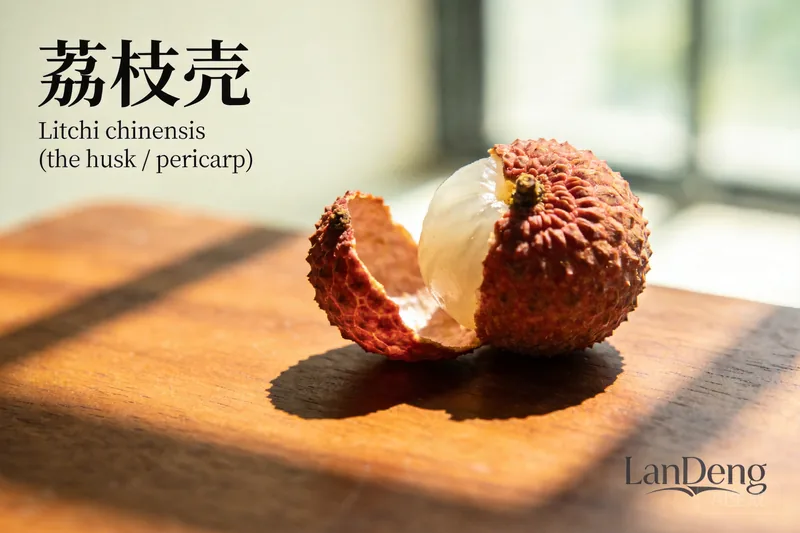
Technical answer: Litchi husk — lìzhī ké (荔枝壳) in Chinese — is the dried, leathery red husk (pericarp) of the litchi fruit, Litchi chinensis, a tropical evergreen tree of the soapberry family (Sapindaceae) native to southern China. It is a distinctly Chinese incense ingredient: the 香乘 (Xiang Cheng) records a “荔枝香” (litchi incense) made from the husk, praised as the freshest and most delicate of fruit-peel incenses. The husk is a fruit peel material, used for its sweet, fruity, faintly floral scent.
Key facts
| Chinese | 荔枝壳 (lìzhī ké) |
| Botanical source | Litchi chinensis (family Sapindaceae) — the dried husk/pericarp |
| What it is | A dried fruit peel, not a wood or resin |
| Aroma | Sweet, fruity, faintly floral, mildly woody |
| Traditional role | Fruit-peel incense (荔枝香), a classical 香谱 specialty |
Aroma profile
Litchi husk, when dried and burned, gives a sweet, fruity, faintly floral scent that is notably fresh and delicate — lighter than citrus peel and less sharp than spice. It is a fruit-peel note, in the same family as tangerine peel (陈皮), but sweeter and more floral. The 香乘 singles it out: of the fruit peels, litchi husk makes the freshest, most refined incense (取其壳合香最清馥).
Botanical source and origin
Litchi chinensis is a tropical evergreen tree of the soapberry family (Sapindaceae), native to the lowlands of southern China — Guangdong, Fujian, and nearby regions — and cultivated across warm regions worldwide. The fruit is the familiar litchi, and its rough red husk (pericarp) is the part used in incense. The husk is dried and blended, and the litchi has been cultivated in China for well over a millennium.
A naming caution: litchi husk (荔枝壳) is a fruit peel material, distinct from the litchi fruit itself and from other fruit peels such as tangerine peel (陈皮). It is valued for its sweetness and delicacy, not for the taste of the fruit.
In Chinese tradition
- 荔枝香 (litchi incense): the 香乘 (Xiang Cheng) records 荔枝香 — an incense made from the litchi husk — quoting the 香谱: “取其壳合香最清馥” (“taking its husk to blend incense, it is the freshest and most refined”). It is a classical fruit-peel specialty.
- A distinctly Chinese material: litchi husk is a rare example of a fruit peel that became a named incense material in its own right, tied to the litchi’s southern-Chinese origin.
- Materia medica: 荔枝 is recorded in traditional Chinese medicine (本草綱目, 果部) with various described uses. This is traditional materia-medica language, not modern clinical evidence.
Traditional use vs modern evidence
The incense use is documented in the classical recipe record. Medicinal uses are traditional, not established clinical fact, and we make no medical claims. The documented, non-medical facts are botanical identity and the husk’s role as a classical fruit-peel incense material.
Quality and sourcing notes
Practical points for buyers:
- Litchi husk should be clean, dry, and intact, with a faintly sweet, fruity scent when warmed.
- It is a fruit peel material — lighter and more delicate than woods and resins, and usually blended, not burned alone.
- Distinguish litchi husk (荔枝壳) from the litchi fruit and from other fruit peels such as tangerine peel (陈皮).
Safety
Incense combustion produces smoke and particulate matter. Burn in a well-ventilated space, avoid inhaling concentrated smoke, and keep away from children and pets. This is editorial knowledge content, not medical advice.
FAQ
What is litchi husk incense? An incense made from the dried, leathery red husk (pericarp) of the litchi fruit, Litchi chinensis. The 香乘 (Xiang Cheng) records a “荔枝香” (litchi incense) made from the husk, quoting the 香谱 that taking the husk to blend incense yields the freshest and most refined result (取其壳合香最清馥). It is a classical fruit-peel specialty.
What does litchi husk smell like? Sweet, fruity, and faintly floral, with a mildly woody undertone — notably fresh and delicate, lighter than citrus peel and less sharp than spice. It is a fruit-peel note in the same family as tangerine peel (陈皮) but sweeter and more floral, valued for its freshness rather than for a heavy or resinous scent.
Why is litchi husk a notable incense material? Because it is a rare example of a fruit peel becoming a named incense material in its own right. The litchi is native to southern China, and the husk’s sweet, delicate scent earned it a place in the classical 香谱 as 荔枝香, where it is praised as the freshest and most refined of the fruit-peel incenses.
What part of the litchi is used in incense? The husk — the rough, leathery red pericarp that wraps the fruit — not the edible flesh. The husk is dried and blended, and it is the part that carries the sweet, fruity, faintly floral aroma. The fruit itself is eaten; the husk is the incense material.
Where does the litchi come from? From Litchi chinensis, a tropical evergreen tree of the soapberry family (Sapindaceae) native to the lowlands of southern China — Guangdong, Fujian, and nearby regions — and cultivated across warm regions worldwide. The litchi has been cultivated in China for well over a millennium, and the tree’s fruit husk is the incense material.
See also: orange-peel, osmanthus, and the full scent guide.
Evidence & Sources
Botanical identity
Source: Litchi chinensis in Flora of China · Litchi chinensis on GBIF. Evidence type: Established.
Traditional Chinese use
Source: 香乘 (Xiang Cheng) recording 荔枝香 from the litchi husk, quoting 香谱 “取其壳合香最清馥”; 荔枝 in the 本草綱目 果部. Evidence type: Historically documented — incense use; medicinal uses are traditional, not modern clinical evidence.
Authenticity / disambiguation
Source: litchi husk (荔枝壳) as a fruit-peel material, distinct from the fruit and from other fruit peels (陈皮). Evidence type: Practical screening.
Safety
Source: incense combustion produces smoke and particulate matter; burn in a well-ventilated space. Evidence type: Established.
Evidence status
| Layer | Status |
|---|---|
| Botanical identity | Established |
| Traditional use | Historically documented |
| Authenticity test | Practical screening |
| Health claims | Not established |
Sources
Sources: botanical references on Litchi chinensis and the 香乘 record of 荔枝香 from the litchi husk. Medicinal uses are treated as traditional, not established clinical fact. This is editorial knowledge content, not medical advice.