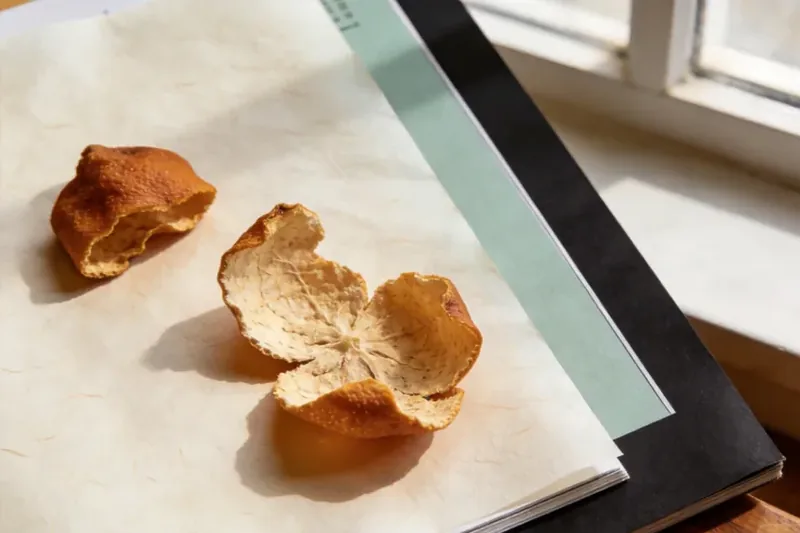
Direct answer: Pomelo peel (柚皮, yòupí) is the peel of the pomelo (Citrus maxima), the largest citrus fruit, a tree of the rue family (Rutaceae) native to Southeast Asia and long cultivated in southern China. It is a bittersweet, floral-woody citrus peel used in Chinese incense as a citrus peel note and in cooking and tea. It is distinct from the aged mandarin peel 陈皮 (Citrus reticulata).
Key facts
| Chinese | 柚皮 (yòupí) — pomelo peel; also 柚子皮 |
| Botanical source | Citrus maxima (family Rutaceae) — the fruit peel |
| What it is | A dried citrus peel, not a wood |
| Aroma | Citrus, bittersweet, floral, faintly woody |
| Traditional role | Citrus peel note; cooking and tea |
Aroma profile
Direct answer: Pomelo peel is citrus and bittersweet, with a floral, faintly woody depth and less of the sharp acidity of orange or mandarin. Its thick white pith gives it a mild bitterness that balances the bright citrus oil of the outer rind — a soft, rounded citrus note closer to dried citrus than to fresh zest.
Pomelo peel is citrus and bittersweet, with a floral, faintly woody depth and less of the sharp acidity of orange or mandarin. Its thick white pith gives it a mild bitterness that balances the bright citrus oil of the outer rind. In a blend it reads as a soft citrus note — the brightness of citrus rounded by a bitter-floral, slightly woody undertone, closer to dried citrus than to fresh zest. This is the defining contrast with 陈皮: where aged mandarin peel trades its brightness for a mellow, tea-like depth, pomelo peel keeps a firmer, more bittersweet edge from its pith.
Botanical source and origin
Direct answer: Citrus maxima is the pomelo (also called shaddock or 柚子), the largest citrus fruit — a tree of the rue family (Rutaceae) with broadly ovate leaves 9–16 × 4–8 cm and a pale-yellow, globose-to-pyriform fruit usually more than 10 cm in diameter. It is native to Southeast Asia and long cultivated across southern China; the part used is the peel.
Citrus maxima is the pomelo, the largest of the citrus fruits, a tree of the rue family (Rutaceae) native to Southeast Asia and long cultivated across southern China. Flora of China records it as a tree with broadly ovate or elliptic leaves 9–16 × 4–8 cm, a winged petiole, and a pale-yellow or yellowish-green fruit, globose to pyriform, usually more than 10 cm in diameter, with large, prominent oil dots in the rind and 25–35 stamens in the flower. The fruit’s size is what matters for the peel: the pomelo’s thick rind-and-pith is proportionally far heavier than a mandarin’s, which is exactly what gives 柚皮 its characteristic bitterness. The part used is the fruit peel — the outer rind and pith — used fresh or dried. The rue family also includes mandarin/tangerine (Citrus reticulata, the source of 陈皮), orange, and lemon, all sharing the family’s citrus-oil chemistry. See Citrus maxima in Flora of China.
A naming caution: 柚皮 (Citrus maxima pomelo peel) and 陈皮 (Citrus reticulata aged mandarin peel) are different peels from different citrus species. 陈皮 is the aged mandarin peel prized from Xinhui, Guangdong; 柚皮 is the pomelo peel. Both are citrus peels with their own entries, and they are not interchangeable.
Chinese name and terminology
Direct answer: 柚皮 (yòupí) means “pomelo peel” — 柚 “pomelo” + 皮 “peel” — and it names the fruit by species and the part by function. The alternative 柚子皮 (“pomelo fruit peel”) is a looser everyday form. The name’s precision matters because it separates the pomelo’s peel from the aged mandarin peel 陈皮.
The Chinese term is straightforward but worth pinning down: 柚 (yòu) is the pomelo (also called shaddock), and 皮 (pí) is the peel or skin, so 柚皮 names the pomelo’s peel specifically. The everyday alternative 柚子皮 (“pomelo fruit peel”) means the same thing. This matters in sourcing because the citrus family is crowded in Chinese fragrance, and 柚皮 must be kept apart from 陈皮 (the aged mandarin peel, a different species) and from the fresh-fruit context of other citrus. The species-and-part precision of 柚皮 is what prevents those conflations.
The citrus-peel family (read this)
Direct answer: 柚皮 sits in a small Chinese family of citrus-peel materials alongside 陈皮 (aged mandarin peel) and the fruit-peel context of 荔枝壳. They share a citrus-peel register but differ by species, pith, and processing — the pomelo’s thick pith, the mandarin’s aging, and the litchi’s sweetness.
The citrus-peel materials form a small but real family, and the distinctions are the point:
- 柚皮 (pomelo peel) — Citrus maxima, bittersweet-floral with a thick white pith; this entry.
- 陈皮 (tangerine/mandarin peel) — Citrus reticulata, the aged peel with a warm, mellow, tea-like depth.
- 荔枝壳 (litchi husk) — Litchi chinensis, a soapberry-family pericarp, sweet and floral — a fruit-peel note outside the citrus family proper.
The family shares a citrus-peel register, but each member is a different species with a different material logic: the pomelo is defined by its thick pith, the mandarin by its aging, and the litchi by its delicate sweetness. See orange-peel (陈皮) and litchi husk (荔枝壳).
In Chinese tradition
- Cooking and tea (Traditional Use): pomelo peel is used in southern Chinese cooking and tea, prized for its bittersweet citrus depth.
- Incense (Traditional Use): 柚皮 is used as a soft citrus peel note in blends, adding a rounded citrus-bitter character.
- Materia medica (Traditional Use): 柚皮 is recorded in traditional Chinese medicine (本草綱目, 果部) with described uses. This is traditional materia-medica language, not modern clinical evidence.
Traditional use vs modern evidence
Direct answer: The culinary and aromatic use is well documented; the medicinal uses are traditional, not established clinical fact. The documented, non-medical facts are botanical identity, the Citrus genus placement, and the bittersweet citrus aromatic use.
- Traditional Use — 柚皮 in cooking, tea, and as a citrus-peel incense note; 柚皮 in the 本草綱目 果部. Traditional materia-medica language, not modern clinical evidence.
- Historical Record — the long cultivation of the pomelo in southern China and its use as a citrus peel material.
- Scientific Evidence — the botanical identity of Citrus maxima (Rutaceae) is established. We present no clinical or medical efficacy claims.
The culinary and aromatic use is well documented. Medicinal uses are traditional, not established clinical fact, and we make no medical claims.
Why is pomelo peel used in incense?
Direct answer: Pomelo peel is used for its soft, rounded citrus note — the brightness of citrus tempered by a bitter-floral, slightly woody undertone from the pith. It is a blending accent that adds citrus depth without the sharp acidity of fresh zest, and it is usually mixed rather than burned alone.
Pomelo peel’s incense role is a soft citrus accent. Unlike a sharp, bright citrus top note (lemon or fresh zest), 柚皮 reads as a rounded, bittersweet citrus — the pith’s mild bitterness balancing the rind’s bright oil. This makes it useful in warm spice-and-wood blends, where it adds a citrus depth that does not clash the way a sharp acid note would. It is almost always blended, not burned alone, and its food-adjacent character means it sits comfortably alongside cooking-and-tea use — a peel that moves between the kitchen and the censer.
How is it processed?
Direct answer: Pomelo peel is used fresh or, more commonly, dried — the outer rind and thick pith together. Processing is drying and (optionally) cutting or grinding, with no distillation or extraction; the pith’s thickness is the variable that sets its bitterness and must be handled as part of the material.
The processing of 柚皮 is simple and drying-based:
- Peeling — the outer rind and the thick white pith are separated from the fruit.
- Drying — the peel is dried, used either fresh or dried.
- Cutting / grinding — for blending, the dried peel is cut or ground.
There is no distillation or extraction — pomelo peel is the whole peel (rind plus pith). The practical point is that the pith is an integral part of the material, not a defect to be trimmed away: its thickness is what gives 柚皮 its characteristic mild bitterness. A buyer should know whether the material includes full pith, since a thinly-peeled lot will read brighter and less bitter.
What determines quality?
Direct answer: Quality turns on freshness, cleanliness, and the intact pith — a clean, fragrant peel with a bittersweet citrus scent and an intact thick pith. The pith’s presence is part of the material’s identity, so a buyer checks for it rather than against it.
The quality factors, in rough order:
- Freshness — a clean, fragrant peel with a bittersweet citrus scent when warmed.
- Pith intactness — the thick white pith should be present; it is part of the material’s character, not a defect.
- Cleanliness — freedom from mold, discoloration, and foreign material.
- Aroma balance — a rounded, bittersweet citrus rather than a flat or musty note.
There is no standardized commercial grading ladder for 柚皮; freshness, pith intactness, and the bittersweet-citrus balance are the practical signals.
Common forms
Direct answer: Pomelo peel is sold as the whole or cut dried peel and, for blending, as a ground powder. It is a loose dried-peel material, not an oil or extract, and it is used as a soft citrus accent rather than a lead material.
| Form | Typical use |
|---|---|
| Whole / cut dried peel | Cooking, tea, warming |
| Ground peel powder | Blended into incense powders |
The distinction is functional — the same peel in different physical forms. As a thick-peeled citrus material, it behaves like other peels: low-density, high-surface-area, and quick to release its volatile citrus note.
What buyers should look for
Direct answer: Buyers should distinguish 柚皮 (Citrus maxima) from 陈皮 (Citrus reticulata) — different citrus, different peels — and expect a clean, fragrant peel with an intact thick pith and a bittersweet citrus scent. It is a soft citrus accent, usually blended, not burned alone.
For an incense maker or sourcing buyer:
- Species — confirm 柚皮 is Citrus maxima (pomelo), not Citrus reticulata (mandarin, the source of 陈皮); they are different peels with different characters.
- Pith — confirm whether the material includes the thick white pith, which defines the bittersweet character.
- Freshness and condition — clean, fragrant peel with no mustiness or discoloration.
- Form — whole/cut peel or ground powder, depending on the blending method.
Because pomelo peel is a soft, food-adjacent citrus note, the buyer is specifying a rounded citrus accent, and the pith’s presence is a key part of that specification.
Safety
Incense combustion produces smoke and particulate matter. Burn in a well-ventilated space, avoid inhaling concentrated smoke, and keep away from children and pets. This is editorial knowledge content, not medical advice.
Pomelo peel vs chenpi
Direct answer: 柚皮 (pomelo peel) and 陈皮 (chenpi) are different peels from different citrus species. 柚皮 is the pomelo peel (Citrus maxima) with a thick pith and a bittersweet, floral-woody character; 陈皮 is the aged mandarin peel (Citrus reticulata) with a warm, mellow, tea-like depth from aging. Both are citrus peels, but they are not interchangeable.
| Pomelo peel (柚皮) | Chenpi (陈皮) | |
|---|---|---|
| Botanical source | Citrus maxima | Citrus reticulata (aged) |
| Character | Bittersweet, floral-woody, thick pith | Warm, mellow, tea-like, bittersweet-citrus |
| Defining variable | Pith thickness | Age |
The two are the same family’s peels with different defining variables: the pomelo is defined by its pith, the mandarin by its aging. See orange-peel (陈皮), grapefruit (葡萄柚), and lemon (柠檬) for the wider citrus family.
Our Industry View
Direct answer: Pomelo peel’s lesson is that “citrus peel” is not one material but a spectrum defined by species, pith thickness, and aging. The pomelo’s thick pith is the material’s identity, not a defect — and a buyer who orders “citrus peel” without naming the species and the pith is ordering a category, not a material.
From a manufacturing and sourcing perspective, pomelo peel sharpens a lesson that runs through the whole citrus-peel family: “citrus peel” is a category, not a specification.
Three points follow:
- Pith is identity, not waste. Where a perfumer might strip the pith for a pure rind oil, 柚皮 keeps the thick white pith precisely because it is the source of the material’s bittersweet-floral character. A buyer who treats the pith as a defect to be trimmed is discarding the very thing that makes pomelo peel pomelo peel rather than generic citrus.
- Species and processing carry the value. The pomelo’s thick pith and the mandarin’s aging are two different answers to the same question — how to turn a common citrus peel into a distinct 香材. 陈皮 and 柚皮 are both “citrus peel,” but they are not interchangeable, and the name alone does not say which material or which variable is in play.
- It is a soft accent, not a lead. Pomelo peel’s rounded citrus works as a blender in warm spice-and-wood formulas, and the right dose depends on formulation. A buyer specifies it as a supporting note, with the pith’s bitterness as a deliberate balancing element.
In our view, the commercial sweet spot is a correctly identified, freshly dried pomelo peel with intact pith bought as a soft, rounded citrus accent — where the species and the pith are named explicitly, rather than collapsed into a vague “citrus peel.”
Summary
Pomelo peel (柚皮) is the peel of the pomelo, Citrus maxima, the largest citrus fruit, a rue-family (Rutaceae) tree native to Southeast Asia and long cultivated in southern China. Its bittersweet, floral-woody character comes from the thick white pith balancing the rind’s bright citrus oil, and it is used as a soft citrus-peel note in incense and in cooking and tea. It must be kept distinct from 陈皮 (Citrus reticulata aged mandarin peel) — the pomelo is defined by its pith, the mandarin by its aging — and both sit alongside 荔枝壳 in a small family of Chinese fruit-peel materials. Commercially its value is correct identification and fresh, pith-intact condition, not a graded standard.
FAQ
What is 柚皮 (pomelo peel)? The peel of the pomelo (Citrus maxima), the largest citrus fruit, a tree of the rue family (Rutaceae) native to Southeast Asia and long cultivated in southern China. It is a bittersweet, floral-woody citrus peel used in Chinese incense as a citrus peel note and in cooking and tea. It is distinct from the aged mandarin peel 陈皮.
How does 柚皮 differ from 陈皮? They are different peels from different citrus species. 柚皮 is the pomelo peel (Citrus maxima), with a bittersweet, floral-woody character and a thick white pith. 陈皮 is the aged mandarin/tangerine peel (Citrus reticulata), prized from Xinhui, Guangdong, with a warm, mellow, tea-like depth from aging. Both are citrus peels, but they are not interchangeable, and each has its own entry in this encyclopedia.
What does pomelo peel smell like? Citrus and bittersweet, with a floral, faintly woody depth and less of the sharp acidity of orange or mandarin. Its thick white pith gives a mild bitterness that balances the bright citrus oil of the outer rind. In a blend it reads as a soft citrus note — the brightness of citrus rounded by a bitter-floral, slightly woody undertone.
What part of the pomelo is used? The fruit peel — the outer rind and the thick white pith — used fresh or dried. The pith is what gives pomelo peel its characteristic mild bitterness, balancing the bright citrus oil of the rind. This distinguishes it from thinner-peeled citrus such as mandarin, whose peel is the source of 陈皮.
How is 柚皮 used in Chinese tradition? Primarily in southern Chinese cooking and tea for its bittersweet citrus depth, and as a soft citrus peel note in incense blends. It is also recorded in traditional Chinese medicine (本草綱目, 果部). The medicinal uses are traditional language, not modern clinical evidence, and this encyclopedia makes no medical claims.
What makes the pomelo’s peel special among citrus? Its thickness. The pomelo is the largest citrus fruit, with a rind-and-pith proportionally far heavier than a mandarin’s, and it is that thick pith that gives 柚皮 its bittersweet, floral-woody character. Where the mandarin’s value comes from aging (陈皮), the pomelo’s comes from its pith — two different answers to the same question of how to turn a citrus peel into a distinct 香材.
See also: orange-peel (陈皮), litchi-husk (荔枝壳), cinnamon, grapefruit (葡萄柚), lemon (柠檬) and the full scent guide.
Evidence & Sources
Botanical identity
Source: Citrus maxima in Flora of China · Citrus maxima on GBIF. Evidence type: Established.
Traditional Chinese use
Source: 柚皮 as a cooking/tea ingredient and citrus peel note, recorded in the 本草綱目 果部. Evidence type: Historically documented — aromatic and culinary use; medicinal uses are traditional, not modern clinical evidence.
Authenticity / disambiguation
Source: 柚皮 (Citrus maxima pomelo peel) vs 陈皮 (Citrus reticulata aged mandarin peel). Evidence type: Practical screening.
Safety
Source: incense combustion produces smoke and particulate matter; burn in a well-ventilated space. Evidence type: Established.
Evidence status
| Layer | Status |
|---|---|
| Botanical identity | Established |
| Traditional use | Historically documented |
| Authenticity test | Practical screening |
| Health claims | Not established |
Sources
Sources: botanical references on Citrus maxima and the pomelo-peel-vs-chenpi distinction. Pomelo peel is recorded as a citrus peel and culinary ingredient; medicinal uses are treated as traditional, not established clinical fact. This is editorial knowledge content, not medical advice.