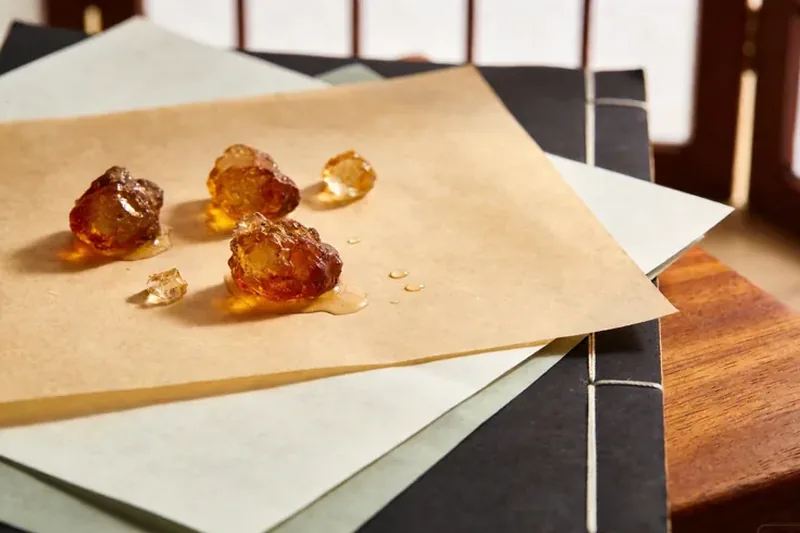
Direct answer: Mastic (玛蹄脂, mǎtízhī) is the aromatic resin of Pistacia lentiscus, the mastic tree, a small evergreen shrub of the cashew family (Anacardiaceae) native to the Mediterranean, most famously cultivated on the Greek island of Chios. It is a fresh, piney, balsamic resin used since antiquity in incense, perfumery, and as a chewing gum. Its Chinese name 玛蹄脂 is also spelled 乳香脂 or 洋乳香, inviting confusion with frankincense (乳香).
Key facts
| Chinese | 玛蹄脂 (mǎtízhī); also 乳香脂 / 洋乳香 (“foreign mastic”) |
| Botanical source | Pistacia lentiscus (family Anacardiaceae) — the resin |
| What it is | A plant resin, from a Mediterranean shrub |
| Aroma | Resinous, piney, fresh, balsamic |
| Traditional role | Western aromatic resin; incense and perfumery |
Aroma profile
Direct answer: Mastic is fresh and piney, with a clean, balsamic sweetness and a hint of lemon and cedar — a brighter, more astringent resin than frankincense. When chewed or burned it releases a crisp, resinous freshness. In a blend it reads as a bright resin top note, adding lift and a clean piney character rather than the deep, sweet warmth of heavier resins.
Mastic is fresh and piney, with a clean, balsamic sweetness and a hint of lemon and cedar — a brighter, more astringent resin than frankincense. When chewed or burned it releases a crisp, resinous freshness. In a blend it reads as a bright resin top note, adding lift and a clean piney character rather than the deep, sweet warmth of heavier resins. This brightness is the core of its identity: it is a resin that freshens, which is why it sits at the top of a blend rather than anchoring it from below.
Botanical identity
Direct answer: Pistacia lentiscus is a small evergreen shrub of the cashew family (Anacardiaceae), native to the Mediterranean region. The family also contains pistachio (Pistacia vera) and, more distantly, sumac — a different family from the frankincense-bearing Burseraceae. The resin is tapped from incisions in the bark and hardens into pale, translucent tears.
Pistacia lentiscus is a small evergreen shrub of the cashew family (Anacardiaceae), native to the Mediterranean region. The resin is tapped from incisions in the bark and hardens into pale, translucent “tears.” The family Anacardiaceae also includes pistachio (Pistacia vera) and, more distantly, sumac — a different family from the frankincense-bearing Burseraceae, which matters for the mastic/frankincense confusion below. See Pistacia lentiscus on GBIF.
Chinese name and terminology
Direct answer: The Chinese name 玛蹄脂 (mǎtízhī) is a loanword for a foreign resin, and its alternates 乳香脂 and 洋乳香 both carry a “乳香” (frankincense) element — which is exactly where the confusion with frankincense arises. The 洋 prefix marks it as a foreign, imported resin.
The name 玛蹄脂 is a phonetic loanword for a foreign resin, and its alternates tell a story:
- 玛蹄脂 (mǎtízhī) — the main Chinese name.
- 乳香脂 (rǔxiāngzhī) — “frankincense-resin,” inviting confusion with frankincense.
- 洋乳香 (yángrǔxiāng) — “foreign frankincense,” where the 洋 (“foreign”) marks it as an imported Western resin.
The 洋 prefix is the useful disambiguation signal: it flags mastic as a foreign, imported resin, distinct from the classic Chinese 乳香 (frankincense). But because two of its names share the “乳香” element, the mastic/frankincense confusion is built into the terminology itself.
The mastic / frankincense confusion (read this)
Direct answer: Mastic (玛蹄脂, Pistacia lentiscus) and frankincense (乳香, Boswellia species) are different resins from different plant families — Anacardiaceae vs Burseraceae — but their Chinese names overlap. 乳香 (frankincense) is a sweet, citrus, earthy resin; mastic is a fresh, piney, balsamic one. When a source means 乳香, it is describing frankincense, not mastic.
Mastic (玛蹄脂, Pistacia lentiscus) and frankincense (乳香, Boswellia species) are different resins from different plant families, but their Chinese names invite confusion:
- 乳香 (frankincense) — Boswellia species (family Burseraceae), a sweet, citrus, earthy resin. This is the classic 乳香 of Chinese incense, with its own entry (see frankincense).
- 玛蹄脂 / 洋乳香 (mastic) — Pistacia lentiscus (family Anacardiaceae), a fresh, piney, balsamic resin. Some sources call mastic “乳香脂” or “洋乳香” (“foreign mastic”), which is where the confusion arises.
This page describes 玛蹄脂 = Pistacia lentiscus = mastic. When a source means 乳香, it is describing frankincense (Boswellia), a different material. The botanical families — Anacardiaceae for mastic, Burseraceae for frankincense — settle the question.
Provenance: the Chios designation (read this)
Direct answer: Mastic’s most instructive commercial feature is provenance. The most famous source is the Greek island of Chios, whose mastic carries protected designation-of-origin status — a rare case of a resin defined by a place name. This makes mastic a model for how geographic origin becomes a quality signal, and a reminder that origin, not just species, can carry the specification.
Mastic’s most instructive feature for a sourcing reader is provenance as specification. The most famous source is the Greek island of Chios, whose mastic — the resin tapped from Pistacia lentiscus shrubs grown only there under a specific traditional method — carries protected designation-of-origin (PDO) status under European law. This is a rare thing for an aromatic resin: a material whose quality is legally tied to a place name and a production method.
The lesson transfers to Chinese incense sourcing even though mastic is not a Chinese material: a resin is not fully specified by its species alone. Where it was grown, how it was tapped, and how it was handled all enter the quality, and the Chios designation is the clearest modern example of a resin defined by its origin. A buyer who treats origin as a specification — for mastic, “Chios” — is applying the same logic that separates a fine resin from a generic one.
Where does mastic come from?
Direct answer: Mastic comes from Pistacia lentiscus, a small evergreen shrub of the Mediterranean, tapped from incisions in the bark into pale, translucent tears. The famous source is Chios (Greece), whose mastic has PDO status; the resin is otherwise gathered across the Mediterranean from North Africa to the Levant.
Pistacia lentiscus grows across the Mediterranean — southern Europe, North Africa, and the Levant — and the resin is tapped from incisions in the bark, hardening into pale, translucent tears. The most celebrated source is Chios, whose PDO mastic is the benchmark. Historically, mastic entered Chinese sources as a Western/foreign aromatic resin (the 洋 in 洋乳香 marks it as imported), used in incense and perfumery across the Mediterranean and, later, the global trade. Its identity as an imported resin is part of its character in Chinese usage — a foreign bright-resin note, distinct from native Chinese resins.
Why is it used in incense?
Direct answer: Mastic is used as a bright, fresh resin note — a piney, balsamic top note that adds lift and clean freshness to a blend rather than deep warmth. It is a resin that freshens, which is why it sits at the top of a composition and complements heavier resins like frankincense and myrrh rather than replacing them.
Mastic’s role in incense is as a bright, fresh resin: a piney, balsamic top note that adds lift and a clean, astringent freshness rather than the deep, sweet warmth of heavier resins. This makes it a complement to frankincense and myrrh, not a substitute — where those deepen and sweeten, mastic brightens and freshens. Its documented use spans Mediterranean and Middle-Eastern incense and perfumery from antiquity, and it entered Chinese sources as a foreign aromatic (洋乳香). It is a top-note resin, added for freshness and lift.
How is it processed?
Direct answer: Mastic is a tapped resin: incisions are made in the bark of Pistacia lentiscus, and the exuding resin hardens into pale, translucent tears, which are then cleaned and sorted. The Chios method involves repeated scoring and collection, and the best material is pale and clean.
Mastic is obtained by tapping: incisions are made in the bark of the shrub, the resin exudes, and it hardens into pale, translucent tears, which are then cleaned and sorted by color and clarity. The traditional Chios method involves repeated scoring of the bark and collection of the hardened tears over a season, and the finest material is pale, clean, and translucent. Quality mastic is therefore a sorting and cleaning question as much as a tapping one — pale, clean tears are the good grade, and dark or stale resin is lower.
What determines mastic quality?
Direct answer: Quality is determined by color, clarity, and freshness: pale, clean, translucent tears with a fresh, piney-lemon scent are the good grade, while dark or stale resin is lower. Provenance (Chios, with its PDO status) is the strongest origin signal. The mastic/frankincense distinction is the identity check.
The quality factors, in rough order:
- Color and clarity — pale, clean, translucent tears are the good grade; dark or stale resin is lower.
- Aroma — fresh, piney, with a hint of lemon and cedar; a clean balsamic sweetness beats a flat or musty one.
- Provenance — Chios mastic carries PDO status, the strongest origin signal available for this resin.
- Identity — Pistacia lentiscus, not frankincense (Boswellia); different families, and the Chinese names overlap.
There is no single standardized grading ladder, but “pale, clean, fresh, and correctly identified” is the durable signal.
Common forms
Direct answer: Mastic is sold as resin tears, and less commonly as a processed extract or oil. The resin-tear form is the traditional material for incense and perfumery; the extract forms serve fragrance and flavor uses rather than burning.
| Form | Typical use |
|---|---|
| Resin tears | Incense and perfumery blending |
| Extract / oil | Fragrance and flavor applications |
In Chinese tradition
- Western aromatic (Traditional Use): mastic entered Chinese sources as a Western/foreign aromatic resin (the “洋” in 洋乳香 marks it as imported), used in incense and perfumery.
- Incense and perfumery (Traditional Use): mastic’s fresh, piney character made it a bright resin note in blends across the Mediterranean and, later, the global trade.
- Materia medica (Traditional Use): 玛蹄脂 / 洋乳香 appears in traditional Chinese medicine with described uses. This is traditional materia-medica language, not modern clinical evidence.
Traditional use vs modern evidence
Direct answer: The incense and perfumery use is well documented in Western and, later, Chinese sources. Medicinal uses are traditional, not established clinical fact, and this page makes no medical claims. The documented facts are botanical identity, the Anacardiaceae family placement, the fresh piney aromatic use, and the Chios provenance.
- Traditional Use — mastic as a Western aromatic resin in incense and perfumery, and its traditional materia-medica applications.
- Historical Record — mastic’s use in Mediterranean and Middle-Eastern incense from antiquity, and its entry into Chinese sources as 洋乳香 (“foreign frankincense”).
- Scientific Evidence — the botanical identity of Pistacia lentiscus (Anacardiaceae) and the resin’s aromatic chemistry are documented; we present no clinical or medical efficacy claims.
The incense and perfumery use is well documented. Medicinal uses are traditional, not established clinical fact, and we make no medical claims.
What buyers should look for
Direct answer: Buyers should confirm identity first — 玛蹄脂 (Pistacia lentiscus), not 乳香 (Boswellia frankincense) — then check color and freshness: pale, clean, translucent tears with a fresh, piney-lemon scent. Provenance (Chios) is the strongest quality signal. Mastic’s freshness makes it a bright top note, not a deep base resin.
For an incense maker or sourcing buyer:
- Identity — 玛蹄脂 (Pistacia lentiscus) vs 乳香 (Boswellia frankincense); different resins, different families, overlapping Chinese names.
- Color and clarity — pale, clean, translucent tears are the good grade; dark or stale resin is lower.
- Aroma — fresh, piney, with a hint of lemon and cedar.
- Provenance — Chios mastic carries PDO status; origin is a specification, not a detail.
Our Industry View
Direct answer: Mastic’s commercial lesson is that provenance and freshness define a bright resin more than any grade name. It is a top-note resin bought for freshness — pale, clean tears, ideally with a place-of-origin attached — and its name overlap with frankincense means the species name is the only reliable identifier.
From a manufacturing perspective, mastic teaches two transferable lessons:
- A bright resin is bought for freshness. Mastic’s value is its clean, piney, astringent top note, which is a freshness-sensitive quality: pale, clean tears with a fresh piney-lemon scent are the good grade, and dark, stale, or musty resin has lost the very thing it is bought for. Unlike a deep base resin that can be more forgiving, a top-note resin must be fresh to do its job.
- Provenance is a specification, not decoration. The Chios PDO is a reminder that a resin is not fully specified by species alone — origin and production method enter the quality. In Chinese sourcing the same logic applies across resins and herbs: where and how a material was produced is part of what is being bought. The mastic/frankincense name overlap (乳香脂, 洋乳香) then makes the species name the only reliable identifier.
In our view, mastic is a fine bright top-note resin — buy it by species name, prefer pale fresh tears, treat origin (Chios) as a quality signal, and keep it clearly separated from frankincense in both terminology and the blend.
Summary
Mastic (玛蹄脂) is the tapped resin of Pistacia lentiscus, a Mediterranean Anacardiaceae shrub, whose fresh, piney, balsamic character made it a bright top-note resin in Western incense and perfumery, entering Chinese sources as a foreign aromatic (洋乳香). It is distinct from frankincense (Boswellia, Burseraceae) despite the overlapping Chinese names, and its most instructive feature is provenance: Chios mastic carries protected designation-of-origin status, making origin itself a quality specification. Its medicinal uses are traditional language, not clinical evidence.
FAQ
What is mastic (玛蹄脂)? The aromatic resin of Pistacia lentiscus, the mastic tree, a small evergreen shrub of the cashew family (Anacardiaceae) native to the Mediterranean, most famously cultivated on the Greek island of Chios. It is a fresh, piney, balsamic resin used since antiquity in incense, perfumery, and as a chewing gum, and known in Chinese sources as a Western aromatic resin.
Is mastic the same as frankincense (乳香)? No. Mastic is Pistacia lentiscus (cashew family, Anacardiaceae), while frankincense is Boswellia species (family Burseraceae). They are different resins from different plant families. The confusion arises because some Chinese sources call mastic “乳香脂” or “洋乳香” (“foreign mastic”), overlapping with the name for frankincense. Each has its own entry in this encyclopedia.
What does mastic smell like? Fresh and piney, with a clean, balsamic sweetness and a hint of lemon and cedar — a brighter, more astringent resin than frankincense. When chewed or burned it releases a crisp, resinous freshness. In a blend it reads as a bright resin top note, adding lift and a clean piney character rather than deep, sweet warmth.
Where does mastic come from? From Pistacia lentiscus, a small evergreen Mediterranean shrub whose resin is tapped from incisions in the bark and hardens into pale, translucent “tears.” The most famous source is the Greek island of Chios, whose mastic has protected designation-of-origin status. The plant’s family, Anacardiaceae, also includes pistachio — a different family from the frankincense-bearing Burseraceae.
What does the “洋” in 洋乳香 mean? “Foreign” — it marks mastic as an imported (Western) aromatic resin, as opposed to a native Chinese material. This is the source of the name confusion with 乳香 (frankincense): both can carry a “乳香”-like name in Chinese, but 洋乳香 (mastic) and 乳香 (frankincense) are different resins. The “洋” prefix is a useful disambiguation signal in classical sources.
Why is Chios mastic special? Chios mastic is a protected designation-of-origin (PDO) product: the resin is produced only on Chios, using a specific traditional method of scoring the Pistacia lentiscus shrubs and collecting the hardened tears. This ties the resin’s quality to a place and a method, making Chios mastic the benchmark — and making provenance itself a quality signal, a rare and instructive case for an aromatic resin.
How do I judge mastic quality? By color, clarity, and freshness: pale, clean, translucent tears with a fresh, piney-lemon scent are the good grade, and dark or stale resin is lower. Confirm the species (Pistacia lentiscus, not frankincense), and treat origin (Chios) as a quality signal. Mastic is a bright top note, bought for freshness rather than depth.
See also: frankincense, pine-resin, myrrh, and the full scent guide.
Evidence & Sources
Botanical identity
Source: Pistacia lentiscus on GBIF. Evidence type: Established.
Traditional Chinese use
Source: 玛蹄脂 / 洋乳香 as a Western aromatic resin in incense and perfumery; the “洋” prefix marks it as imported. Evidence type: Historically documented — aromatic use; medicinal uses are traditional, not modern clinical evidence.
Provenance
Source: Chios mastic as a protected designation-of-origin (PDO) product; origin as a quality specification. Evidence type: Established provenance.
Authenticity / disambiguation
Source: 玛蹄脂 (Pistacia lentiscus) vs 乳香 (Boswellia frankincense) — different resins, different families. Evidence type: Practical screening.
Safety
Source: incense combustion produces smoke and particulate matter; burn in a well-ventilated space. Evidence type: Established.
Evidence status
| Layer | Status |
|---|---|
| Botanical identity | Established |
| Traditional use | Historically documented |
| Provenance | Established (Chios PDO) |
| Authenticity test | Practical screening |
| Health claims | Not established |
Sources
Sources: botanical references on Pistacia lentiscus, the mastic-vs-frankincense distinction, and the Chios PDO provenance. Mastic is recorded as a Western aromatic resin; medicinal uses are treated as traditional, not established clinical fact. This is editorial knowledge content, not medical advice.