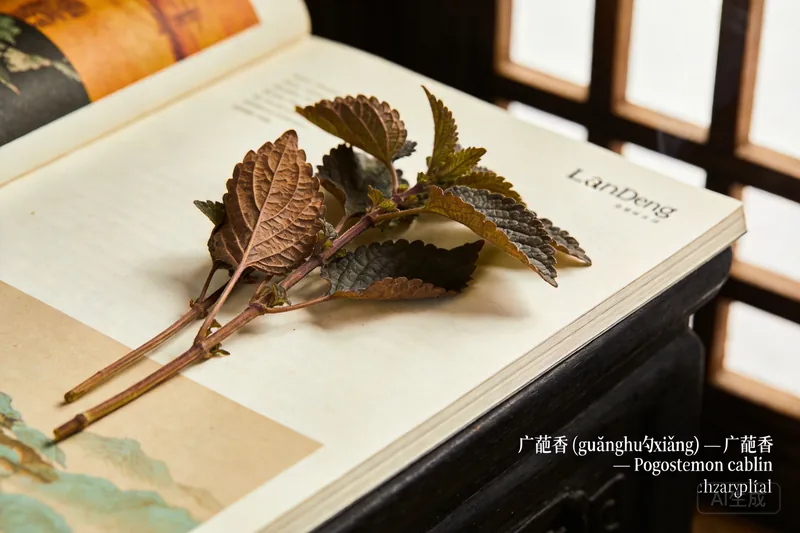
Definition: Patchouli — guǎnghuòxiāng (广藿香) in Chinese — is the dried leaf of Pogostemon cablin, a bushy mint-family herb, with a heavy, earthy, woody, balsamic aroma. It is an important ingredient in East Asian incense and a classic perfumery base note.
Key facts
| Chinese | 广藿香 (guǎnghuòxiāng) |
| Botanical source | Pogostemon cablin (Lamiaceae — mint family) |
| What it is | Dried leaves (steam-distilled) |
| Aroma | Earthy, woody, balsamic, spicy, musty-sweet |
| Traditional role | Incense, perfume, insect repellent |
Aroma profile
Patchouli has a heavy, earthy, woody-balsamic scent with a musty-sweet, spicy edge. It is a strong base note that lingers. Like vetiver, it tends to be a supporting/base note rather than the star.
The character is earthy and “rooted” — wet soil, dry wood, and a faint sweetness — rather than bright or floral. It is long-lasting and penetrating, which is why a little patchouli can anchor an entire blend and why it became the signature of a whole era of fragrance (the 1960s–70s association in the West).
A Chinese naming distinction (广藿香 vs 藿香)
Chinese has two “huo xiang” herbs that English blurs together:
- 广藿香 (Pogostemon cablin) — patchouli, the earthy incense/perfume material.
- 藿香 (Agastache rugosa) — Korean mint / giant hyssop, a different herb used in Chinese medicine and cooking.
They share a name and a mint-family relationship but are different plants with different aromas and uses. In an incense or perfume context, 广藿香 means patchouli.
In East Asian incense
Patchouli is an important ingredient in East Asian incense, not just a Western “hippie” scent (its 1960s–70s popularity in the West is a more recent chapter). In China, 广藿香 also appears in traditional materia medica.
- Incense: patchouli is used in Chinese and Japanese incense as an earthy base, often blended with woods and resins.
- Perfumery: it is a classic base note in Western perfumery (chypre, oriental families).
- Insect repellent: patchouli has a long folk use as an insect deterrent, especially for protecting textiles.
Patchouli vs vetiver
Both are earthy base notes, but patchouli is the leaf (mint family) and vetiver the root (grass). Patchouli is mustier and spicier; vetiver is smokier and smoother. They are often used together to build a deep, earthy foundation under woods and florals.
Traditional use vs modern evidence
Patchouli is used as an insect repellent and in traditional medicine; early research on its anti-inflammatory and antimicrobial properties exists but is preliminary, not established clinical fact. We describe its aromatic and incense use; we do not make medical claims.
Safety
Incense combustion produces smoke and particulate matter. Burn in a well-ventilated space; avoid inhaling concentrated smoke. Patchouli is potent — a little goes a long way.
FAQ
Is patchouli a wood? No — it is the dried leaf of a mint-family herb (Pogostemon cablin). The fragrant oil is obtained by steam-distilling the dried leaves, which gives patchouli its heavy, earthy, woody-balsamic character despite being a leaf material rather than a wood. So although the aroma reads as woody and rooted, the botanical source is a leafy herb, not a tree. This distinction matters because “woody” describes the scent, not the plant part.
Is patchouli only a “hippie” scent? Its 1960s–70s Western popularity is well-known, but patchouli has a much longer history in East Asian incense and perfumery. Long before the Western association, patchouli (广藿香) was an established incense ingredient in China and Japan and a classic perfumery base note, so the “hippie” chapter is only one recent slice of its history. It also has a long folk use as an insect deterrent, especially for protecting stored textiles.
What is the difference between 广藿香 and 藿香? 广藿香 is patchouli (Pogostemon cablin); 藿香 is Korean mint (Agastache rugosa). They share a name and mint-family relationship but are different plants. In an incense or perfume context, 广藿香 means patchouli, whereas 藿香 is a different herb used in Chinese medicine and cooking. English blurs the two together, but in Chinese they are distinct materials with different aromas and uses.
What does patchouli smell like? Heavy, earthy, woody-balsamic with a musty-sweet, spicy edge — a strong base note that lingers. The character is earthy and “rooted,” like wet soil and dry wood with a faint sweetness, rather than bright or floral, which is why a little patchouli can anchor an entire blend. It is long-lasting and penetrating, so it works as a base that carries lighter top notes.
Where does patchouli come from? Southeast Asia — patchouli (Pogostemon cablin) is native to the region and has long been an ingredient in East Asian incense and perfumery, well before its 1960s–70s Western popularity. Today it is also cultivated in other tropical regions for its oil, but Southeast Asia remains its historical and botanical home. The dried leaves are what get distilled into the familiar heavy, earthy oil.
How is patchouli oil made? The dried leaves are steam-distilled. Interestingly, patchouli oil is often described as improving with age, mellowing from a sharp green note to a deeper, smoother earthiness. The leaves are typically dried, sometimes fermented, then distilled to extract the heavy, long-lasting essential oil. The fermentation and drying steps are part of what develops the oil’s characteristic earthy, musty-sweet character. The fermentation and drying steps are part of what develops the oil’s characteristic earthy, musty-sweet character.
See also: vetiver and cedar, its fellow earthy/woody notes, plus the full scent guide.
Evidence & Sources
Botanical identity
Source: Pogostemon in Flora of China · Pogostemon on GBIF. Evidence type: Established.
Traditional Chinese use
Source: this page records 广藿香 (Pogostemon cablin) as an important East Asian incense ingredient and a materia medica herb. Evidence type: Historically documented — traditional materia-medica language, not modern clinical evidence.
Authenticity / adulteration
Source: the 广藿香 (Pogostemon cablin) vs 藿香 (Agastache rugosa) naming distinction. Evidence type: Practical screening.
Safety
Source: incense combustion produces smoke and particulate matter; patchouli is potent. Evidence type: Established.
Evidence status
| Layer | Status |
|---|---|
| Botanical identity | Established |
| Traditional use | Historically documented |
| Authenticity test | Practical screening |
| Laboratory confirmation | Requires analytical testing |
| Health claims | Not established |
Sources
Sources: botanical references on Pogostemon cablin (Lamiaceae, steam distillation) and accounts of its use in East Asian incense. The 广藿香/藿香 distinction is a standard Chinese-herb naming point. This is editorial knowledge content, not medical advice.