Direct answer: Schisandra (五味子, wǔwèizǐ) is the dried berry of Schisandra chinensis, a woody climbing vine of the family Schisandraceae native to China and the Russian Far East. Its name means “five-flavor berry,” from the berry’s combined sour, sweet, salty, bitter, and pungent tastes. It is a classical Chinese materia-medica fruit with a faint, fruity, sour-berry scent, not a lead incense 香材.
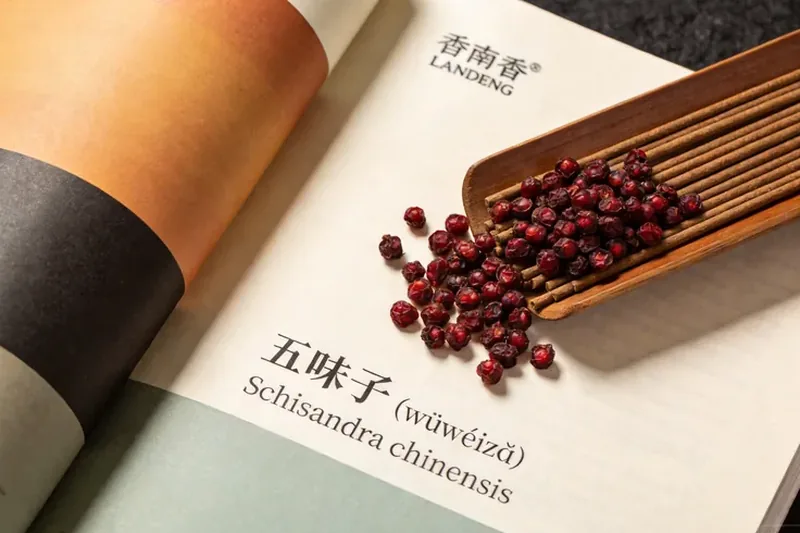
Key facts
| Chinese | 五味子 (wǔwèizǐ); the “five-flavor berry” |
| Botanical source | Schisandra chinensis (family Schisandraceae) — the fruit |
| What it is | A dried berry of a woody vine, not a resin or wood |
| Aroma | Fruity, berry, sour, slightly woody |
| Traditional role | Materia medica; distinguished by north-south grading |
Aroma profile
Direct answer: 五味子 has a soft, fruity, sour-berry scent with a faint woody, tea-like undertone — the tart-sweet aroma of a dried red berry rather than a flower. Its fragrance is quiet and is not a driving note in incense; the berry’s fame rests on its “five tastes” in materia medica, not on a strong scent.
五味子 has a soft, fruity, sour-berry scent with a faint woody, tea-like undertone — the tart-sweet aroma of a dried red berry rather than a flower. Its fragrance is quiet and is not a driving note in incense; the berry’s fame rests on its “five tastes” in materia medica, not on a strong scent.
Botanical identity
Direct answer: Schisandra chinensis is a deciduous woody vine in the family Schisandraceae, native to China, Korea, and the Russian Far East, where it climbs trees and shrubs. The part used is the dried ripe berry, harvested in late summer and dried whole. The genus Schisandra holds several Chinese species, but S. chinensis is the classical 五味子.
Schisandra chinensis is a deciduous woody vine in the family Schisandraceae, native to China, Korea, and the Russian Far East, where it climbs trees and shrubs. Flora of China records the species (五味子). The part used is the dried ripe berry, harvested in late summer and dried whole. The genus Schisandra holds several Chinese species, but S. chinensis is the classical 五味子. See Schisandra chinensis in Flora of China.
Chinese name and terminology
Direct answer: The name 五味子 means “five-flavor seed/berry” — 五味 (five tastes) + 子 (fruit/seed) — a taste-name, not a scent-name. This is the key to the material: it is named for what it tastes like, not what it smells like, which is precisely why it is a weak incense material despite its fame.
The name 五味子 (wǔwèizǐ) is a taste-name: 五味 “five flavors” + 子 “fruit/seed.” This matters more than it first appears. Most incense materials are named for a color, a fragrance, or a place; 五味子 is named for a taste — the five flavors (sour, sweet, salty, bitter, pungent) said to meet in one berry. That naming is the whole story of the material’s odd position: it is famous in materia medica precisely for a property (taste) that has almost nothing to do with incense, where the relevant sense is smell. The classical aliases — 荎蕏, 玄及, and 會及 — reinforce that it belongs to the materia-medica register, not the fragrance register.
The 五味 (five-taste) naming — a taste-name, not a scent-name (read this)
Direct answer: The Bencao Gangmu (本草纲目) 草之七 explains the name: the berry’s skin and flesh are sweet and sour, its seed is pungent and bitter, and the whole carries a salty note — “皮、肉甘、酸,核中辛、苦,都有鹹味” — so all five tastes meet in one fruit. This is a taste-based definition, and it is the reason the berry is a famous medicine but a faint incense note.
The 本草考据 of 五味子 centers on a single, well-documented naming explanation. The Bencao Gangmu (本草纲目), 草之七, records it through Su Gong (苏恭):
五味,皮、肉甘、酸,核中辛、苦,都有鹹味,此則五味具也。
That is: the skin and flesh are sweet and sour, the seed is pungent and bitter, and the whole carries a salty note — so the five tastes are complete in one fruit. The text adds that the Shennong Bencao Jing (《本經》) “但云味酸” — recorded only the sour taste — “當以木為五行之先也” (taking wood as the first of the five phases). The entry opens by classifying 五味子 as a top-grade (上品) drug of the Bencao Jing.
The point for an incense reader is the category this naming puts the material in: a taste-defined materia-medica fruit. A berry famous for five tastes is famous for a sense incense does not primarily engage. That is why 五味子 sits at the edge of the incense canon — present as a quiet fruity accent at most, never a driving 香材 — despite its large presence in materia medica.
The north–south grading (本草考据, continued)
Direct answer: Li Shizhen records a north–south division: southern berries ripen red (南產者,色紅), northern berries ripen black (北產者,色黑), and the northern ones were used for tonic preparations (入滋補藥必用北產者,乃良). This is a sourcing distinction — two color forms of the same species — not a different plant.
The Bencao Gangmu also preserves a sourcing distinction that reads as a grading system:
- Li Shizhen (时珍): 五味,今有南北之分,南產者,色紅;北產者,色黑,入滋補藥必用北產者,乃良 — “there is now a north–south division: the southern ones are red, the northern ones are black; for tonic preparations one must use the northern ones, which are good.”
- Tao Hongjing (弘景), on provenance: 今第一出高麗,多肉而酸甜;次出青州、冀州,味過酸 — the best came from Goryeo (Korea), fleshy and sweet-sour; next from Qingzhou and Jizhou, too sour.
- Su Song (颂), on the plant: 今河東、陝西州郡尤多,杭越間亦有之…七月成實,叢生莖端,如豌豆許大,生青熟紅紫,入藥生曝不去子 — abundant in Hedong and Shaanxi, also around Hangzhou and Yue; fruits in the seventh month, green when raw, red-purple when ripe, used raw and sun-dried with the seeds left in.
- Wang Ji (机), on use: 五味治喘嗽,須分南北…宜用北者…風寒在肺,宜用南者 — the north and south forms were assigned to different uses.
These are the documentary layers: the origin record (《別錄》: 生齊山山谷及代郡,八月採實,陰乾 — grows in the Qishan valleys and Daijun, fruit harvested in the eighth month and dried in shade), the provenance ranking (Korea first), and the north–south color grading. This page describes 五味子 = Schisandra chinensis. The north–south division is a sourcing distinction within the one species, not a claim this page extends into any medical statement.
Where does schisandra come from?
Direct answer: Schisandra comes from Schisandra chinensis, a woody vine native to China, Korea, and the Russian Far East. The classical record places it in the Qishan valleys and Daijun (生齊山山谷及代郡), harvested in the eighth month and dried in shade, with Korea’s fleshy sweet-sour berries long ranked first.
Schisandra chinensis is native to China, Korea, and the Russian Far East, where it climbs trees and shrubs. The Bencao Gangmu preserves the classical origin record — the Qishan valleys and Daijun, fruit harvested in the eighth month and dried in shade — and a provenance ranking that put the fleshy, sweet-sour Korean berries first, ahead of the more acidic Qingzhou and Jizhou material. The dried ripe berry is the part of trade.
Why is it used in incense?
Direct answer: 五味子 is at most a quiet, fruity, sour-berry accent in a blend, not a lead incense material. Its fame is in materia medica and the five-taste naming; in incense its faint fragrance lends only a subtle tart-sweet berry note, and its classical role is medicinal rather than aromatic.
五味子’s role in incense is minor by nature: its fragrance is a quiet, tart-sweet berry note that can lend a subtle fruity accent at most. It is not a driving 香材, and it is not burned for fragrance in the classical tradition. The gap between its fame and its aromatic weakness is exactly the point made above — a berry named for five tastes does not automatically carry five useful scents. In incense it is a supporting, at most accenting, material whose classical standing is in materia medica.
How is it processed?
Direct answer: 五味子 is used as the dried ripe berry, harvested in late summer and dried whole with the seeds left in. The classical record specifies sun-drying (陰乾/曝), and — for the materia-medica tradition — splitting the berry with a copper knife and processing it; for incense and aromatic use, the dried whole berry is the material.
The classical record describes the handling of 五味子 with unusual specificity:
- Harvest and drying — the fruit is harvested in the eighth month (八月採實) and dried in shade (陰乾); Su Song records it used raw and sun-dried with the seeds left in (入藥生曝不去子).
- Materia-medica processing — Lei Xiao (雷斅) specifies splitting the berry with a copper knife, steaming it steeped in honey, then soaking it in rice-water overnight before drying (以銅刀劈作兩片,用蜜浸蒸…以漿浸一宿,焙乾用); Li Shizhen adds that it was cooked for tonic use and raw for cough use.
For aromatic and incense use, the dried whole berry is the material — the processing steps above belong to the materia-medica tradition, which this page notes but does not translate into any aromatic or medical claim.
What determines schisandra quality?
Direct answer: Quality turns on species identity and berry condition, with the classical record adding a north–south color distinction — red southern versus black northern berries, the northern preferred for tonic use. The useful grade is clean, well-dried ripe berries of Schisandra chinensis.
The quality factors:
- Species identity — 五味子 (Schisandra chinensis) rather than another Schisandra species.
- Berry condition — clean, well-dried ripe berries; the classical record prizes fleshy, sweet-sour fruit (Korea first).
- Color form — the classical north–south distinction: red (south) versus black (north), the northern preferred for tonic use.
- Aroma — a soft, fruity, sour-berry note; the fragrance is quiet by design.
Common forms
Direct answer: 五味子 is sold as the dried whole berry and, for the materia-medica tradition, as processed (honey-steamed) berries. The whole dried berry is the standard form; the fragrance is quiet, so it is a supporting material at most in incense.
| Form | Typical use |
|---|---|
| Dried whole berry | Materia medica; subtle aromatic accent |
| Processed berry (honey-steamed) | Materia-medica preparation |
In Chinese tradition
- Materia medica (Traditional Use): 五味子 is a classical materia-medica fruit, recorded in the Bencao Gangmu (本草纲目), 草之七. This is traditional materia-medica language, not modern clinical evidence.
- Naming (Historical Record): the “five-flavor” name records the berry’s combined tastes — the skin and flesh sweet and sour, the seed pungent and bitter, the whole salty — explained by Su Gong and preserved by Li Shizhen.
- North–south grading (Historical Record): the classical north–south division (red southern vs black northern) was a sourcing distinction, with the northern preferred for tonic use and the two forms assigned different uses.
- Not a lead incense material (Historical Record): the berry’s fragrance is faint; its classical role is materia medica, not as a driving incense 香材.
Traditional use vs modern evidence
Direct answer: The materia-medica record is traditional, not established clinical fact, and this page makes no medical claims. The documented facts are botanical identity, the Schisandraceae placement, the five-flavor naming, and the north–south sourcing distinction.
- Traditional Use — 五味子’s materia-medica role, recorded in the Bencao Gangmu 草之七. Traditional language, not modern clinical evidence.
- Historical Record — the five-flavor naming explanation (皮、肉甘、酸,核中辛、苦,都有鹹味), the classical aliases (荎蕏, 玄及, 會及), the origin record (生齊山山谷及代郡), and the north–south grading (南產者色紅,北產者色黑).
- Scientific Evidence — the botanical identity of Schisandra chinensis (Schisandraceae) is documented. We present no clinical or medical efficacy claims.
What buyers should look for
Direct answer: Buyers should confirm species — 五味子 is Schisandra chinensis, the dried ripe berry, distinct from other Schisandra species — and note the classical north–south color distinction when sourcing. In incense it is a quiet fruity accent at most, not a lead note; its standing is in materia medica.
For a buyer or formulator:
- Species — 五味子 (Schisandra chinensis), not another Schisandra species.
- Berry condition — clean, well-dried ripe berries.
- Color form — the classical north–south distinction (red southern vs black northern) when it matters for the intended use.
- Role clarity — a quiet fruity accent at most in incense; its classical standing is materia medica.
Safety
Incense combustion produces smoke and particulate matter. Burn in a well-ventilated space, avoid inhaling concentrated smoke, and keep away from children and pets. This is editorial knowledge content, not medical advice.
Our Industry View
Direct answer: 五味子’s commercial lesson is the taste-versus-scent boundary: it is a famous materia-medica berry named for five tastes, which is exactly why it is a weak incense material. A buyer should value it by its medicinal provenance, not as a fragrance — and never let the medicinal fame bleed into an incense or health claim.
From a manufacturing perspective, 五味子 is a clean illustration of why fame and fragrance are different assets:
- A taste-name is not a fragrance. The berry is named for five tastes and is famous in materia medica for them. But incense engages smell, not taste, and the berry’s scent is quiet. A buyer who imports the berry’s medicinal renown into an incense formula is paying for a property the format cannot use.
- The north–south grading is a sourcing, not a fragrance, distinction. The red-versus-black division matters for materia-medica provenance, not for aroma. For incense, that grading is largely irrelevant — which is a useful thing to know when a supplier leans on it.
- Keep the registers apart. The disciplined approach is the same as for other famous medicine materials (当归, 莪术): record the materia-medica standing accurately, use the modest aromatic value honestly, and make no medicinal claims.
In our view, 五味子 is a materia-medica berry whose incense value is marginal and quiet: buy it by species if a subtle sour-berry accent is genuinely wanted, but do not let its five-taste fame be mistaken for fragrance value — and keep the medicine and the incense strictly separate.
Summary
五味子 (Schisandra chinensis) is the dried berry of a woody Schisandraceae vine, named for the five tastes — sweet and sour skin, pungent and bitter seed, a salty whole — that the Bencao Gangmu records meeting in one fruit. That taste-name is the whole of its story: it is a famous materia-medica fruit precisely for a property incense does not engage, which is why its fragrance is a quiet, tart-sweet berry note and its incense role is minor at most. The classical record adds the aliases 荎蕏, 玄及, and 會及, an origin in the Qishan valleys and Daijun, and a north–south color grading (red southern, black northern). Its medicinal uses are traditional language, not clinical evidence.
FAQ
What is 五味子 (schisandra)? The dried berry of Schisandra chinensis, a woody climbing vine (Schisandraceae) native to China and the Russian Far East. Its name means “five-flavor berry,” from the berry’s combined sour, sweet, salty, bitter, and pungent tastes. It is a classical Chinese materia-medica fruit with a faint, fruity, sour-berry scent.
Why is it called 五味子? The Bencao Gangmu (本草纲目), 草之七, explains that the berry’s skin and flesh are sweet and sour, its seed is pungent and bitter, and the whole carries a salty note — “皮、肉甘、酸,核中辛、苦,都有鹹味” — so all five tastes meet in one fruit. It is a taste-name, not a scent-name, which is why the berry is a famous medicine but a faint incense note.
What is the north-south division of 五味子? Li Shizhen records that southern berries ripen red (南產者,色紅) and northern berries ripen black (北產者,色黑), with the northern ones preferred for tonic use (入滋補藥必用北產者,乃良). It is a classical sourcing distinction within the one species, not a different plant.
What does schisandra smell like? Soft, fruity, and sour-berry, with a faint woody, tea-like undertone — the tart-sweet aroma of a dried red berry. Its fragrance is quiet, so it is not a driving incense note.
Is schisandra an incense ingredient? Not a lead one. Its classical standing is in materia medica, and its berry fragrance is faint. It could lend a subtle fruity accent in a blend, but its fame rests on the five-taste naming and its materia-medica role, not on a strong scent.
Where does schisandra come from? Schisandra chinensis is native to China, Korea, and the Russian Far East. The Bencao Gangmu records an origin in the Qishan valleys and Daijun (生齊山山谷及代郡), harvested in the eighth month and dried in shade, with the fleshy, sweet-sour Korean berries long ranked first in provenance.
See also: peony (芍药), amomum-villosum (砂仁), licorice (甘草), and the full scent guide.
Evidence & Sources
Botanical identity
Source: Schisandra chinensis in Flora of China · Schisandra chinensis on GBIF. Evidence type: Established.
Traditional Chinese use
Source: the Bencao Gangmu (本草纲目), 草之七, records 五味子 (“皮、肉甘、酸,核中辛、苦,都有鹹味”), with north (black) and south (red) grading. Evidence type: Historically documented — materia medica; medicinal uses are traditional, not modern clinical evidence.
Authenticity / disambiguation
Source: 五味子 (Schisandra chinensis) as the five-flavor berry, distinct from other Schisandra species. Evidence type: Practical screening.
Safety
Source: incense combustion produces smoke and particulate matter; burn in a well-ventilated space. Evidence type: Established.
Evidence status
| Layer | Status |
|---|---|
| Botanical identity | Established |
| Traditional use | Historically documented (materia medica) |
| Authenticity test | Practical screening |
| Health claims | Not established |
Sources
Sources: botanical references on Schisandra chinensis and the Bencao Gangmu (本草纲目) 草之七 record of 五味子. Medicinal uses are treated as traditional, not established clinical fact. This is editorial knowledge content, not medical advice.