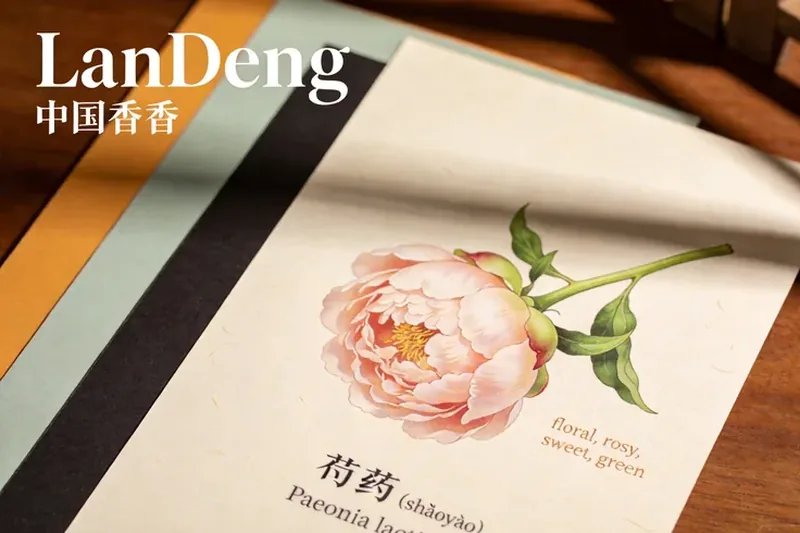
Direct answer: Peony (芍药, sháoyào) is the Chinese herbaceous peony, Paeonia lactiflora, a long-cultivated flowering perennial of the peony family (Paeoniaceae). One of China’s oldest ornamental flowers, it is recorded in the Bencao Gangmu under the classical name 将离 (jiānglí, “about to part”). It is a garden and materia-medica flower first, a fragrance second.
Key facts
| Chinese | 芍药 (sháoyào); classical 将离 (jiānglí) |
| Botanical source | Paeonia lactiflora (family Paeoniaceae) — the flowers and root |
| What it is | An ornamental flowering perennial |
| Aroma | Floral, rosy, sweet, green |
| Traditional role | Garden flower; materia medica; 将离 parting flower |
Aroma profile
Direct answer: 芍药 is floral and rosy, sweet with a fresh green undertone — a soft, romantic bloom scent, less spicy than rose and less almondy than plum blossom. Some cultivars are nearly scentless, while others carry a clear, sweet rose-like fragrance. It is a living-plant fragrance enjoyed in the garden rather than a burned incense material.
芍药 is floral and rosy, sweet with a fresh green undertone — a soft, romantic bloom scent, less spicy than rose and less almondy than plum blossom. Some cultivars are nearly scentless, while others carry a clear, sweet rose-like fragrance. It is a living-plant fragrance, enjoyed on the plant in the garden, rather than a burned incense material; its classical significance is ornamental and cultural rather than aromatic in the incense sense. The scentless-cultivar fact matters: 芍药 is grown for its flowers as much as for fragrance, so “peony” does not guarantee a perfumed bloom.
The 将离 (jiang li) name (read this)
Direct answer: 芍药’s classical name is 将离 — “about to part.” The Bencao Gangmu records under 芍药 the name 将离, glossed “芍药一名将离” (the peony is also called 将离), tied to the ancient custom of presenting 芍药 as a parting gift — a flower of farewell and remembrance recorded in the Shijing tradition.
芍药’s classical name is 将离 — “about to part.” The Bencao Gangmu (本草纲目), in its fragrant-herb section (草之三), records under 芍药 the classical name 将离, and the text glosses the origin: “芍药一名将离” (the peony is also called 将离). This name is tied to the ancient custom recorded in the Shijing (诗经) and later commentaries of presenting 芍药 as a parting gift — a flower of farewell and remembrance. The point for this encyclopedia: 芍药 is first a garden and cultural flower; its classical name records a social custom, not an incense role.
The 芍药 / 牡丹 distinction (read this)
Direct answer: 芍药 and 牡丹 are different peonies that are often confused. 芍药 is the herbaceous peony (Paeonia lactiflora), which dies back to the ground each winter; 牡丹 is the tree peony (Paeonia × suffruticosa), a woody shrub. Both are ancient Chinese ornamentals, but they are distinct plants with different traditional roles — including different materia-medica parts (root vs bark).
芍药 and 牡丹 are different peony species, and the distinction is both botanical and cultural:
- 芍药 (herbaceous peony) — Paeonia lactiflora, a soft-stemmed perennial that dies back each winter; the root (白芍/赤芍) is the materia-medica part. This entry.
- 牡丹 (tree peony) — Paeonia × suffruticosa (and its bark, 牡丹皮/树牡丹皮), a woody shrub that persists above ground; the bark is the materia-medica part. Its own entries (tree-peony and tree-peony-bark).
The two are the ancient pair of Chinese peonies, but “peony” in English covers both, which is a recurring source of confusion for buyers. The herbaceous 芍药 is the softer garden flower; the tree 牡丹 is the woody “king of flowers.”
Botanical source and origin
Direct answer: Paeonia lactiflora is a herbaceous perennial of the peony family, native to central and eastern Asia (northern China, Mongolia, Siberia, and adjacent regions) and cultivated in China for well over a thousand years, with many double-flowered garden cultivars. The fragrant part is the flower; the root (白芍/赤芍) is separately a traditional medicine. Flora of China records the species.
Paeonia lactiflora is a herbaceous perennial of the peony family, native to central and eastern Asia (northern China, Mongolia, Siberia, and adjacent regions) and cultivated in China for well over a thousand years, with many double-flowered garden cultivars. The fragrant part is the flower; the root (白芍/赤芍 in materia medica) is separately a traditional medicine. Flora of China records the species. The genus Paeonia is a family of its own (Paeoniaceae), and the split between the herbaceous and tree forms is the single most useful distinction for anyone sorting Chinese peonies.
Where does 芍药 come from?
Direct answer: Paeonia lactiflora is native to central and eastern Asia — northern China, Mongolia, Siberia, and adjacent regions — and has been cultivated in China for over a thousand years. It is a widely grown garden perennial, not a scarce wild material, and its value is ornamental and cultural rather than aromatic in the incense sense.
The herbaceous peony ranges across central and eastern Asia, from northern China into Mongolia, Siberia, and neighboring regions, and it is one of China’s oldest cultivated ornamentals, bred into countless double-flowered garden forms over more than a millennium. It is a common, renewable garden perennial — not a scarce wild aromatic — and its importance lies in its flowers, its materia-medica root, and its cultural symbolism, rather than in any incense-grade fragrance.
In Chinese tradition
Direct answer: 芍药 is among China’s oldest cultivated ornamentals, prized for its large, often fragrant flowers, and its classical name 将离 records the ancient parting-gift custom. Its root appears in traditional Chinese medicine as a materia-medica item — traditional language, not modern clinical evidence.
- Garden flower: 芍药 is among China’s oldest cultivated ornamentals, prized for its large, often fragrant flowers.
- 将离 (jiānglí): the Bencao Gangmu (本草纲目) records 芍药’s classical name 将离, tied to the ancient parting-gift custom.
- Materia medica: the root appears in traditional Chinese medicine. This is traditional materia-medica language, not modern clinical evidence.
Traditional use vs modern evidence
Direct answer: The ornamental and cultural use is well documented, and the botanical identity is established. Medicinal uses of the root are traditional, not clinical fact, and this page makes no medical claims. The documented facts are botanical identity, the Paeoniaceae placement, and the garden/parting-flower record.
- Traditional Use — 芍药 as a garden flower and its traditional materia-medica root descriptions (白芍/赤芍). This is traditional language, not modern clinical evidence.
- Historical Record — the Bencao Gangmu (本草纲目), 草之三, records 芍药 with the classical name 将离 (“芍药一名将离”), tied to the ancient parting-gift custom; this is a documented classical record.
- Scientific Evidence — botanical identity (Paeoniaceae, Paeonia lactiflora) and the herbaceous-vs-tree-peony distinction are established; no clinical or medical efficacy claims are made.
How is it used in fragrance?
Direct answer: 芍药 is a living garden fragrance, not a burned incense material. Its sweet, rosy, green scent is enjoyed on the plant or as a cut flower, and some cultivars are nearly scentless. It is not a classical 香材, and its aromatic value is the garden bloom rather than the burner.
芍药’s fragrance role is the garden and the vase, not the incense burner. Its sweet, rosy, green scent — present in the more fragrant cultivars, absent in others — is a living-plant and cut-flower pleasure. It is not a classical 香材, and it is not extracted or burned in any established tradition. The practical point is that “peony” in a fragrance context usually means a modern synthetic accord (a peony-style floral note) rather than a natural extract or a burned material, and the living flower’s scent is a garden matter, not an incense one.
What buyers should look for
Direct answer: A buyer should distinguish 芍药 (the herbaceous peony, Paeonia lactiflora) from 牡丹 (the tree peony, Paeonia × suffruticosa), which is a different peony species. Expect a floral, rosy, sweet, green scent in the fragrant cultivars — some are nearly scentless — and treat it as a garden/cultural flower, not a classical 香材 or a burned material.
For a sourcing buyer, the checks are:
- Species — confirm Paeonia lactiflora (herbaceous peony) and distinguish it from 牡丹 (Paeonia × suffruticosa, tree peony); the two are different peonies with different forms and materia-medica parts.
- Aroma — expect a floral, rosy, sweet, green scent in the fragrant cultivars, but note that some cultivars are nearly scentless, so “peony” does not guarantee fragrance.
- Role — it is a garden and cultural flower; its classical name 将离 records a parting custom, not an incense role.
- Format — for fragrance, expect a modern peony-style accord rather than a natural extract or a burned flower.
Our Industry View
Direct answer: 芍药’s lesson is about the gap between a flower’s cultural weight and its aromatic utility. It is one of China’s oldest ornamentals, with a documented classical name (将离) and a materia-medica root — yet as an incense material it is nearly nothing: a garden fragrance, often scentless, with no classical 香材 role. The disciplined buyer separates the cultural flower from the (largely absent) aromatic material.
芍药 is a striking case of cultural richness meeting aromatic thinness, and the contrast is the lesson:
- Cultural weight is not aromatic value. 芍药 carries a millennium of cultivation, a classical parting-flower name (将离), and a materia-medica root — real, documented cultural substance. But none of that translates into an incense material: it is a garden flower, sometimes scentless, with no classical 香材 role. Confusing the two is the central risk.
- “Peony” is a synthetic-accord term in practice. In modern fragrance, “peony” almost always names a synthetic floral accord, not a natural peony extract. A buyer who orders “peony” should know which they are getting — a modern note, not a botanical product.
- The herbaceous/tree split is the useful distinction. 芍药 (herbaceous, root medicine) and 牡丹 (tree, bark medicine) are both “peony” in English, but they are different plants with different parts used. Naming the species and the form is the discipline that resolves the confusion.
In our view, 芍药 is a cultural flower, not an incense material: its value is ornamental, symbolic, and materia-medica, and its honest characterization is a garden and parting-flower record — not a 香材 claim it has never supported.
Summary
芍药 (Paeonia lactiflora) is the herbaceous Chinese peony, a Paeoniaceae perennial of central and eastern Asia cultivated for over a millennium as one of China’s oldest ornamentals. Its classical name 将离 (“about to part”), recorded in the Bencao Gangmu, ties it to the ancient parting-gift custom; its root is a traditional materia-medica item (traditional language, not clinical fact). It is a garden and cultural flower, distinct from the tree peony 牡丹 (Paeonia × suffruticosa), with a rosy-sweet scent in some cultivars but no classical 香材 role — a cultural flower whose aromatic utility is, honestly, minimal.
FAQ
What is 芍药 (peony)? The Chinese herbaceous peony, Paeonia lactiflora, a long-cultivated flowering perennial of the peony family (Paeoniaceae), native to central and eastern Asia. It is among China’s oldest ornamental flowers, and the Bencao Gangmu (本草纲目) records its classical name 将离 (jiānglí).
Why is 芍药 called 将离 (about to part)? The name 将离 ties to an ancient parting custom. The Bencao Gangmu (本草纲目) records that “芍药一名将离” (the peony is also called 将离), and the name is connected to the classical practice of presenting 芍药 as a farewell gift — a flower of parting and remembrance.
What does peony smell like? Floral and rosy, sweet with a fresh green undertone. Some cultivars are nearly scentless, while others carry a clear, sweet rose-like fragrance. It is a living-plant fragrance enjoyed in the garden, less spicy than rose and less almondy than plum blossom.
Is 芍药 a classical Chinese incense material? Not in the burned-incense sense. 芍药 is a garden and cultural flower whose classical significance is ornamental and social (the 将离 parting custom); it is not a 香乘 incense ingredient. Its aromatic value is as a living flower.
Is 芍药 the same as 牡丹 (tree peony)? No — they are different peony species. 芍药 is the herbaceous peony (Paeonia lactiflora), which dies back to the ground each winter, while 牡丹 is the tree peony (Paeonia × suffruticosa), a woody shrub. Both are ancient Chinese ornamentals, but they are distinct plants.
What is the peony root used for? In traditional Chinese medicine the root (白芍/赤芍) is a materia medica item. This is traditional materia-medica language, not modern clinical evidence, and this page makes no medical claims about it.
See also: rose, plum-blossom, tree peony, tree peony bark, apricot kernel and the full scent guide.
Evidence & Sources
Botanical identity
Source: Paeonia lactiflora in Flora of China · Paeonia lactiflora on GBIF. Evidence type: Established.
Traditional Chinese use
Source: the Bencao Gangmu (本草纲目), 草之三, records 芍药 with the classical name 将离 (“芍药一名将离”), tied to the ancient parting-gift custom. Evidence type: Historically documented — garden flower and cultural custom; medicinal uses are traditional, not modern clinical evidence.
Authenticity / disambiguation
Source: 芍药 (Paeonia lactiflora, herbaceous peony) vs 牡丹 (Paeonia × suffruticosa, tree peony). Evidence type: Practical screening.
Safety
Source: incense combustion produces smoke and particulate matter; burn in a well-ventilated space. Evidence type: Established.
Evidence status
| Layer | Status |
|---|---|
| Botanical identity | Established |
| Traditional use | Historically documented (garden, cultural) |
| Authenticity test | Practical screening |
| Health claims | Not established |
Sources
Sources: botanical references on Paeonia lactiflora and the Bencao Gangmu (本草纲目) 草之三 record of the 芍药/将离 name. 芍药 is documented as a garden and cultural flower; medicinal uses are treated as traditional, not established clinical fact. This is editorial knowledge content, not medical advice.