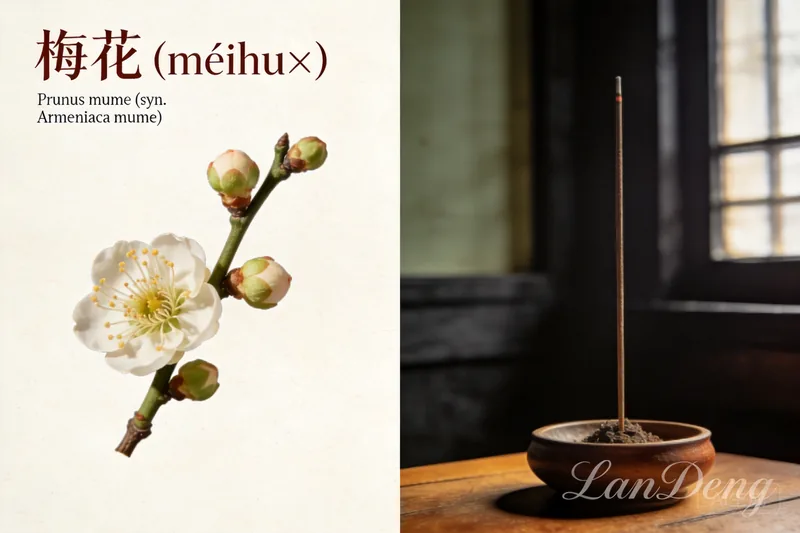
Technical answer: Plum blossom — méihuā (梅花) in Chinese — is the flower of Prunus mume, the East Asian “plum” (actually a close relative of the apricot) that blooms in late winter. It is one of the great floral motifs of Chinese incense and poetry, and the flower is used dried in floral incense blends and in the classical “plum incense” (梅花香) recipes.
Key facts
| Chinese | 梅花 (méihuā); dried flower also 白梅花 / 绿萼梅 |
| Botanical source | Prunus mume (syn. Armeniaca mume) — the flower |
| What it is | A dried flower, not a wood or resin |
| Aroma | Delicate, sweet, almondy, green-floral |
| Traditional role | Floral incense (梅花香), tea, poetry and seasonal culture |
Aroma profile
The fresh plum blossom has a delicate, cool, almond-sweet scent that arrives while most plants are still dormant — a “winter” floral note. The dried flower is far subtler, used for a gentle floral lift in blends. The blossom’s cultural weight — first flower of the year, a symbol of resilience — has always mattered as much as its scent.
Botanical source and origin
Prunus mume is native to China and has been cultivated for millennia for its flowers and fruit. The same tree yields:
- 梅花 (méihuā) — the blossom, used dried in incense and tea.
- 乌梅 (wūméi) — the smoked, dried fruit, a materia-medica and culinary item.
Note that “plum blossom” in English is a translation of convenience: Prunus mume is botanically closer to the apricot than to the European plum, and its Chinese name 梅 is its own thing. The flower’s identity — P. mume, the winter-blooming “mei” — is what matters.
In Chinese tradition
- 梅花香 (plum incense): classical incense recipes built around the plum-blossom theme are among the most famous in the tradition, including the storied 寿阳公主梅花香 (Princess Shouyang’s plum incense). The Song-dynasty Xiangpu (香譜) includes a 梅花香 method.
- A naming caution: “梅花” also names a grade of borneol — 梅花脑 / 梅花片, the top ice-like borneol crystal named for resembling plum-blossom ice. That is 龙脑 (borneol), a completely different material. The word 梅花 in an incense label can mean either the flower or the borneol grade.
- Seasonal culture: plum blossom is the emblem of early spring and the “first of the four gentlemen” (梅兰竹菊), woven through poetry, painting, and seasonal ritual.
Traditional use vs modern evidence
The plum blossom’s role is cultural and aromatic, not medical. The dried flower (白梅花 / 绿萼梅) does appear in traditional materia medica, but we treat any such use as traditional, not established clinical fact, and make no medical claims. This page describes the flower’s floral and cultural role only.
Quality and sourcing notes
Dried plum blossom is subtle; its quality is judged by cleanliness and a gentle, intact floral character. Practical points:
- “梅花” on an incense label may refer to the flower, or to borneol (梅花脑 / 梅花片) — check which is meant.
- The flower is usually blended (it is too delicate to carry a formula alone), or referenced as a theme in a named recipe rather than as a dominant ingredient.
Safety
Incense combustion produces smoke and particulate matter. Burn in a well-ventilated space, avoid inhaling concentrated smoke, and keep away from children and pets. This is editorial knowledge content, not medical advice.
FAQ
Is plum blossom used in Chinese incense? Yes, in two distinct senses. The flower (Prunus mume blossom) is used dried in delicate floral blends, and it gives its name and theme to the famous classical “plum incense” (梅花香) recipes, including Princess Shouyang’s plum incense. But “梅花” also names a grade of borneol — 梅花脑 / 梅花片, the top ice-like crystal. So an incense label saying 梅花 may mean the flower or the borneol grade, and the two are completely different materials.
What does plum blossom smell like? The fresh blossom has a delicate, cool, almond-sweet, green-floral scent that appears in late winter, before most plants bloom. It is subtle rather than heavy — a quiet “first flower of the year” note. The dried flower used in incense is even more delicate and is blended to add a gentle floral lift rather than to dominate a formula.
What is Princess Shouyang’s plum incense (寿阳公主梅花香)? It is one of the most famous named incense recipes in the Chinese tradition, built around the plum-blossom theme and attributed to Princess Shouyang (寿阳公主). It is a blended incense whose name and character reference the plum blossom, and it survives as a classical recipe — see our page on the Shouyang princess plum recipe. It is a cultural and aromatic tradition, not a medical formula.
Is the “plum” in plum blossom the same as a European plum? Not exactly. Prunus mume is a close relative of the apricot, native to East Asia and grown for its winter blossom and its fruit (乌梅), not the European plum. The English name “plum blossom” is a translation of convenience for 梅 (méi). The botanical identity that matters is Prunus mume, the winter-blooming “mei.”
What is the difference between 梅花 and 乌梅? Both come from the same tree, Prunus mume. 梅花 (méihuā) is the blossom, used dried in floral incense and tea; 乌梅 (wūméi) is the smoked, dried fruit, used in materia medica and cooking. They are different parts of the same plant with different uses, and neither should be confused with the borneol grade 梅花脑 / 梅花片.
See also: osmanthus, chrysanthemum, the Shouyang princess plum recipe, and the full scent guide.
Evidence & Sources
Botanical identity
Source: Armeniaca mume (= Prunus mume) in Flora of China · Prunus mume on GBIF. Evidence type: Established.
Traditional Chinese use
Source: the Song-dynasty Xiangpu (香譜) includes a 梅花香 method (卷三, “梅花香法”); the plum-blossom theme appears in classical incense recipes including 寿阳公主梅花香. Evidence type: Historically documented — cultural and aromatic use, not medical.
Authenticity / disambiguation
Source: 梅花 (the flower) vs 梅花脑 / 梅花片 (the borneol crystal grade) — the word’s two meanings in incense labels. Evidence type: Practical screening.
Safety
Source: incense combustion produces smoke and particulate matter; burn in a well-ventilated space. Evidence type: Established.
Evidence status
| Layer | Status |
|---|---|
| Botanical identity | Established |
| Traditional use | Historically documented |
| Authenticity test | Practical screening |
| Health claims | Not established |
Sources
Sources: botanical references on Prunus mume (syn. Armeniaca mume) and the Song-dynasty Xiangpu (香譜) plum-incense method. The 梅花 / 梅花脑 disambiguation is recorded as market terminology. Medicinal uses of the dried flower are treated as traditional, not established clinical fact. This is editorial knowledge content, not medical advice.