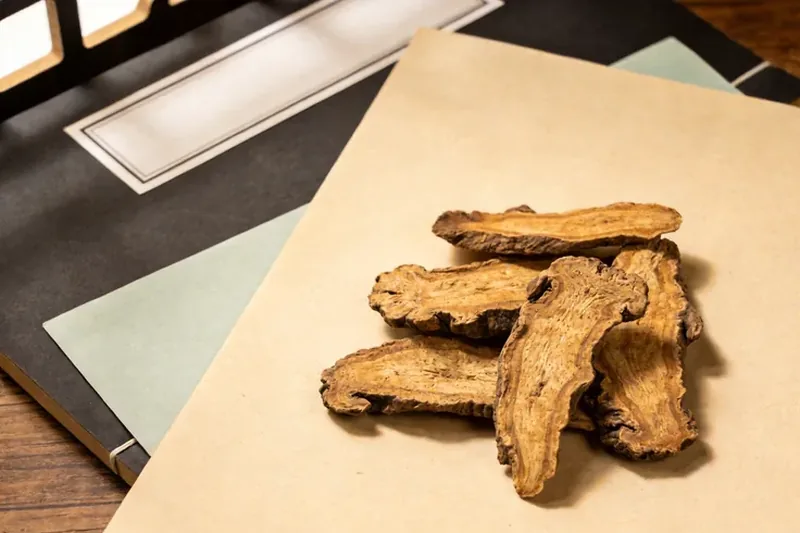
Direct answer: Tree peony bark (牡丹皮, mǔdānpí) is the dried root bark of Paeonia suffruticosa, the tree peony (Paeoniaceae) native to China. It is a classical Chinese materia-medica part with a faint, rooty, earthy, woody scent. It is the root bark of the very same tree as the peony flower (牡丹) — same species, different part — and the two must be kept distinct.
Key facts
| Chinese | 牡丹皮 (mǔdānpí); the root bark of 牡丹 |
| Botanical source | Paeonia suffruticosa (family Paeoniaceae) — the root bark |
| What it is | The dried root bark of the tree peony, distinct from its flower |
| Aroma | Rooty, earthy, woody, faintly floral |
| Traditional role | Materia medica; same tree as 牡丹 (tree peony flower) |
Aroma profile
牡丹皮 has a quiet, rooty, earthy, woody scent with a faint, dry floral undertone — the muted aroma of a dried root bark, far less fragrant than the tree peony’s flower. It is a subtle material, its fame in materia medica rather than in scent; in an incense blend it reads as a faint earthy-woody accent at most.
The 牡丹皮 / 牡丹 distinction (read this)
牡丹皮 and 牡丹 come from the same tree, different parts:
- 牡丹皮 (tree peony bark) — the dried root bark of Paeonia suffruticosa. This entry.
- 牡丹 (tree peony) — the flower of the same tree, the celebrated “king of flowers” (花王). Its own entry.
The Bencao Gangmu (本草纲目), 草之三, records the tree under 牡丹, with the root bark as its materia-medica part — “根似芍藥,肉白皮丹” (the root resembles the peony’s, white flesh, red bark) — and notes that “惟山中單葉花紅者,根皮入藥爲佳” (only the red single-petaled mountain flower’s root bark is good for medicine). This page describes 牡丹皮 = the root bark, not the flower.
Botanical source and origin
Paeonia suffruticosa is a woody-stemmed shrub peony (Paeoniaceae), native to China and the ancestor of the garden tree-peony cultivars. The tree peony is famous for its flower (牡丹); its root bark (牡丹皮) is a distinct materia-medica part. Flora of China records the species (牡丹); the same botanical identity underlies both the flower entry and this root-bark entry.
In Chinese tradition
- Materia medica: 牡丹皮 is a classical Chinese materia-medica part, recorded in the Bencao Gangmu (本草纲目), 草之三, as the root bark (根皮) of 牡丹. This is traditional materia-medica language, not modern clinical evidence.
- Naming: the Bencao Gangmu notes “肉白皮丹” — white flesh, red bark — which is exactly what gives 牡丹皮 its name (the red “丹” bark of the 牡丹).
- Sourcing: classical texts record that the red single-petaled mountain flower’s root bark was preferred for medicine.
Traditional use vs modern evidence
The materia-medica record is traditional, not established clinical fact, and we make no medical claims. The documented facts are botanical identity, the Paeoniaceae placement, and the root-bark distinction from the flower.
Quality and sourcing notes
Practical points for buyers:
- 牡丹皮 is the dried root bark of Paeonia suffruticosa; expect a faint, rooty, earthy, woody scent.
- Distinguish it from the flower (牡丹, tree peony) — same tree, different part, different use.
- Specify the part (根皮/牡丹皮 vs 花/牡丹) when sourcing; the bark is a quiet, earthy material, not a fragrant flower.
Safety
Incense combustion produces smoke and particulate matter. Burn in a well-ventilated space, avoid inhaling concentrated smoke, and keep away from children and pets. This is editorial knowledge content, not medical advice.
FAQ
What is 牡丹皮 (tree peony bark)? The dried root bark of Paeonia suffruticosa, the tree peony (Paeoniaceae) native to China. It has a faint, rooty, earthy, woody scent and is a classical Chinese materia-medica part — the root bark of the same tree whose flower is 牡丹.
Is 牡丹皮 the same as 牡丹? No — same tree, different parts. 牡丹皮 is the root bark; 牡丹 is the flower, the “king of flowers” (花王). The Bencao Gangmu (本草纲目), 草之三, records the tree under 牡丹 with the root bark (根皮) as its materia-medica part.
Why is it called 牡丹皮? The Bencao Gangmu records the root as “肉白皮丹” — white flesh, red bark. The red (丹) bark of the 牡丹 gives 牡丹皮 its name. Classical texts also note that the red single-petaled mountain flower’s root bark was preferred for medicine.
What does tree peony bark smell like? Quiet, rooty, earthy, and woody, with a faint, dry floral undertone — the muted aroma of a dried root bark. It is far less fragrant than the tree peony flower and reads as a subtle earthy-woody accent in a blend.
Is tree peony bark an incense ingredient? Not a lead one. Its classical standing is in materia medica, and its root-bark scent is faint. It could lend a muted earthy note, but its fame rests on the materia-medica record, not on fragrance.
See also: tree-peony (牡丹), peony (芍药), orris-root, and the full scent guide.
Evidence & Sources
Botanical identity
Source: Paeonia suffruticosa in Flora of China · Paeonia suffruticosa on GBIF. Evidence type: Established.
Traditional Chinese use
Source: the Bencao Gangmu (本草纲目), 草之三, records 牡丹 with its root bark (根皮) as the materia-medica part (“根似芍藥,肉白皮丹”; “惟山中單葉花紅者,根皮入藥爲佳”). Evidence type: Historically documented — materia medica; medicinal uses are traditional, not modern clinical evidence.
Authenticity / disambiguation
Source: 牡丹皮 (root bark) vs 牡丹 (flower) — same tree, Paeonia suffruticosa, different parts. Evidence type: Practical screening.
Safety
Source: incense combustion produces smoke and particulate matter; burn in a well-ventilated space. Evidence type: Established.
Evidence status
| Layer | Status |
|---|---|
| Botanical identity | Established |
| Traditional use | Historically documented (materia medica) |
| Authenticity test | Practical screening |
| Health claims | Not established |
Sources
Sources: botanical references on Paeonia suffruticosa and the Bencao Gangmu (本草纲目) 草之三 record of 牡丹/牡丹皮. 牡丹皮 is documented as the root bark of the tree peony, distinct from the flower 牡丹; medicinal uses are treated as traditional, not established clinical fact. This is editorial knowledge content, not medical advice.