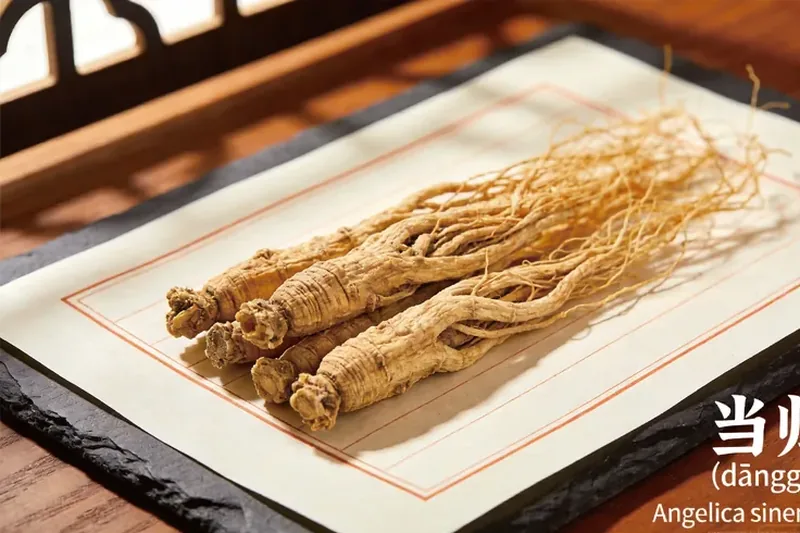
Direct answer: Dong quai (当归, dāngguī) is the dried root of Angelica sinensis, a herb of the carrot family (Apiaceae) native to China. One of the most famous roots in Chinese materia medica, the Bencao Gangmu calls it “the essential herb for women” (女人要药). It is a different species from 白芷 (Angelica dahurica) — same genus, different plant, different role.
Key facts
| Chinese | 当归 (dāngguī); classical 乾归, 山蕲, 文无 |
| Botanical source | Angelica sinensis (family Apiaceae) — the dried root |
| What it is | A famous materia-medica root, distinct from 白芷 |
| Aroma | Herbal, sweet, warm, slightly spicy |
| Traditional role | 当归 in materia medica; a 香囊 (sachet) herb |
Aroma profile
Direct answer: 当归 has a warm, sweet, herbal scent with a slightly spicy, rooty undertone — dry and earthy, more like a seasoned root than a flower. It is less sharp than its close relative 白芷, and its sweetness is fuller. As an aromatic it contributes a warm, grounding root note rather than a bright top note.
当归 has a warm, sweet, herbal scent with a slightly spicy, rooty undertone — dry and earthy, more like a seasoned root than a flower. It is less sharp than its close relative 白芷 (Angelica dahurica), and its sweetness is fuller. As an aromatic it contributes a warm, grounding root note rather than a bright top note, which suits its traditional place in 香囊 (scented sachets) and blended preparations.
Botanical identity
Direct answer: Angelica sinensis is a perennial herb of the carrot family (Apiaceae), native to China and cultivated chiefly in Gansu, Sichuan, and Yunnan. The material of value is the dried, aromatic root. It is not the same plant as the European garden angelica (Angelica archangelica) nor its genus-mate 白芷 (Angelica dahurica).
Angelica sinensis is a perennial herb of the carrot family (Apiaceae), native to China and cultivated chiefly in Gansu, Sichuan, and Yunnan. The material of value is the dried root, which is aromatic and rich in the compounds that give 当归 its warm, sweet scent and its place in materia medica. Flora of China records the species; it is not the same plant as the European garden angelica (Angelica archangelica) nor 白芷. See Angelica sinensis in Flora of China.
Chinese name and terminology
Direct answer: The name 当归 literally means “ought to return,” and it carries a classical story recorded in the Bencao Gangmu of a wife awaiting her husband’s return. The Bencao Gangmu also records the classical aliases 乾归, 山蕲, and 文无 — multiple names for one root, a pattern that signals how central the herb was to the materia-medica tradition.
The name 当归 (dāngguī) is a phrase, not a descriptive compound: 当 “ought to” + 归 “return.” The Bencao Gangmu records the classical story behind it — a wife awaiting her husband’s return — which is why the root’s name reads as a proverb rather than a botanical description. The same text records three classical aliases — 乾归, 山蕲, and 文无 — a cluster of names that signals the herb’s long and central place in the materia-medica canon.
The 当归 / 白芷 distinction (read this)
Direct answer: 当归 and 白芷 are same genus, different species — Angelica sinensis versus Angelica dahurica — and the difference in role is as large as the difference in plant. 当归 is the warm, sweet “women’s herb” of materia medica and a 香囊 sachet root; 白芷 is the sharper aromatic root used in 合香 (blended incense). The shared English word “angelica” hides a real botanical and functional difference.
当归 and 白芷 are same genus, different species — and the difference matters:
- 当归 (dong quai) — Angelica sinensis. The “women’s herb” of materia medica; a warm, sweet root. This entry.
- 白芷 (angelica) — Angelica dahurica. The aromatic root used in 合香 (blended incense). Its own entry.
The Bencao Gangmu (本草纲目), herb section (草之三), records 当归 with the classical names 乾归, 山蕲, and 文无, and quotes the Bencao Jingshu tradition calling it 女人要药 (“the essential herb for women”). This page describes 当归 = Angelica sinensis, not 白芷 = Angelica dahurica. See angelica (白芷).
A materia-medica root in an incense encyclopedia (read this)
Direct answer: 当归’s presence in an incense encyclopedia needs a caveat: it is a sachet herb, not a burned incense material. Its scent is carried by proximity in a cloth 香囊, not by combustion — and its fame is medicinal, not aromatic. Understanding this category boundary is the honest, useful fact about the material.
A reader might reasonably ask why a famous medicine root appears in an incense encyclopedia at all. The answer is a category boundary worth stating plainly:
- 当归 is a sachet herb, not a burn material. Its place in Chinese aromatics is the 香囊 (scented sachet) — a small cloth pouch of fragrant herbs worn or hung so the scent is carried by proximity. It is not a classical 香乘 incense staple and is not burned as a 香材.
- Its fame is medicinal, not aromatic. 当归 is one of the best-known roots in Chinese materia medica, but that renown is a medicinal tradition, not a fragrance one. The warm, sweet root note it contributes is quiet and grounding — useful in a blend, but not the reason the root is famous.
- The aromatic role and the medicinal role must not be run together. This page records the sachet and aromatic use; the medicinal reputation is traditional language, not something to import into an incense claim.
This distinction — a famous medicine herb whose incense-adjacent role is modest and sachet-based — is precisely the kind of honesty that separates an encyclopedia from a marketing page.
Where does dong quai come from?
Direct answer: Dong quai comes from Angelica sinensis, a perennial herb of the carrot family cultivated chiefly in Gansu, Sichuan, and Yunnan provinces of China. The dried root is the material of use, harvested from cultivated stands rather than gathered wild.
Angelica sinensis is cultivated across the western and southwestern provinces of China — chiefly Gansu, Sichuan, and Yunnan — where the climate suits its growth. The root is harvested, cleaned, and dried, becoming the warm, sweet, aromatic material of trade. It is a cultivated crop herb, not a wild-gathered aromatic, which is consistent with its role as a staple materia-medica root.
Why is it used in incense?
Direct answer: 当归 is used in aromatics as a warm, grounding root note in 香囊 sachets and blended preparations, not as a burned incense material. Its value is the warm, sweet, earthy depth it lends a blend by proximity, which suits sachet use better than combustion.
当归’s aromatic role is the sachet: a warm, sweet, grounding root note carried by proximity in a 香囊 rather than by burning. In a blended aromatic preparation it contributes depth and warmth — a “seasoned root” character that anchors lighter floral or green notes. It is not a classical 香乘 material and is not a lead 香材; its modest aromatic role sits beside, and is easily overshadowed by, its far larger medicinal reputation.
How is it processed?
Direct answer: 当归 is handled as a dried root — harvested, cleaned, and dried, then sliced or ground for use. In the materia-medica tradition it is further prepared (for example, sliced and processed) for its medicinal role, but for aromatic use the dried root is the material, and freshness of the warm-sweet scent is the practical concern.
As a root aromatic, 当归 is handled by drying rather than distilling or tapping. The root is harvested, cleaned, and dried, then used whole, sliced, or ground. For sachet and aromatic use, the dried root is the material, and the practical concern is the same as for any root: a well-dried, recently harvested root retains its warm, sweet scent, while a stale or overdried one fades toward flatness. The materia-medica tradition applies additional preparations for its medicinal role, which this page does not address.
What determines dong quai quality?
Direct answer: Quality turns on species identity, root condition, and freshness of the warm-sweet aroma. Genuine Angelica sinensis root — distinct from 白芷 — that is clean, well-dried, and freshly aromatic is the useful grade. Identity matters most, because the two Angelica species are easily confused.
The quality factors, in rough order:
- Species identity — the decisive check: 当归 (Angelica sinensis), not 白芷 (Angelica dahurica), which is a different species with a sharper aroma and a different role.
- Aroma freshness — a warm, sweet, herbal character; faded root has lost its aromatic value.
- Condition — clean, well-dried root free of mold and excess soil.
- Part — the root, not the aerial herb.
Common forms
Direct answer: 当归 is sold as the whole dried root, sliced root, and ground powder. Whole and sliced root suit sachet and materia-medica use; powder suits blending into aromatic preparations. The root is the material throughout.
| Form | Typical use |
|---|---|
| Whole dried root | Sachet; materia medica |
| Sliced root | Sachet; materia medica; display |
| Powder | Blending into aromatic preparations |
In Chinese tradition
- Materia medica (Traditional Use): 当归 is one of the best-known roots in Chinese medicine, recorded in the Bencao Gangmu (本草纲目) as 女人要药. This is traditional materia-medica language, not modern clinical evidence.
- 香囊 sachet (Traditional Use): 当归 is among the aromatic roots placed in 香囊 — small cloth sachets of fragrant herbs worn or hung for their scent.
- Naming (Historical Record): the name 当归 (“ought to return”) carries a classical story of a wife awaiting her husband’s return, recorded in the Bencao Gangmu, along with the aliases 乾归, 山蕲, and 文无.
Traditional use vs modern evidence
Direct answer: The materia-medica record is extensive but traditional, not established clinical fact, and this page makes no medical claims. The documented, non-medical facts are botanical identity, the Apiaceae placement, and the root’s aromatic and sachet use.
- Traditional Use — 当归’s materia-medica role as 女人要药, and its sachet (香囊) aromatic use. Traditional language, not modern clinical evidence.
- Historical Record — the Bencao Gangmu (本草纲目) 草之三 record of 当归 with its classical names 乾归, 山蕲, and 文无, and the naming story behind 当归.
- Scientific Evidence — the botanical identity of Angelica sinensis (Apiaceae) is documented. We present no clinical or medical efficacy claims.
What buyers should look for
Direct answer: Buyers should confirm species first — 当归 is Angelica sinensis, not 白芷 (Angelica dahurica) — then judge a warm, sweet, herbal aroma and clean, well-dried root. Remember it is a sachet herb and materia-medica root, not a burned incense material or a classical 香乘 staple.
For a buyer or formulator:
- Species — 当归 is dong quai (Angelica sinensis); distinguish it from 白芷 (Angelica dahurica), same genus but different species, aroma, and role.
- Aroma — a warm, sweet, herbal, slightly spicy note; reject faded root.
- Form — whole root, sliced, or powder, depending on sachet or blending use.
- Role clarity — it is a sachet herb and materia-medica root, not a burned incense material.
Safety
Incense combustion produces smoke and particulate matter. Burn in a well-ventilated space, avoid inhaling concentrated smoke, and keep away from children and pets. This is editorial knowledge content, not medical advice.
Dong quai vs angelica (白芷)
Direct answer: These are two Angelica roots — same genus, different species and roles. Dong quai (当归, Angelica sinensis) is the warm, sweet materia-medica “women’s herb” and sachet root; angelica (白芷, Angelica dahurica) is the sharper aromatic root used in 合香 blended incense. The shared English word “angelica” hides the difference.
| Dong quai (当归) | Angelica (白芷) | |
|---|---|---|
| Botanical source | Angelica sinensis | Angelica dahurica |
| Aroma | Warm, sweet, herbal, slightly spicy | Herbal, aromatic, sweet-bitter, slightly spicy |
| Role | Materia medica (“women’s herb”); sachet (香囊) | Aromatic root in 合香 (blended incense) |
| Key point | Sachet herb, not a burn material | The incense-use Angelica |
See angelica (白芷), atractylodes, and the material comparison matrix.
Our Industry View
Direct answer: 当归’s commercial lesson is a category boundary: it is a famous medicine root whose aromatic role is modest and sachet-based, not a burned incense material. A buyer should not pay an incense-grade premium for a root whose real value is medicinal — and should never let the medicinal fame bleed into an incense claim.
From a manufacturing perspective, 当归 is a lesson in keeping a material’s fame separate from its actual aromatic function:
- Medicinal fame is not aromatic value. 当归 is one of the most famous roots in Chinese medicine, but that renown does not translate into incense value. Its scent is a quiet, warm root note useful in sachets and blends — not a driving fragrance, and not a burned 香材. A buyer who prices 当归 by its medicinal reputation is paying for the wrong attribute.
- The sachet-versus-burn boundary matters. 当归 works by proximity in a cloth 香囊, not by combustion. For a stick or cone formula it is at best a minor, warm depth note; for a sachet product it is genuinely useful. Matching the material to the right format is the practical skill.
- Identity discipline is the entry ticket. With two Angelica species sharing the English name “angelica,” the first check is always species — 当归 versus 白芷 — because they differ in aroma, role, and price.
In our view, 当归 is a warm, sweet sachet root whose commercial value sits in its medicinal tradition, not its fragrance: buy it by species, use it by proximity, and keep the medicine and the incense claims strictly apart.
Summary
当归 (Angelica sinensis) is the warm, sweet, slightly spicy root of an Apiaceae herb cultivated in Gansu, Sichuan, and Yunnan, famous in Chinese materia medica — the Bencao Gangmu records it as 女人要药, with the classical names 乾归, 山蕲, and 文无, and a naming story (“ought to return”) that reads like a proverb. In aromatics it is a 香囊 sachet root, not a burned 香材, and it is a different species from the incense-use 白芷 (Angelica dahurica), the shared English word “angelica” notwithstanding. Its medicinal renown is traditional language, not clinical evidence, and its modest aromatic role must be kept separate from that fame.
FAQ
What is 当归 (dong quai)? The dried root of Angelica sinensis, a herb of the carrot family (Apiaceae) native to China. It is one of the most famous roots in Chinese materia medica, recorded in the Bencao Gangmu (本草纲目) as 女人要药 (“the essential herb for women”), with a warm, sweet, herbal scent.
Is 当归 the same as 白芷 (angelica)? No. 当归 is Angelica sinensis and 白芷 is Angelica dahurica — same genus, different species, different roles. 当归 is the warm, sweet “women’s herb” of materia medica and a 香囊 sachet root, while 白芷 is the sharper aromatic root used in 合香 (blended incense). The shared English word “angelica” hides a real botanical difference.
What does 当归 smell like? Warm, sweet, and herbal, with a slightly spicy, rooty undertone — dry and earthy, more like a seasoned root than a flower. It is less sharp and fuller-sweet than its relative 白芷 (Angelica dahurica), contributing a warm, grounding root note rather than a bright top note.
Does 当归 appear in the Bencao Gangmu? Yes. The Bencao Gangmu (本草纲目), herb section (草之三), records 当归 with the classical names 乾归, 山蕲, and 文无, and describes it as 女人要药. The name 当归 (“ought to return”) carries a classical story of a wife awaiting her husband’s return. Medicinal uses are traditional, not established clinical fact.
Is 当归 used in incense? Not as a classical burned material. 当归 is a materia-medica root and a 香囊 (scented sachet) herb — its scent is carried by proximity in a cloth sachet rather than by burning. Its role in aromatics is a warm root note in sachets and blends, not a 香乘 incense staple.
How should I buy 当归 for aromatic use? Confirm the species (Angelica sinensis, not Angelica dahurica), check for a warm, sweet, herbal aroma and clean, well-dried root, and match the form to the use — whole or sliced root for sachets, powder for blending. Price it as a sachet herb, not by its medicinal fame, and keep the two roles apart.
See also: angelica (白芷), atractylodes, calamus, and the full scent guide.
Evidence & Sources
Botanical identity
Source: Angelica sinensis in Flora of China · Angelica sinensis on GBIF. Evidence type: Established.
Traditional Chinese use
Source: the Bencao Gangmu (本草纲目), 草之三, records 当归 with the names 乾归, 山蕲, 文无, as 女人要药. Evidence type: Historically documented — materia medica; medicinal uses are traditional, not modern clinical evidence.
Authenticity / disambiguation
Source: 当归 (Angelica sinensis) vs 白芷 (Angelica dahurica) — same genus, different species. Evidence type: Practical screening.
Safety
Source: incense combustion produces smoke and particulate matter; burn in a well-ventilated space. Evidence type: Established.
Evidence status
| Layer | Status |
|---|---|
| Botanical identity | Established |
| Traditional use | Historically documented (materia medica) |
| Authenticity test | Practical screening |
| Health claims | Not established |
Sources
Sources: botanical references on Angelica sinensis and the Bencao Gangmu (本草纲目) 草之三 record of 当归. 当归 is documented as a materia-medica root; medicinal uses are treated as traditional, not established clinical fact. This is editorial knowledge content, not medical advice.