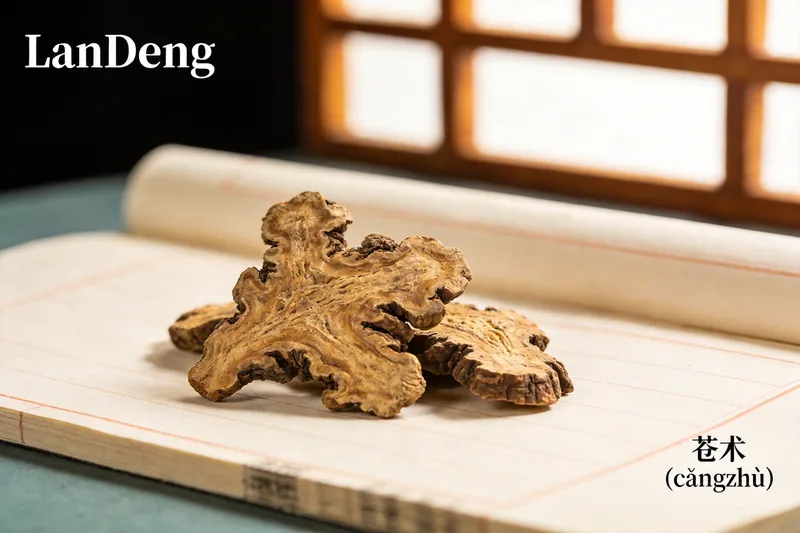
Technical answer: Atractylodes — cāngzhú (苍术) in Chinese — is the dried rhizome of Atractylodes lancea, an aromatic herb in the daisy family (Asteraceae). It is a major herb of Chinese materia medica and a traditional fumigation material — burned with mugwort to “clear” a space — but it is not one of the classical fragrance ingredients of huxiang (合香). This page records that distinction precisely.
Key facts
| Chinese | 苍术 (cāngzhú), also 茅苍术 / 南苍术 |
| Botanical source | Atractylodes lancea (Asteraceae) — the dried rhizome |
| What it is | A dried aromatic root/rhizome, not a wood or resin |
| Aroma | Herbal, woody, pungent, earthy |
| Traditional role | Materia medica; fumigation (烟熏) with mugwort |
Aroma profile
Atractylodes rhizome has a pungent, herbal, woody scent — dry and medicinal rather than sweet or floral. It is not a “perfume” material in the classical sense. Its aroma is why it has been used in smoking traditions (fumigation) rather than in fragrance-forward huxiang blends.
Botanical source and origin
Atractylodes lancea is a perennial herb native to East Asia, found across central and southern China and the Korean peninsula. The dried rhizome is the part used. It is one of two closely related medicinal roots:
- 苍术 (cāngzhú) — Atractylodes lancea (and related taxa), the pungent “brown” atractylodes.
- 白术 (báizhú) — Atractylodes macrocephala, the “white” atractylodes, a different, widely used materia-medica root.
The two share a genus but are distinct species with different profiles and roles.
In Chinese tradition
- Materia medica: 苍术 is a major herb in traditional Chinese medicine, classically described for “drying dampness and strengthening the spleen” (燥湿健脾) and related uses. This is traditional materia-medica language, not modern clinical evidence.
- Fumigation (烟熏): 苍术 has long been burned, often together with mugwort (艾草), as a traditional fumigation practice associated with clearing a space and warding off “impure qi” (辟秽) — a folk-custom and seasonal practice rather than a fragrance art.
- Incense context: unlike 甘松, 藿香, or 零陵香, 苍术 does not appear in the classical incense manuals (香乘 / 香譜) as a huxiang fragrance material. Its “burning” role is fumigation, a different tradition.
Traditional use vs modern evidence
苍术’s medicinal reputation is extensive in the classical literature, but it is traditional, not established clinical fact, and we make no medical claims. The well-documented, non-medical facts are its botanical identity and its long folk use as a fumigation herb burned with mugwort. Its absence from the classical fragrance manuals is the key editorial distinction this page preserves.
Quality and sourcing notes
Because 苍术 and 白术 are both sold as “atractylodes,” buyers should check which species they are getting — the two have different aromas and uses. 苍术 (A. lancea) is the pungent, fumigation-oriented root; 白术 (A. macrocephala) is the milder medicinal root. A label that says only “atractylodes” is underspecified.
Safety
Burning plant material produces smoke and particulate matter. Fumigation with 苍术 and mugwort produces dense smoke, so it should be done in a well-ventilated space, and concentrated smoke should not be inhaled. Keep away from children and pets. This is editorial knowledge content, not medical advice.
FAQ
Is atractylodes an incense ingredient? Not in the classical sense. 苍术 does not appear in the Song- and Ming-dynasty incense manuals (香譜 / 香乘) as a huxiang (blended-fragrance) material. Its burning role is fumigation — burning it, often with mugwort, as a folk custom for clearing a space and warding off “impure qi” (辟秽). That is a different tradition from fragrance-forward incense, and the two should not be conflated.
What is the difference between 苍术 and 白术? They are two closely related medicinal roots in the same genus. 苍术 (Atractylodes lancea) is the pungent “brown” atractylodes used in fumigation and described for “drying dampness”; 白术 (Atractylodes macrocephala) is the milder “white” atractylodes, a different and widely used materia-medica root. The shared English word “atractylodes” hides the difference, so buyers should check which species a label specifies.
What does atractylodes smell like? Atractylodes rhizome has a pungent, herbal, woody scent that reads as dry and medicinal rather than sweet or floral. It is not a perfume note in the classical sense. Its strong aroma is precisely why it has been used for fumigation rather than for blending into fragrance-forward incense.
What is atractylodes used for in Chinese tradition? 苍术 is a major traditional-medicine herb, classically described for “drying dampness and strengthening the spleen” (燥湿健脾) and related uses — traditional materia-medica language, not modern clinical evidence. Separately, it has a long folk use as a fumigation herb, burned together with mugwort (艾草) as a seasonal practice for clearing a space. This page records both roles while making no medical claims.
Is atractylodes the same as mugwort? No. Mugwort (艾草) is an Artemisia herb, while atractylodes (苍术) is an Atractylodes rhizome — different plants and families. They appear together in one specific context: the traditional fumigation practice of burning 苍术 and mugwort together to “clear” a space. That shared fumigation role is the reason they are linked, not a botanical relationship.
See also: mugwort, angelica, and the full scent guide.
Evidence & Sources
Botanical identity
Source: Atractylodes lancea in Flora of China · Atractylodes lancea on GBIF. Evidence type: Established.
Traditional Chinese use
Source: 苍术 as a materia-medica herb (燥湿健脾) and its fumigation use with mugwort (艾草) for 辟秽. Evidence type: Historically documented — traditional materia-medica language, not modern clinical evidence. Note: 苍术 is absent from the classical fragrance manuals 香乘 / 香譜; its burning role is fumigation, not huxiang.
Authenticity / disambiguation
Source: the 苍术 (Atractylodes lancea) vs 白术 (A. macrocephala) species distinction. Evidence type: Practical screening.
Safety
Source: burning plant material (incl. 苍术-mugwort fumigation) produces smoke and particulate matter; ventilate and avoid inhaling concentrated smoke. Evidence type: Established.
Evidence status
| Layer | Status |
|---|---|
| Botanical identity | Established |
| Traditional use | Historically documented |
| Authenticity test | Practical screening |
| Health claims | Not established |
Sources
Sources: botanical references on Atractylodes lancea and the 苍术 / 白术 disambiguation. Medicinal uses are treated as traditional, not established clinical fact; 苍术’s fumigation role is recorded as folk custom, distinct from the classical fragrance manuals. This is editorial knowledge content, not medical advice.